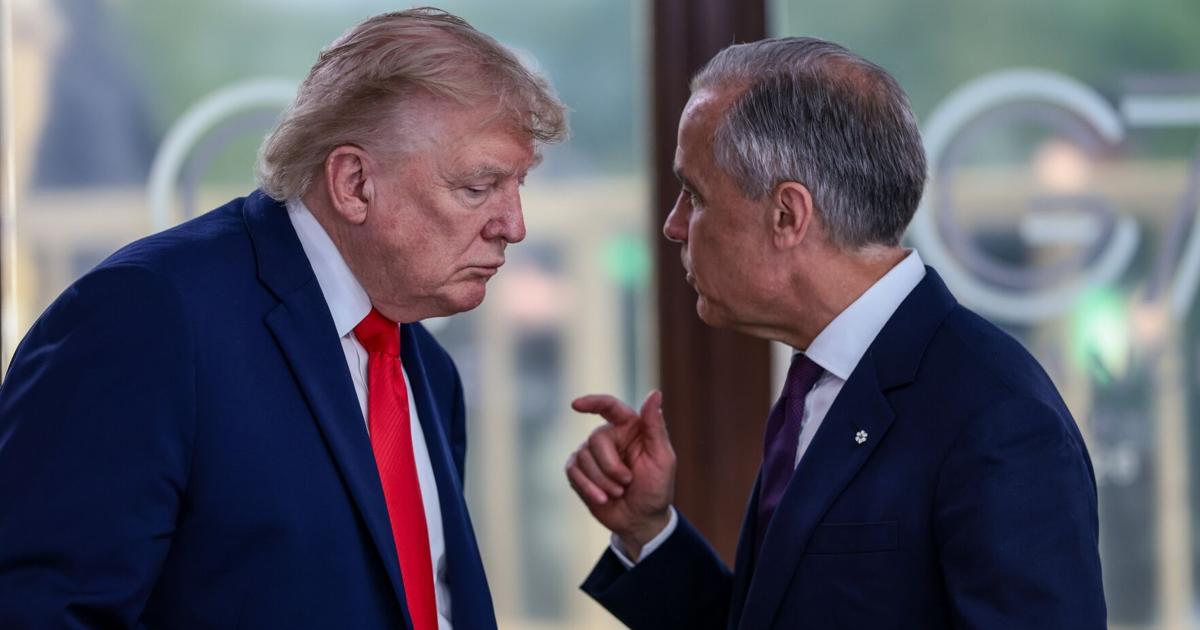
OTTAWA—The Carney government and the Trump administration are getting closer to a “comprehensive” trade deal, two sources say, as negotiations intensify ahead of a looming wave of new U.S. tariffs.
Talks have centred on Canada making concessions on a list of major U.S. trade irritants, some of which involve provincial policies, in exchange for tariff relief, the sources say.
But the path to a deal already faces hurdles, with Quebec warning Friday that it alone will decide whether to make concessions, highlighting the difficulties Prime Minister Mark Carney faces in uniting the country’s premiers in the midst of a trade war.
The sources, both with knowledge of the situation and granted anonymity because they were not authorized to speak publicly, said Canada is open to compromise on issues including the boycott of American alcohol sales in most provinces, cross-country “Buy Canadian” procurement policies, retaliatory levies on American autos and the dairy supply management system.
In exchange, the sources said Friday, Ottawa is pushing for a reduction in tariffs that have hit key industries such as Canada’s steel and aluminum sectors. It is not expected that the U.S. will remove those Section 232 tariffs outright, the sources added.
The Carney government is also trying to stave off the latest threat of escalated tariffs from U.S. President Donald Trump, who last month ordered new 50 per cent tariffs on $28 billion worth of Canadian imports, including goods covered by the Canada-U.S.-Mexico Agreement (CUSMA).
Canadian negotiators are hoping to reach an agreement on these issues before Trump’s latest threatened tariffs are scheduled to begin on Aug. 19, the sources said, with one describing that deadline as a “cliff.”
The two sources said talks on a “comprehensive” deal have kicked up to more serious levels than seen in months, and that the ramped-up negotiations have gone beyond the tariffs.
The next priorities in talks include security and defence matters, like Canada’s purchase of American F-35 fighter jets and potential participation in Trump’s proposed Golden Dome missile defence system, issues relating to the energy and critical minerals sectors, and the renegotiation of CUSMA.
Details on the latest points of discussion were first reported by the Globe and Mail on Friday.
Canada-U.S. Trade Minister Dominic LeBlanc and lead trade negotiator Janice Charette met with Trump’s top trade envoy in Washington on Thursday.
Reached by the Star, LeBlanc’s office declined to comment on specifics, but said “Canada’s objective remains to reach a comprehensive deal that addresses sectoral tariffs and benefits Canadian workers, farmers and businesses.”
At an unrelated news conference in Quebec on Thursday, Prime Minister Mark Carney described negotiations as “tough,” but said Canada was pushing hard for a deal to address Trump’s tariffs.
It’s not yet clear where Canada’s premiers stand on the concessions under discussion, but the Quebec government noted Friday the sale of alcohol is its exclusive responsibility.
“The withdrawal of American products from the SAQ’s shelves will remain in effect until there is a deal negotiated that we judge to be equitable,” a spokesperson for Quebec Premier Christine Fréchette said in a French statement. “It’s Quebec and only Quebec that will make a decision.”
Manitoba Premier Wab Kinew’s office, meanwhile, said “the booze ban will remain until we have a good deal for Canada.”
Premier Doug Ford’s government did not comment publicly Friday, but has been firm about the ban on the sale of American booze — such as Kentucky bourbon and California wine — from LCBO shelves that was imposed in March 2025, and received public backing from Carney as recently as last month.
On Wednesday, Ontario Finance Minister Peter Bethlenfalvy reiterated why the prohibition, which polls have suggested is a politically popular response to Trump’s tariffs, remains in place.
“We’ve always looked at a range of options, but right now we’re steadfast that this is the approach that we’ve taken,” said Bethlenfalvy.
“We think it’s a small price to pay — a lot of Ontarians and Canadians are facing the burden of this unnecessary tariff-related challenge,” said the provincial treasurer.
“The plan is … ‘Come to the table, let’s get a trade deal done,’ and we’ll talk about the alcohol,” he said. “But make no mistake, our resolve is firm that any sort of move on alcohol is paired with landing a deal with the United States.”
With files from Robert Benzie and Alex Ballingall
Error! Sorry, there was an error processing your request.
There was a problem with the recaptcha. Please try again.
You may unsubscribe at any time. By signing up, you agree to our terms of use and privacy policy. This site is protected by reCAPTCHA and the Google privacy policy and terms of service apply.
Want more of the latest from us? Sign up for more at our newsletter page.