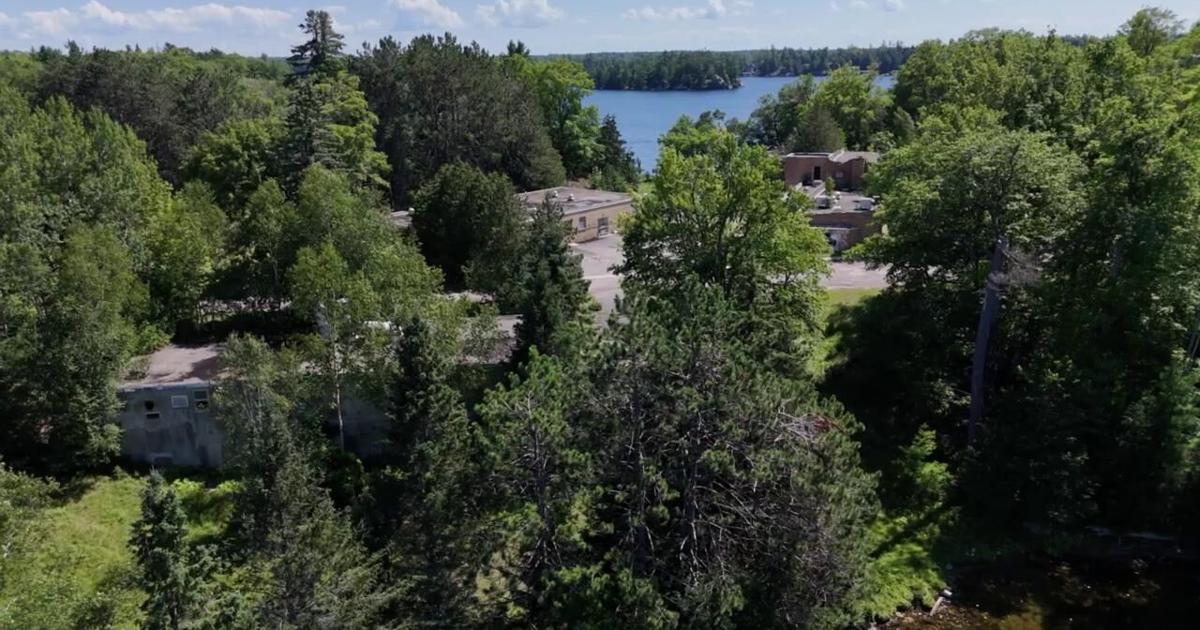
Approached by boat from busy Muskoka Bay near Gravenhurst, the land at first seems empty.
The area’s windswept trees, jagged rock faces and deep blue water resemble a Group of Seven painting brought to life.
But then a yellow brick building with a crumbling roof, broken windows and a sign warning against trespassing appears — and it starts to look more like a scene from a zombie apocalypse movie.
The roughly 77-acre stretch was once home to a tuberculosis sanatorium, and then an institution for people with developmental disabilities. It’s been vacant for decades but was conditionally sold by the province a few years ago.
Now there are plans to build a massive new development on the site called “Cliff Bay.” According to the developer, KS Group, it will feature year-round hotels, residences, restaurants and a spa, including some buildings as high as six storeys and structures that stretch into the water on stilts.
Many local residents and cottage owners are not impressed. Some are now engaged in a fierce battle against the project, with much of their anger directed at the province over the deal, the terms of which remain secret.
The main point of contention is whether the province has promised a Minister’s Zoning Order (MZO) as part of the sale, a controversial tool that allows projects to bypass local zoning rules to speed up construction on provincial priorities.
The MZO has been hotly discussed at town council and public meetings, there’s even a draft version on the project’s website.
A planner for KS Group told the Star last month that not only was the MZO promised when the land was purchased from the province, that promise was “written” into the agreement of purchase and sale. The mayor of Gravenhurst too says she understands one is coming.
But the province has since denied that any MZO was a condition of the sale and when the lead developer was asked to confirm, he said he’s unable to provide details of the sale as he’s bound by a non-disclosure agreement.
The province also denied repeated requests for details on the sale, citing confidentiality due to commercial sensitivities.
While locals have a long list of complaints — some don’t want anything there, some object to the size and scope — many argue the use of an MZO would mean a loss of local control over what can be built. Others have questions about the developer’s experience building such large projects (the developer said he can’t comment on his previous development experience due to confidentiality obligations).
It’s a fight over public land, transparency, and a community’s right to be involved in the decision-making that some say has similarities to Toronto’s Ontario Place redevelopment.
“The MZO takes it right out of the hands of the local planning,” said Ken Pearce, the president of the Muskoka Lakes Association.
At a recent town hall on the project that drew more than 100 people, attendees were asked to come up with a word that represents their feelings on the project.
The word that Gary Stevenson, who has been living in the area since 1975 and spent decades in the local building industry, wrote in his notes in big block letters is “betrayed.”
“There will be nothing but people here, and buildings,” Stevenson said, gesturing to the overgrown land behind him. At a fence that surrounds the property at the end of the road, someone has recently vandalized the “for sale” sign advertising 75 acres, chopping it in half.
“There are rules for a reason,” added his wife, Anita, “the lake is delicate.”
An MZO or no?
Bob List, the land-use planner working with developer KS Group, told the Star that an MZO is “written into the agreement of purchase and sale as a deliverable.”
He said he has seen parts of the agreement but does not have a copy of it, and stressed the town will still have jurisdiction over things like site plan agreements and environmental approvals.
List said he drafted the wording of a potential MZO that’s on the project website, but that wording will evolve based on public feedback and it has not been submitted to the province yet. It probably won’t be until sometime next year, he added.
The property is “part of the urban area of the town of Gravenhurst,” List said, and lines up with the goals in the town’s official plan to increase density. It’s currently zoned primarily as institutional.
“Nobody’s going to buy this property unless they know with certainty that it can be developed,” he said.
Sofia Sousa-Dias, a spokesperson for the provincial Ministry of Infrastructure, said in an email there is “no condition on the government to issue an MZO.” If the developer wants one they will have to “go through the formal MZO framework as all other MZOs must do.”
“The government’s realty agent has negotiated a conditional agreement of purchase and sale with the successful bidder following the evaluation period from an open and competitive process.”
She declined to answer questions about price and other conditions of the sale, saying they must remain confidential due to commercial sensitivities. She said the sale is not yet finalized.
“The prospective purchaser is conducting its own due diligence and a closing date for the sale has not been determined,” she added.
Asked about this, KS Group CEO Kirill Soloviev said in an email that he is “bound by confidentiality and non-disclosure obligations with the vendor” and cannot discuss the agreement of purchase and sale, including “the purchase price, the terms or conditions of the transaction, any planning-related conditions.”
After presenting the initial plans to the public, the team “carefully considered the feedback we received from both members of the public and elected officials,” he added.
“Since then, we have undertaken a comprehensive redesign of the project, including significant revisions to all of the buildings and a substantial reduction in the overall gross floor area to better reflect the character of Muskoka.”
From ghost town to resort
On a recent clear and sunny weekday afternoon, there’s no sign of the controversial plans except for “Save the Bay” signs affixed to trees and boathouses.
From the dock in downtown Gravenhurst, it takes only a few minutes by boat to reach the shore of the land at the centre of the controversy.
The bay is dotted with large cottages and homes, inflatable waterslides, and Muskoka chairs in primary colours.
Around the bend near where the abandoned building comes into view from a boat there’s a blue and white gazebo where residents of the institution, known as the Muskoka Regional Centre, would gather in the ‘70s and ‘80s, said local resident Dave Kellam.
He grew up across from it and now lives full-time at his cottage nearby, after retiring from his job as a sales manager for Hefty garbage bags.
He’s running for Gravenhurst Ward 2 councillor, the area impacted by the development, “primarily because of this issue.” He’s not against development, he added, but doesn’t support overdevelopment.
“What’s happening is Toronto is coming to Cottage Country and duplicating what they have down there, which is concrete jungles,” he said.
The original project proposal called for two waterfront restaurants “sticking way out into the water” that have been “drawn back into the shoreline,” List said.
“They still stick out over the water, but they’re nowhere close to what they were originally intended to do, and that is a direct result of public input.”
The number of tourist structures over the water has also been reduced because of local feedback, from about 29 or 30 down to two dozen, he added.
There will be in the neighbourhood of 400 hotel suites and 800 residential units, with a maximum of six storeys.
Pearce, of the Muskoka Lakes Association, said two of the community’s biggest objections are the planned structures that go right up to and even into the water.
“The stuff in the lake is obviously not only not set back from the shore, it’s actually going the opposite direction out the lake,” he said.
List said the project is now planned at about a third of the density that was originally proposed.
“It’s still substantial,” he said of the project’s footprint, “but it’s not out of line with the density provisions that are applicable in the waterfront of Gravenhurst.”
List said there are already exemptions on setbacks for urban areas in the Muskoka District Official Plan. A town of Gravenhurst spokesperson confirmed the land is in an urban serviced area, but said the 30-metre setback still applies with limited exceptions, under the town’s official plan.
To get around that, builders need to apply for a zoning bylaw amendment — or get a Minister’s Zoning Order from the province.
Developer’s experience
Bruce Parlette, who has a cottage on Cliff Bay across from the proposed development and has organized a “Save the Bay” campaign, also has questions about the lead developer, Soloviev, who he said doesn’t appear to have completed any similar projects.
There is a New Jersey-based real estate acquisition group called KS Group, as well as U.S.-based Soloviev Group, but his company KS Group of Companies Ltd. has “no affiliation” with either, and “any similarity in name is coincidental,” Soloviev said in an email.
The Cliff Bay project, he added, is “not dependent on the experience of any one individual,” he said.
“I am representing the project, supported by a broader team of experienced professionals and strategic partners with backgrounds in planning, architecture, construction, real estate development, hotel development and hotel operations.”
Asked about relevant experience, he said that is “subject to confidentiality obligations.”
His Cliff Bay project website bio says he has over a decade of experience in the private equity sector and is “at the forefront of not only a leading real estate development firm but also groundbreaking technology ventures.”
According to publicly available court records, Soloviev is involved in a lawsuit by several purchasers of condos in a Vaughan development called Improve Canada. They allege that he and others defrauded them when selling units with a conspiracy to artificially inflate sales.
Soloviev denies all allegations and said he is not in a position to comment further given the matter is before the court.
Sousa-Dias, the Ministry of Infrastructure spokesperson, said in an email that “numerous bidders who expressed interest underwent a rigorous evaluation and assessment based on standardized criteria,” before “the proponent was selected in August 2023 to enter in negotiations on a potential final sale.”
According to the Ontario campaign donation registry, Soloviev donated almost $3,000 to the Progressive Conservative party of Ontario between 2021 and 2023.
“My political contributions are personal and have no connection whatsoever to the Cliff Bay project,” he said in an email. “I support the Progressive Conservative party and believe that modest personal contributions are a normal way for Ontarians to participate in the democratic process and support the direction they believe is best for the province.”
A town still waiting
The town of Gravenhurst, meanwhile, is anticipating an MZO.
Gravenhurst Mayor Heidi Lorenz said they “understand” from both the province and the developer that the sale of the land is conditional upon an MZO. But she said that the town will be asked to take a municipal position before the province considers the MZO, “which we have not been presented with to date.”
“We don’t know the details of the sale, so we aren’t privy to the price or to any of that,” she said.
Lorenz shares some of the other residents’ concerns about the density and the shoreline development and structures in the water. “I believe we owe it to the public to take their considerations in as well and ask for their opinions,” she said.
“But at the same time, I do believe that we need to do something,” she added. “For it to have been vacant all this time, is certainly not beneficial to the town as a whole.”
It’s hard for Wes Skitch, who lives directly across from the Muskoka Regional Centre land, to believe that his “postcard” view will change so much.
“I think it would be a fantastic park,” he said.
Skitch, 70, who lives on the bay full time with his wife, Janice, also worries about the impact on wildlife. From his property he has spotted everything from beavers, to blue herons.
List again stressed that the land is classified as an urban area in the town’s official plan and that carries with it an expectation of density. He says their aim is to mitigate and minimize the impact on wildlife.
Soloviev added that the team is “committed to preserving the natural character of the property,” and removing as few trees as possible. They want to keep “significant vegetation” and preserve “shoreline buffers,” as well as ensure that “environmental and water-quality considerations are addressed through the appropriate technical studies and regulatory review process.”
But the terms of the deal are troubling for Skitch.
“We don’t really have any say in it at all,” he said.
Error! Sorry, there was an error processing your request.
There was a problem with the recaptcha. Please try again.
You may unsubscribe at any time. By signing up, you agree to our terms of use and privacy policy. This site is protected by reCAPTCHA and the Google privacy policy and terms of service apply.
Want more of the latest from us? Sign up for more at our newsletter page.