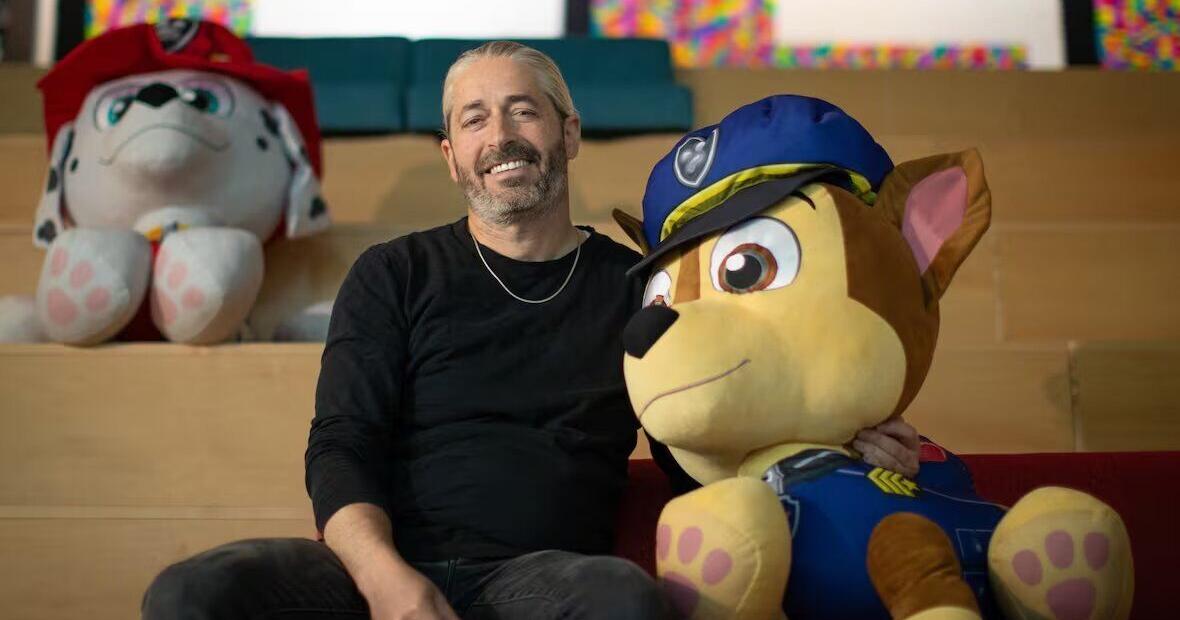
“This book is not a how-to,” writes Ronnen Harary near the start of his new memoir, “No Experience Necessary.” The book chronicles the Spin Master co-founder and chairman’s adventures in business, from selling fertilizer door-to-door with his university roommate in the early 1990s, to presiding over the global success of “PAW Patrol,” the children’s cartoon that has helped to push the company’s valuation to more than $2 billion.
Harary’s subject isn’t so much the making of money — or the mystery of innovation — as the marshalling of initiative. “No Experience Necessary” reads, swiftly and sweetly, as a celebration of impatience. Its thesis is that risk aversion can itself be a dicey proposition for potential entrepreneurs, and that experience — that most lionized of commodities — is, if not overrated, then unduly privileged by educators and professional mentors.
The upshot: leap before you look, lest you decide otherwise to remain rooted to the spot, what Harary calls “inverse risk.”
“In your twenties, the energy you’re able to tap into isn’t just jet fuel,” he offers in the introduction. “It’s rocket fuel.”
Origin of an empire
Harary’s office in downtown Toronto comes with the sort of view you get long after achieving liftoff. The 55-year-old South Africa native, who came to Canada at age five and grew up around York Mills, has a panoramic, top-down point of view of his adopted city. What’s more eye-catching, though, is the miniature metropolis’s worth of merchandise lining the windows, clusters of objects — board games and plastic figures; erector sets and stuffies — offering their own tactile testimony to the occupant’s history of world-building.
“I’ve got some Bakugans on the table here,” said Harary, referring to the spring-loaded sphere toys that became Spin Master’s first billion-dollar property in 2008. “The magical thing is the pop-up or the transformation. You want to (play with) it over and over again. It’s physical, and I think that’s the key theme that runs through toys during the decades. It’s something that people want in their hands.”
There’s plenty of backstory on Bakugan in “No Experience Necessary,” as well as a thorough exegesis on such crucial precedents as Grass Heads (component parts: sawdust, seeds and pantyhose), Devil Sticks and the Air Hog Sky Sharks — foam-based propeller planes that created a sensation when released in 1998. (“It was pixie dust with wings,” Harary writes of the prototype.)
And, predictably, there’s material on PAW Patrol, which Harary notes with pride is one of the most omnipresent Canadian pop-cultural exports of the 21st century. “It’s one of my favourite things when I’m walking through an airport and I see someone with a PAW Patrol toy,” he said. “Or I see a kid watching it on an iPad.”
Harary knows that one by-product of having helped to put something so successful into the world is being defined by it: “No matter what we do,” he writes of himself and Spin Master co-founders Anton Rabie and Ben Varadi, “we’ll forever be known as ‘the PAW Patrol guys.’” (Both Rabie and Varadi are major characters in the book.) And yet he’s also quick to point out that PAW Patrol’s breakthrough came about not because of a master plan, but from a return to the daredevil mentality of the team’s younger days.
“PAW Patrol was created at the lowest point in our company history,” Harary said. “We had a lot of hubris, and we thought everything we touched and put out to market would be a hit. That’s not what happened. So with PAW Patrol, we thought, ‘Let’s get into the details, let’s focus on the storytelling, the character development, the play pattern.’ Nobody was dreaming of a massive success. It was more like going back to our roots.” (Harary is executive producer of “PAW Patrol: The Dino Movie,” opening in theatres on Aug. 14.)
These kids today
The stories in “No Experience Necessary” cover a lot of historical ground in terms of the toy industry; read between the lines and the saga of Spin Master becomes about the larger transition from an analogue world to a digital one.
“There’s been an age compression in the toy industry,” Harary said, acknowledging that the exponential proliferation of screen-based entertainment means that kids are growing out of playthings earlier than before.
“The irony is actually there’s a whole section called ‘kidult’ now,” he added, “which is adults that are buying toys and staying with their youth. I do think the age compression has bottomed out.”
These generational shifts are significant insofar as “No Experience Necessary” is angled at young adults, and Harary is aware that it might seem hard — or disingenuous — to sell contemporary twentysomethings on optimistic, get-up-and-go rhetoric.
“Kids today have definitely had a tough run,” he said, “when you look at the political situation, the economy, COVID, changes in technology. That being said, there are certain things that are inherent to you in your 20s that will be inherent to you in any decade. One thing is that everybody is rooting for you. People want you to win, and they don’t see you as competition. People in middle age want to be around younger people — they love that energy.”
Looking on the bright side
Throughout our conversation, Harary talks about the importance of maintaining a youthful curiosity and enthusiasm, which he believes come naturally to him. “I’m the shiny penny guy,” he said. “I get excited very easily. Part of my talent is bringing together diverse groups of individuals to help birth things into the world that haven’t existed before. If you were a fly on the wall at one of our meetings, it starts with three or four people, and by the end there’s like eight people there and everybody is jamming.”
“I try to think of myself as a conductor,” he added. “The meeting is the symphony. I try to refer to business as an art form, and I think if more people looked at it that way, it would be better.”
There’s a danger for a book like “No Experience Necessary” to split the difference between sincerity and vanity — to read like a mogul’s victory lap around his own intellectual property. But Harary doesn’t project smugness, on the page or in conversation. His personable prose is also contextualized by a plangent feeling of vulnerability. Harary writes candidly throughout the book about his childhood diagnosis of dysgraphia, which affected his writing output in elementary school.
“I grew up with a lot of shame around my learning disability,” he said. “One thing you learn in therapy is that the only way to deal with shame is to share and talk about it.” This book, he added, was also an opportunity to put everything out in the world and not hold anything back.
“People think that life is short,” Harary said. “Life is actually long. It’s a lot longer than you think it is. It goes by very quickly, but you have your kicks at the can. I think that it’s important for people to meet themselves where they’re at, and to enjoy the journey, and to savour the journey.”
Error! Sorry, there was an error processing your request.
There was a problem with the recaptcha. Please try again.
You may unsubscribe at any time. By signing up, you agree to our terms of use and privacy policy. This site is protected by reCAPTCHA and the Google privacy policy and terms of service apply.
Want more of the latest from us? Sign up for more at our newsletter page.