Between 1950 and 1969, around 251,000 Americans moved to Canada, a groundswell commonly attributed to an economic boom, relaxed immigration policy, and, in what turned out to be a windfall for this country’s cultural life, opposition to the war in Vietnam.
“Both Sides Now,” at Daniel Faria Gallery through Aug. 22, gathers work by American-born women — including June Clark, Barbara Astman, Suzy Lake, Lynne Cohen, Pamela Harris and Laura Jones — who settled here in the late 1960s and early ‘70s.
The title, of course, borrows from Joni Mitchell, that famous Canadian in America, whose song evokes the impossibility of seeing anything whole from a single position.
Sight is the motif at the show. Photography was the common medium for the artists whose work is shown here. Many of them gathered at the Baldwin Street Gallery of Photography, opened in 1969 by artists Laura Jones and John Phillips. Both had recently left the United States as conscientious objectors.
It was the first independent photography gallery in the country, and, when required, turned into a place for new Toronto arrivals to sleep.
In 1972, artists Jones, Clark, Harris and Lisa Steele founded the Women’s Photography Co-op after discovering that women were banned from using the dark rooms at the University of Toronto’s Hart House.
In addition to holding workshops, the Co-op also curated exhibitions of work by women artists. The most famous of these was “Photographs of Women by Women,” which included 230 prints and toured across North America.
Each artist incorporated photography into their practice in singular ways.
Suzy Lake turned the camera on itself to investigate the relationship between images, identity and womanhood. The show includes four panels from her “On Stage” (1972-74). Typewritten text is set beneath black-and-white images in English and French. These photographs range from studio poses to family snapshots: “Halloween 1949,” “Christmas 1957,” a high school prom. They are taped down and annotated in pencil, almost like evidence.
“‘Role-playing’ is a daily occurrence,” the text argues, whether that is primping for a party or inadvertently picking up a partner’s mannerisms. In this light, the nostalgic pictures are tinged with bitterness.
Lake was working in Montreal in the 1970s, and the work’s bilingualism shows a newly arrived artist wading into her province’s language debates. But her ideas about performance supersede language. These images are universal.
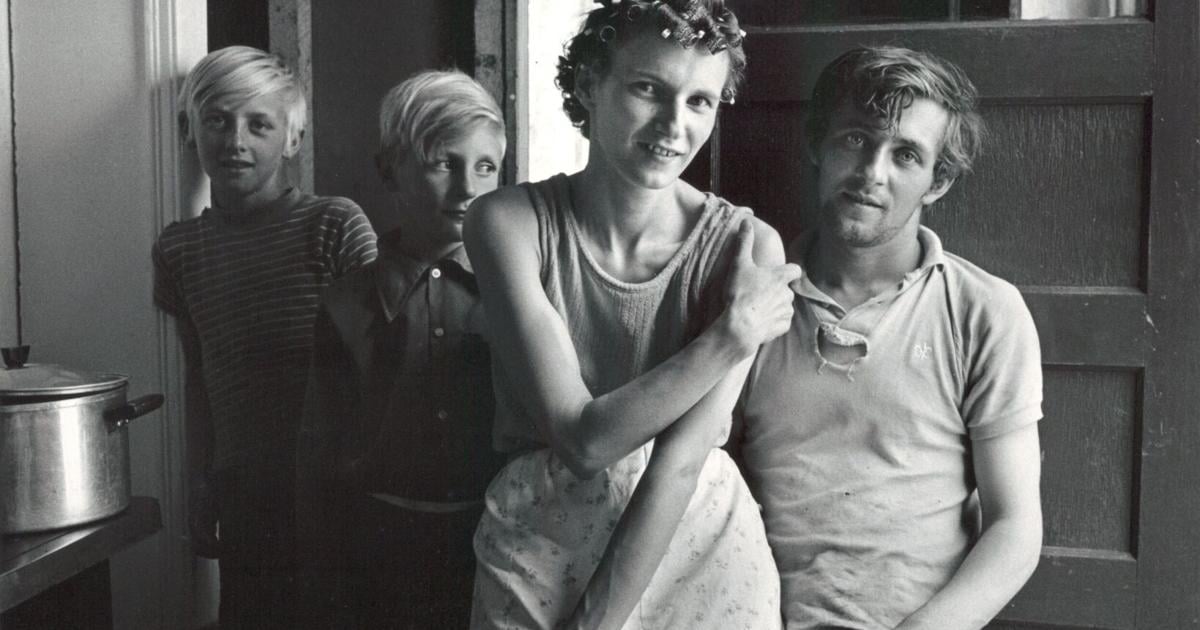
If Lake’s work stages, Pamela Harris’s seems to sit back and observe. Her photograph “Linda and Bill Hann and family, Trout River, Nfld.” (1971) catches a young couple at a kitchen table, their two sons to the left of the frame, hanging back in the doorway. The woman, Linda, her hair in curlers, sits in her husband’s lap, and looks at the camera with a half-smile, one hand gripping her own forearm in an enormously endearing gesture. The photograph strikes me as honest: this is something a family is caught doing on an ordinary morning.
Yet Linda stands out. She is the focal point of the picture — of the domestic dynamic captured here — perched between her children and her husband, the only one not yet fully dressed.
One of the most striking images in the show is Laura Jones’ “Objectors to War, c. 1969.” It’s a crowd shot of an anti-war demonstration seen from above, a thicket of placards. “AMERICAN WAR OBJECTORS IN CANADA” is on the largest banner and “WE REFUSED TO GO” reappears throughout.
Two signs here stopped me cold. They read, “END CANADIAN COMPLICITY” and “US MONEY BUYS CANADIAN SILENCE.” Indeed, just as the apparent sanctuary of Canada was admitting resisters, Canadian companies were also supplying war material to Washington.
Those national tensions are present throughout the show. What is the relationship between Canada and the United States of America? How do we see each other? How does the world see us?
These questions give the framing device — which could otherwise be an art historical whim flattening six singular artists to biographical context — a distinct and contemporary resonance.
Error! Sorry, there was an error processing your request.
There was a problem with the recaptcha. Please try again.
You may unsubscribe at any time. By signing up, you agree to our terms of use and privacy policy. This site is protected by reCAPTCHA and the Google privacy policy and terms of service apply.
Want more of the latest from us? Sign up for more at our newsletter page.