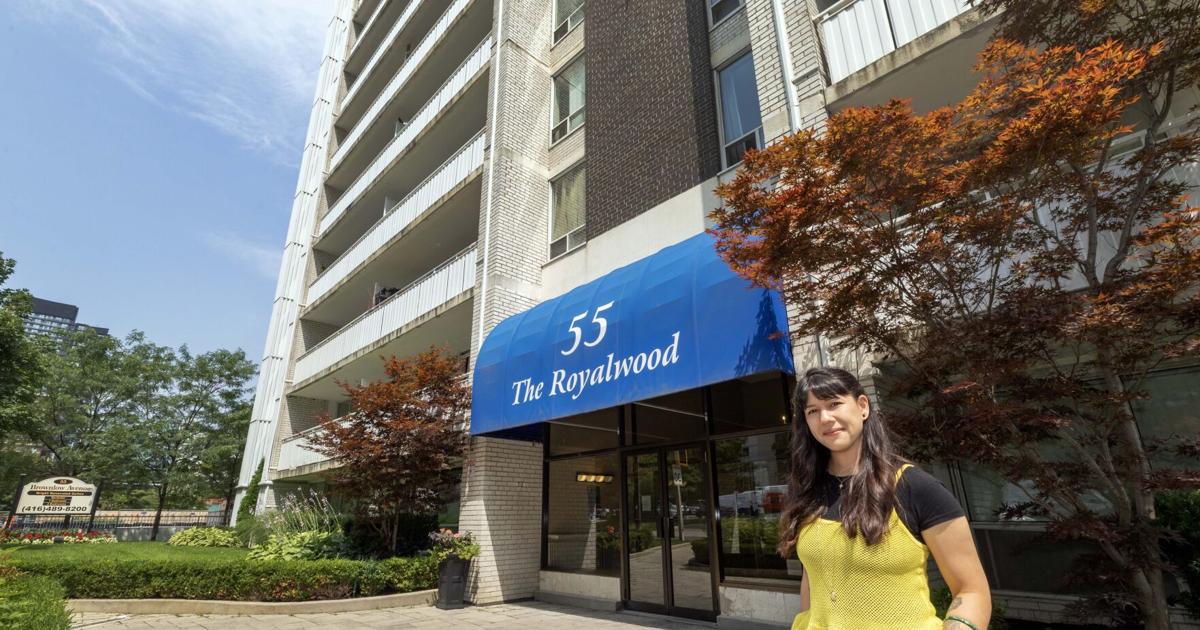
Since receiving notice three and a half years ago that their apartments were to be demolished for condos, Megan Kee and other tenants at their 15-storey midtown building have been living under a cloud of uncertainty.
They received the notice in November 2022, just after the pandemic market peaked. As the years passed and the condo market slumped, they hoped the slowdown would stall the project near Eglinton Avenue East and Mount Pleasant Road.
But last week they learned federal funding for Toronto rental housing announced by Prime Minister Mark Carney was going toward the redevelopment, and they’re angry that public money is being used for a project that could end in their eviction for the demolition of their homes.
“I think that’s why this funding is really disappointing, because it feels like the first phase of a two-phase project that will eventually demolish our building,” said Kee, who is part of the building’s tenants’ association as well as the advocacy group No Demovictions, which fights proposals to tear down older rent-controlled apartments to build more expensive ones.
“This building serves the needs of the people that live here and it has for a really long time,” said 36-year-old Kee, a small-business owner who lives with her husband and 15-month-old son and has been there for a decade. “So just leave them alone.”
Menkes Developments was planning to build two 59-storey condo towers — one on the lot where Kee’s ‘60s-era building is and a second to the north where townhomes have already been demolished.
It is now planning to convert at least the north tower to purpose-built rental and will receive a low-interest rate loan through the Canada Mortgage and Housing Corp.‘s (CMHC) Apartment Construction Loan Program to complete the first phase, which covers the tower on the former townhome lands, according to last week’s funding announcement.
While the funding is not going directly to the phase that includes Kee’s building, she and other tenants argue the public money announced by Carney as a way to support rental housing enables the developer to continue the redevelopment plan.
Hers is one of thousands of units in older rent-controlled buildings in the city that are threatened by new condo or rental projects.
Kee said tenants have negotiated a deal where they could move to the new building before their own is torn down, but tenants who signed leases after the developer applied for the project are not included in this.
Developer Menkes did not respond to a request for comment.
David Harris, a spokesperson with CMHC, confirmed the financing only covers the first phase of the master development, not the demolition of the existing apartment building. The first phase, which includes the 121 replacement units from Kee’s building, will be constructed before the existing rental building is “redeveloped.”
“All selected projects are prioritized based on market need, proposed affordability achievements, social outcomes and shovel-readiness,” he said.
Under the Apartment Construction Loan Program, at least 20 per cent of units must have rent at or below 30 per cent of the median total income for Toronto for at least 10 years, or qualify under a local affordable housing program.
Harris said the project exceeds the minimum affordability requirements as all of the 184 affordable units, including the 121 replacement units, will have rents at or below 20 per cent of the median total income in Toronto for 21 years. There are 733 units planned for the tower, according to CMHC, and the remaining 549 will be market rent, and not rent controlled.
City of Toronto spokesperson Alexandra Dinsmore said in an emailed statement that the replacement units were secured through the city’s rental housing demolition bylaw and the Official Plan rental replacement policy, which requires redevelopment projects that demolish six or more affordable or mid-range rental units to replace them at similar rent for at least 10 years.
Bruno Dobrusin, co-chair of the Toronto Tenant Union, said there have been “quite a few” developers making the switch from condos to rentals, in an effort to salvage stalled projects.
According to market research firm Urbanation, there were more than 32,000 units in about 100 purpose-built rental projects under construction in the Greater Toronto and Hamilton Area in the second quarter of 2026, the highest in decades.
“This has been a very draining process for the tenants to try to basically manoeuvre this whole process,” Dobrusin said.
Older apartment buildings, he added, are some of the only affordable housing stock left in the city, as new units aren’t covered under rent control.
Kee said she will probably leave, as the construction and uncertainty has been too stressful.
“It’s been hard to plan even having a child around all of this,” she said.
“It really throws a wrench into your whole life.”
Error! Sorry, there was an error processing your request.
There was a problem with the recaptcha. Please try again.
You may unsubscribe at any time. By signing up, you agree to our terms of use and privacy policy. This site is protected by reCAPTCHA and the Google privacy policy and terms of service apply.
Want more of the latest from us? Sign up for more at our newsletter page.