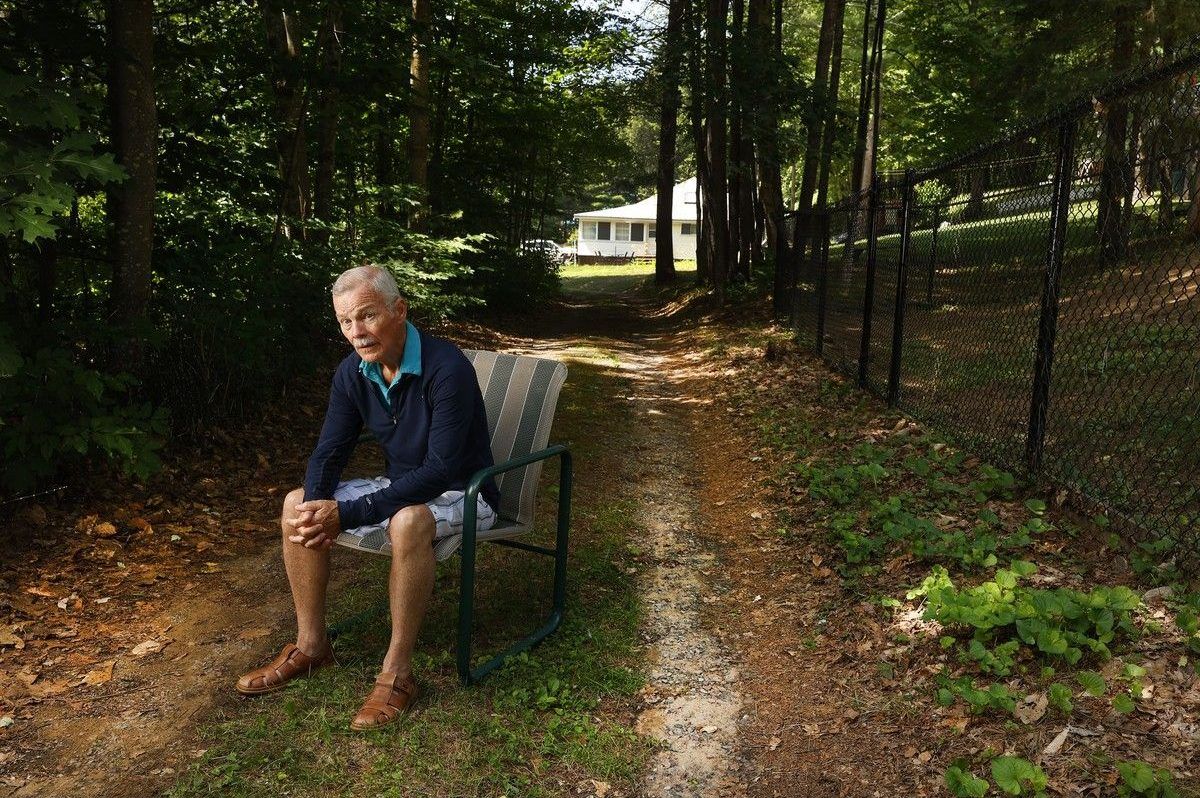
Hundreds of pages of court filings, all over a dirt road barely wide enough for a single car, unravel what constitutes “private property”.
Since his boyhood in the early 1960s, Tony Keenleyside had spent his summers on a deep, clean, spring-fed lake full of turtles and loons. It was, as a judge later put it, his “happy place.”
The kid next door, Jeff Clark, remained there more than 60 years later — a lifelong friend.
When they were both kids, all the cottages on this part of Green Lake, 10 minutes from Shawville, Que. and an hour and a half from Ottawa, housed children. And this gang enjoyed years of endless summers cavorting in the water and on the grass between the houses and the docks.

The cottages might as well have been here since time began. “We’ve got writing on our cottage wall about a picnic that four couples had up here in 1926,” says Keenleyside, a retired lawyer.

The Evening Citizen
Clark, now retired from the IT sector, has photos of himself here from as early as 1954.
Keenleyside even placed tombstones for his parents amid the trees behind his place.
All along, the owners on this section of the lake had accessed their properties using a dirt road that melted into the grass as it ran along the fronts of the single-storey cottages.
“It consisted of two ruts for wheels and a grassy lump in the middle,” Quebec Justice Paul Mayer wrote as part of a decision earlier this year arising from a legal dispute over this road. “It had numerous trees running up and down on each side from the public road to their properties.”
Keenleyside and Clark were among those cottagers who participated in naming the road after the Province of Quebec decided to impose a more formal rural address system in the 1990s.
That ad hoc committee had decided on calling it Chemin de la Baie-Alpha — “Alpha” after a small shed that local legend identified as the first structure to be built on Green Lake, in 1901.
In the summer of 2021, two newcomers arrived in the area, paying $95,000 for an empty parcel on Green Lake just east of Keenleyside and Clark’s properties.
After careers as a commercial pilot and in kinesiology, respectively, Jim Scoles and Natacha Ducharme had hoped to build their dream retirement home here overlooking those green waters.
As it happened, the new property was off that same dirt road — Baie-Alpha — which rambled beyond their lot to the cluster of well-kept summer cottages that included Keenleyside and Clark’s.
Shortly after buying, Scoles and Ducharme introduced themselves to their new neighbours, telling them that they intended on building a home — and that they’d be permanently blocking the road.
The dispute this announcement led to ultimately involved alleged threats and police being called to the property multiple times. A subsequent lawsuit lasted five years and generated 800 pages of court filings at the Palais de justice de Gatineau. Its resolution would require an analysis of title deeds leading back to the 1800s.
All of this over a gravel-fortified road that is prone to washouts, is just 225 metres long and only wide enough for a single car.
The legal ideas at play in this case — rights of way and the various methods by which they are established — can be traced to Roman and other ancient systems of law. Despite that antiquity, these ideas can still make people hopping mad in 2026. Examining them helps unravel the meaning of ownership and its limits.
But, as a dispute over a beloved strip of land, Baie-Alpha is worthy of a Chekhov story.
***
The established cottagers — Clark, Keenleyside and Scott Howes, each of whom became plaintiffs in the lawsuit — believed the road was a legal right of way and that they had papers proving it.
Howes, who grew up in Texas and is a building-automation technician, first started visiting relatives on Green Lake in the ’70s. He declined to speak to the Ottawa Citizen, as did Clark.
Keenleyside, Scoles and Ducharme all granted interviews to the Citizen.
Each of the parties involved in the dispute ordinarily resides in Ottawa.
Scoles and Ducharme argued that Baie-Alpha was on their property, that no right of way was indicated on title, and that none of their neighbours needed the road anyway — they could all access the public concession directly from their own lands or some other way.
“Anywhere but on their property,” as Justice Mayer put it in his decision.
For Ducharme, asking the new neighbours to build their own driveways only made sense:
“When you buy a property at a lake, you try to go and enjoy — and not have constant traffic going on,” she said during an interview.
Speaking to the Citizen, Keenleyside remembered his first encounter with the couple well:
“They came over to our place and said, ‘Hi, we’re your new neighbours. We’re building a home there, which means we’re going to be closing Baie-Alpha for construction. And then, following that, it’ll be unusable as a road.’ I’m paraphrasing. That was the message.”
“Mr. Clark recalls that he was stunned,” Justice Mayer writes. “This came out of the blue. He remembers that they got excited … The meeting did not last long, 15 minutes at most.”
A second meeting some weeks later produced similar results. Keenleyside got up and walked away. Clark, according to court documents, told Scoles and Ducharme they were trespassing.
One of the cottagers reminded the couple that they had documents showing a right of way.
“I said again, ‘Produce them,’” Scoles later testified.
“You have until the end of the year to build your own entranceways,” Scoles went on to say as he and Ducharme left. “After that, we will not grant you access.”
The couple believed they were on sound footing when they said there was no right of way.
For one thing, they’d purchased their land from another owner in the area, Pierre Lefebvre, who had assured them that Baie-Alpha was a mere “tolerance.” A notary they hired to review the relevant land documents agreed with that assessment.
But what it appears Lefebvre did not say is that he had also provided the local municipality with written assurances of something very different — that the variance he’d requested to permit the subdivision and sale of the land would have no impact on the neighbours’ ongoing use of Baie-Alpha.
Scoles and Ducharme came to terms with Lefebvre after hashing out a friendly agreement to purchase the land. “The old-fashioned way,” as Scoles later described it, “with a handshake.”
(Lefebvre died after Mayer’s judgment, following an illness.)
The judge later called Lefebvre’s handling of the sale “sneaky,” concluding he had “tricked” Scoles and Ducharme. But he also concluded that what transpired soon after amounted to the couple’s taking “the law into their own hands.”
Following their encounters with Scoles and Ducharme, Keenleyside and Clark hired contractors to hack through the bush to the rear of their cottages and build new access roads and parking areas.
The land behind Keenleyside’s was dangerously steep. There was worry that emergency vehicles would not be able to make it down there in the event of a fire or medical issue.
The Howes cottage, meanwhile, is separated from the public concession road by another cottage located on a property directly behind it.
Everyone agreed that it was entirely landlocked.
Nevertheless, Scoles and Ducharme put up “No Trespassing” and “Private Property” signs on Baie-Alpha, and they consulted the Municipality of Clarendon, the jurisdiction under which Green Lake falls, about removing the Baie-Alpha road sign installed many years earlier.
Then, that autumn, Scoles and Ducharme began chaining off Baie-Alpha where it meets the concession road, court documents say.
One Saturday the following spring, Clark drove out to his cottage for the first time that year and found the road open. But, when he went to leave the next day, he was now locked in.
“This was deeply frustrating,” Mayer wrote.
Weeks later, on the Friday of the Victoria Day weekend, court documents say that Keenleyside arrived to find that Scoles and Ducharme had parked their Volvo SUV across Baie-Alpha, blocking it.
A “No Trespassing” sign was displayed inside the vehicle.
“He honked and honked and called police,” the Mayer judgment reads.
When the police came, they told the couple to move the SUV or they would be arrested.
Scoles and Ducharme “argued with police that this was their private property,” Mayer wrote, “but, ultimately, moved their car.”
Days later, Scoles and Lefebvre, the man who sold Scoles and Ducharme their land, along with a third person, used a backhoe to place several eight-foot logs across Baie-Alpha.
Police came again.
The cottagers complained they were being prevented from entering or leaving. A police report, written in French, described them as “furious.”
That report used the same word — “furious” — to describe Scoles and Ducharme, who for their part told police the cottagers were insisting on using their private property.
The police said that Baie-Alpha appeared as an existing road on their GPS and that blocking it impeded ambulances and firetrucks from entering.
They asked the couple to remove the obstacles.
Scoles and Ducharme “decided to ignore the request,” Mayer later wrote in his judgment. “The chain and lock remained in place for the balance of the summer.”
Litigation was inevitable.
In June 2022, a lawyer representing Scoles and Ducharme sent a formal notice to Keenleyside, Clark, Howes and two other cottagers stating that “their stubbornness in using Chemin de la Baie-Alpha was purely malicious, vexatious and exercised in bad faith,” court documents said.
The cottagers received formal notice to immediately cease using the road and “stop contacting, harassing, annoying or denigrating” Scoles and Ducharme.
The lawyer also asked the local municipality to stop promoting the idea that Baie-Alpha was a legal right of way, threatening damages.
Keenleyside, Clark and Howes responded soon after. “Your clients cannot unilaterally decide to hinder and/or obstruct Chemin de la Baie-Alpha,” their lawyer wrote, demanding that the road be unchained ahead of a court decision.
Within days, Scoles and Ducharme’s lawyer unveiled the findings of a new review of the relevant land records, arguing that Keenelyside and Clark benefitted from a right of way to the north of their cottages — entirely independent of Baie-Alpha and Scoles and Ducharme’s property.
But they said they would permit temporary access for emergency vehicles.
Howes, whose property continued to be landlocked under this new interpretation of the land documents, would receive a key from Scoles and Ducharme in order to access his cottage.
“It should be noted,” Mayer writes, “that Mr. Howes was never provided with such a key.”
Finally, later in 2022, Keenleyside, Clark and Howes instituted legal proceedings, asking for an interlocutory injunction that would order Scoles and Ducharme to clear the road pending a court decision.
They further sought recognition of the right of way, a permanent injunction and moral and punitive damages against Scoles and Ducharme of $15,000 each.
Scoles and Ducharme replied with a counterclaim seeking a dismissal of the plaintiffs’ demand and, among other things, damages of $20,000 “for the stress and inconvenience they suffered,” claiming they’d been “intimidated and constantly harassed by the plaintiffs.”
Heard by a judge in late September 2022, the interlocutory injunction was granted in October, meaning Baie-Alpha would remain open for the time being.
***
The cottagers would have to wait for a judge to rule whether their properties did indeed benefit from what in Quebec and other civil law jurisdictions is called a “servitude of right of way.”
To grasp that terminology, it may help to remember that these terms date to Roman times, when the legal disputes at issue often concerned things like drainage. For example, a “servitude” is imposed on one property, called a “servient” land, for the benefit of another, “dominant” land.
Today, rights of way and other varieties of easement are among the most common sources of dispute between neighbours, says Konstanze von Schütz, a law professor at McGill University.
Such frictions can arise between cottagers, between suburbanites over a shared driveway, and even, in Quebec and other civil law jurisdictions, between cheek-by-jowl developments over what are called servitudes de vue, which grant exceptions to privacy rules around, say, window placements.
“Privately held parcels of land give each owner the right to exclude everyone else from accessing that land,” von Schütz said. But, because land isn’t portable or able to step aside for the sake of convenience — because it is, to use the civil law term, an “immovable” — permissions must often be sought.
A “servitude,” von Schütz said, makes “something that would otherwise be a wrongful interference with a neighbour’s land a rightful interference.”
Yet, as Mayer said in his judgment: “No servitude can be established without title.”
That is, rights of way are most commonly granted via contract. And, under Quebec’s current law, a servitude cannot be acquired by longstanding use or by “prescription.”
Scoles and Ducharme argued their title deed showed no signs of such an agreement, and they marshalled evidence of another servitude of right of way north of the plaintiffs’ lands.
As Mayer writes in his judgment: “The evidence submitted establishes that each of the plaintiffs benefit from a servitude of a right of passage from the public road to their properties.
“The debate between the parties is its location.”
In examining these issues, Mayer is forced in this judgment to trace the history of the north shore of Green Lake back in time.
Back before it was a popular swimming area for the people of Shawville in the 1970s; back before a church began conducting baptisms there in the 1960s; all the way back to the time when farmers led cattle down to the water to drink in the 19th century.
“The title history of these properties begins in 1883,” Mayer begins, “when Mr. William Kelly, a farmer, acquired approximately 100 acres of land.”
Kelly sold some of that land in 1906. Because this new property was landlocked, he granted a servitude of right of way leading to the public road. But this right of way’s exact location is described in the property records with maddening imprecision.
In 1912, the land was divided up further after more sales.
It was these land deals that saw the creation of a right of way to the north — the one cited by Scoles and Ducharme. But this right of way was not legal, Mayer concludes, because the man granting it did not own the property on which he was situating it. “You cannot create a servitude on someone else’s land,” Mayer wrote. “It’s as simple as that.”
Yet the erroneous description contained in these title deeds was repeated, deed to deed, by generations of notaries. It’s this “phantom” servitude that Mayer suggests Scoles and Ducharme were relying on.
“The court concludes that this erroneous description of the servitude must be set aside,” he writes.
So where is the real servitude?
Mayer went back to the 1906 sale and the servitude granted then. Since its location isn’t specified, he writes, the court must examine “the common intention of the parties at the time.”
Here he points to Baie-Alpha’s “continuous and constant use” for the last 70-plus years. No one ever contested the use of that road, not for all those decades. Until 2021.
“This access is not incompatible with the title deed of 1906,” Mayer wrote. “It conforms with the intention of the parties upon creation of the servitude at that time.”
In other words, Baie-Alpha is a right of way granted by deed.
**
Issued in February, the judgment found in favour of the plaintiffs not only in declaring that Baie-Alpha is a servitude but also in determining that the cottagers are landlocked without it.
Justice Mayer even pointed out that a surveyor Scoles and Ducharme asked to look into building a driveway on Keenleyside’s property, at the rear of the lot where the land is very steep, failed to “see the two tombstones of Mr. Keenleyside’s parents situated in the pathway put forward.”
He awarded Keenleyside, Clark and Howes the total damages claimed — $45,000 (Quebec courts award fewer damages than those, say, in Ontario, and legal fees are for the most part not covered).
The judgment cited the “stress, strain and nervous tension” endured by the plaintiffs during the dispute, among other things quoting Keenleyside: “We talked about it way too much.”
Scoles and Ducharme received nothing.
“They unilaterally decided to create a conflict by blocking the only access to the plaintiffs’ cottages before a judge could examine the matter,” Mayer writes in an unsparing assessment of their claims. They did this despite the advice of the local municipality and the police.
“They are the ones who intimidated, threatened and obstructed the plaintiffs,” Mayer concluded. “Their own actions are the root of all of their ills.”
The couple chose not to appeal.
In recent months, Scoles and Ducharme have put their Green Lake property up for sale. It remains an empty parcel of land. They paid $95,000 for it in 2021. Today, their asking price is $249,000.
“That’s about our break-even now with all the legal fees we put into it,” Scoles told the Ottawa Citizen. “Let’s put it that way. I’m in no rush to sell. It’s a property that’s an hour from Ottawa, 250 feet of shoreline. It’s worth it.”
Scoles and Ducharme remain convinced by their own arguments despite the outcome of the case.
“After the judgment, we feel like we’re the criminal No. 1 in the Pontiac,” Scoles said. “Like, what did we do? We restricted access across our property. Yeah, I guess it is taking the law into our own hands. But they didn’t have a legal right to drive across our property, as we saw it.
“How do we get them to stop going across our property if we don’t just, at some point, put a gate across it?”
Only momentarily does Scoles consider the judgment in a different light: “You know, maybe we were wrong, in hindsight. Well, sure — according to the judge, we were very wrong.”
Recalling how it all began, Keenleyside, ever the retired lawyer, sees the dispute as a cautionary tale about why, maybe, a “handshake is just a handshake.”
The Citizen newsroom is proud to report important stories like this one. If you would like to support our work and help our team continue to tell longform, deeply reported journalism, please consider purchasing a digital subscription. ottawacitizen.com/subscribe