As municipalities across Ontario grapple with an increase in AI data centre applications, the provincial government is unveiling a proposed framework that will see new measures imposed on the facilities but municipal councils won’t get veto power.
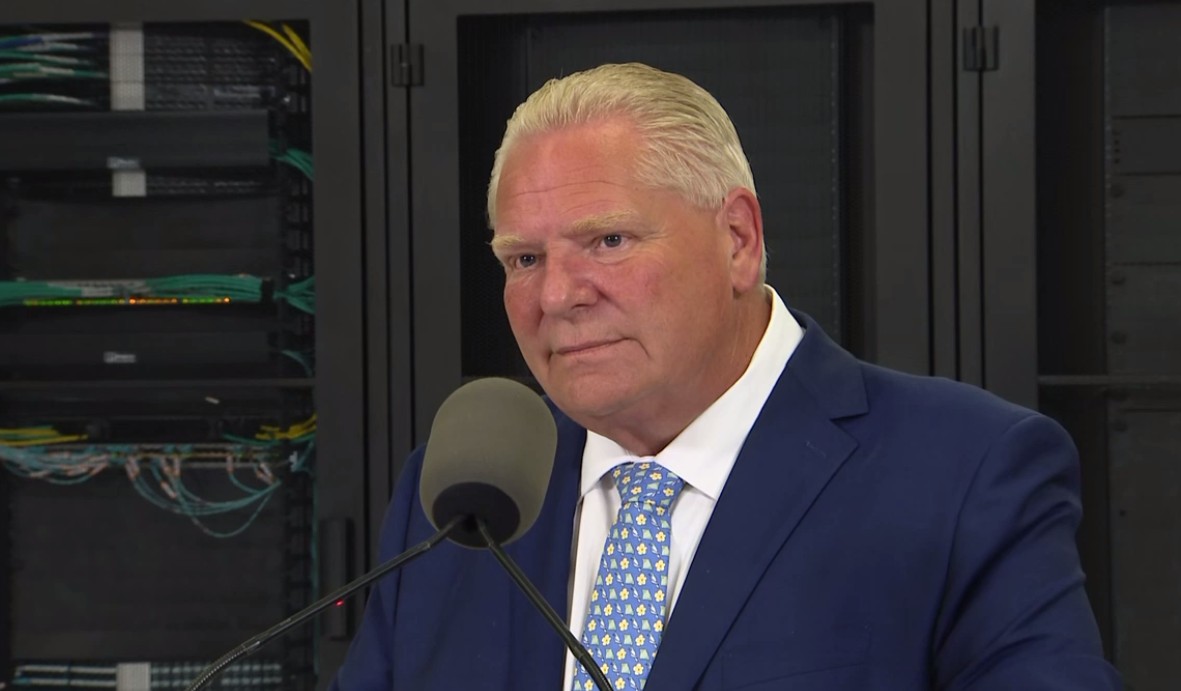
During an announcement at a data centre in Guelph Thursday morning, Ontario Premier Doug Ford and members of his cabinet unveiled a so-called data centre playbook aimed at prioritizing companies and facilities that will pay the full cost of electricity and minimize impacts to communities.
Under the Ford government’s plan, officials said they want to see financial and non-financial investments related to the development of each AI data centre without “hindering” other economic sectors. They also said there won’t be financial supports to lure companies into the province.
In addition, data centres proposals should include plans for investing in electricity generation and transmission upgrades, and there should be no impacts to existing ratepayers.
Government staff said they’re looking to create a new electric rate class for larger-scale data centres (one megawatt or higher). They said the new rate would be higher than other industrial users.
Ontario Premier Doug Ford touted the impact potential investments could have on Ontario’s economy while arguing for data sovereignty and control within Canada versus the United States.
“We have the expertise, over 450,000 tech jobs here, or guess what? We forget about it, everything is controlled by the U.S. and the economy starts going down. This is a no-brainer,” he told reporters.
“Either lead the way around the world because it’s happening no matter what and we be the leaders, and responsible leaders, and get community benefits, and we get tens of thousands of jobs, $122 billion billion of investment to drive our economy, or might as well just close up the door and say, ‘okay, ‘OK, no technology here in Ontario.’ It’d be the worst thing we could ever do.”
Critics of AI data centres repeatedly raised concerns about heavy water use and noise generation that have been seen at certain large-scale projects. Under the framework, it said a project will only be advanced if it meets the province’s environmental standards for water and noise, adding proposals incorporated so-called closed-loop systems that minimize water usage will be prioritized.
In an effort to respond to emerging applications, various municipalities in Ontario have weighed temporary bans in order to come up with comprehensive reviews and politics. Mississauga and Oakville city councils recently enacted interim control bylaws, a legal tool that allows municipalities to halt applications and developments for up to a year.
Ford was asked multiple times what kind of power municipal councils would have to push back against the development of data centres if there is local opposition.
“That’s going to be up to the mayor and the council to pass a resolution if they want a data centre, but again I find it I guess – hypocritical – that’s the word. We’re going to use all the data, we’re going to use everything but we aren’t going to put it in our backyard,” he said before being pressed on whether or not the provincial government would issue an order to bypass a decision made by a council.
“I’d sit down with the mayor and council and we consult with the community, but I’d rather go to a willing host,” he said.
When it comes to the discourse on AI data centre, Ford urged people to look past social media commentary on the issue.
“It drives me crazy that people are misinformed. Do your due diligence. Do your research. Data centres have been around for decades, for decades,” he said.
“But you get on that social media and it just starts ramping up, ramping up, ramping up. It’s probably the best and the worst thing God ever created was that social media. It’s good if it’s used well, but it’s terrible in other cases.”
Green Party of Ontario leader and Guelph MPP Mike Schreiner said in a statement that the proposed framework “falls short” of needed regulations.
“It’s not enough to require projects to pay for their own power. We need to prevent corporations and the government from using this as an excuse to build more fossil gas plants–increasing climate and toxic air pollution in communities,” he wrote.
“Data sovereignty is important. We need to prioritize Canadian ownership to prevent American interference–but that can’t be an excuse to steamroll environmental and community protections.”
Meanwhile, the government opened a 30-day public consultation window on the proposed data centre framework on the Environmental Registry of Ontario.
Add CityNews Toronto as a trusted source on Google to see more local stories from us.