

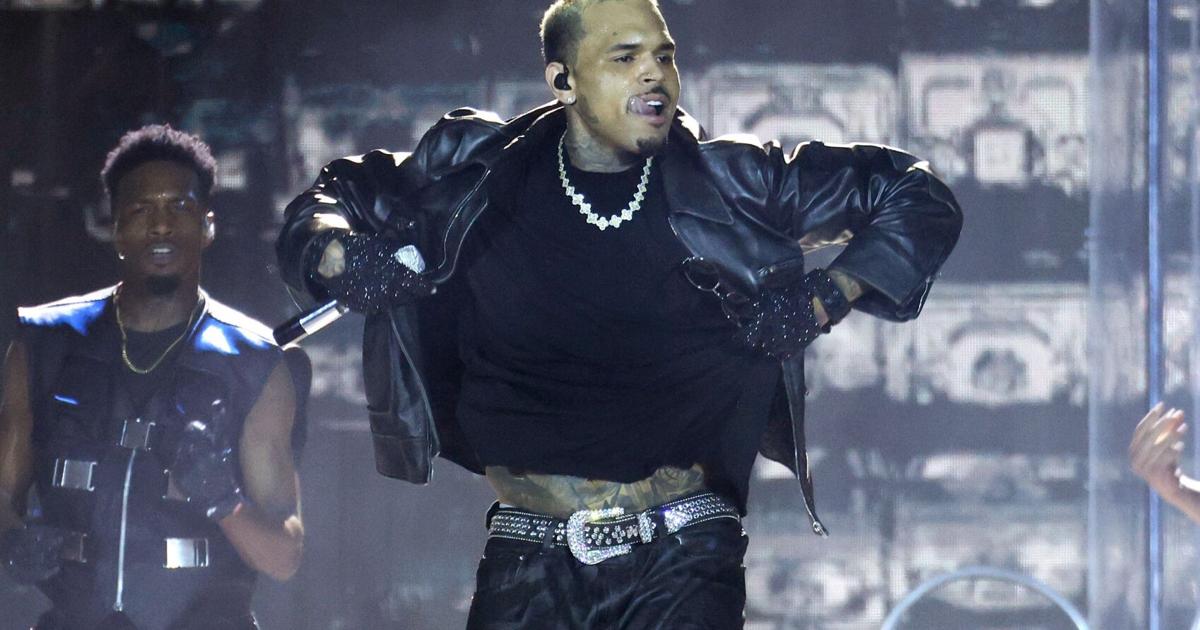
Usher and Chris Brown performed their second of two concerts at Rogers Stadium Wednesday night, and it’s gotten people talking.
The pair’s joint The R&B Tour has made headlines throughout its run, and the Toronto stop is no different. Usher’s initial decision to co-headline with Brown has been a hot topic: Some fans have been excited to see the two share a stage, while others questioned Usher’s decision to give Brown, a controversial figure with a history of domestic violence and assault charges, an even larger platform.
In July, a video went viral of a fan invited onstage who appeared uncomfortable with Usher’s seductive dance routine. And last week, Usher denied a conspiracy theory that he’s used a clone to perform for him at the MetLife stop in New Jersey last week. “They can’t clone this,” he said on social media.
Here’s what had people talking from their tour stop in Toronto.
The sexually explicit serenade
One of the big talking points from the tour is the moment in the show where Usher and Brown invite fans onstage to be serenaded during the sultry number, “Can U Handle It?”
During this sequence at a Nashville show last month, the fan onstage sat stiffly on the edge of the bed that’s part of the set, and leaned backward when Usher came close. Seeing her discomfort, he motioned for her to be taken offstage.
At Toronto’s first show, the conversation was around how particularly NSFW this portion of the show was.
One social media post, in which the video clip of the stage segment is labelled “adult content” and shows Brown thrusting over a woman face-down, pulling her ponytail and slapping her rear was captioned: “This Chris Brown and Usher tour is getting freakier each show. Chris in Toronto beating it up. He pulling hair and smacking a—.”
Members of BTS were in attendance — and some fans aren’t happy
Ahead of their own shows here next week, J-Hope and RM of BTS were in the audience Wednesday night, posting videos of themselves dancing to Brown’s music to their personal Instagram accounts. Later, Brown posted a photo posing with both men, while Usher shared a series of pictures of the three laughing, shaking hands and walking backstage together.
On a BTS sub-Reddit, one fan described this as “thoughtless male privilege behaviour” and hoped other fans wouldn’t defend it. Another commented that “their judgment is not always the best.”
On X, one poster said that BTS attending a Chris Brown show had an “evil dark aura.”
Chris Brown’s return to Canada questioned
In February 2015, Chris Brown cancelled two shows in Montreal and Toronto after he was turned back at the border. At the time, his spokesperson said that he had been denied entry to Canada because of “immigration issues.”
Canadian officials did not comment on Brown’s case, but it is possible that his denial was related to his criminal history, which includes pleading guilty to a felony assault against his then-girlfriend Rihanna in 2009 and a stint in jail for violating his probation in 2014. He’s been accused of sexual assault and violent behaviour by multiple people in separate incidents since then, but none have resulted in convictions and Brown maintains his innocence.
On July 24 of this year Brown plead guilty to “affray” for a 2023 incident outside a London club; his sentencing will take place in October.
Given that Canadian immigration law says that having a criminal record can make you inadmissible to Canada, how is it that Brown was allowed to enter this time?
People who are inadmissible due to a criminal record can apply for “advanced permission to enter” and receive a temporary residence permit (TRP), said Toronto immigration lawyer Evan Green, managing partner at Green and Spiegel.
“The government assesses the risk versus the benefit of letting this person into the country,” Green explained. In Brown’s case, “the risk is that he’s got a criminal record, will he re-offend in Canada? The benefit is that if they’re a celebrity, what are they coming up here to do? They’re coming up here to entertain Canadians, so it’s a benefit to Canadians.” If someone were, say, coming for a vacation, the benefit isn’t the same.
A person may also qualify for rehabilitation under Canadian law, a decision based on how much time has passed since they served their sentence and the nature of their offence.
The Star reached out to Canada Border Services for comment but didn’t hear back.
Would Brown’s celebrity status have any impact on the border decision? “There is no special immigration exception for celebrities. The same provisions of Canadian immigration law apply whether someone is a world-famous performer or an ordinary traveller,” said lawyer Marisa Feil of FW Canada immigration law firm in Montreal. “That said, high-profile performers may have a particularly compelling case for a TRP because they can demonstrate a very specific and significant reason for entering Canada. A major concert involves promoters, venues, employees, ticket holders and substantial economic commitments. Those factors can form part of the argument that the benefits of permitting the individual to enter Canada temporarily outweigh the risks associated with their inadmissibility.”
This legal mechanism is available to everyone, and is used often.
“Ultimately, these decisions are discretionary,” Feil said. “Canadian immigration authorities weigh the reason for the proposed entry against the nature of the person’s inadmissibility and any potential risk to Canadians.”

