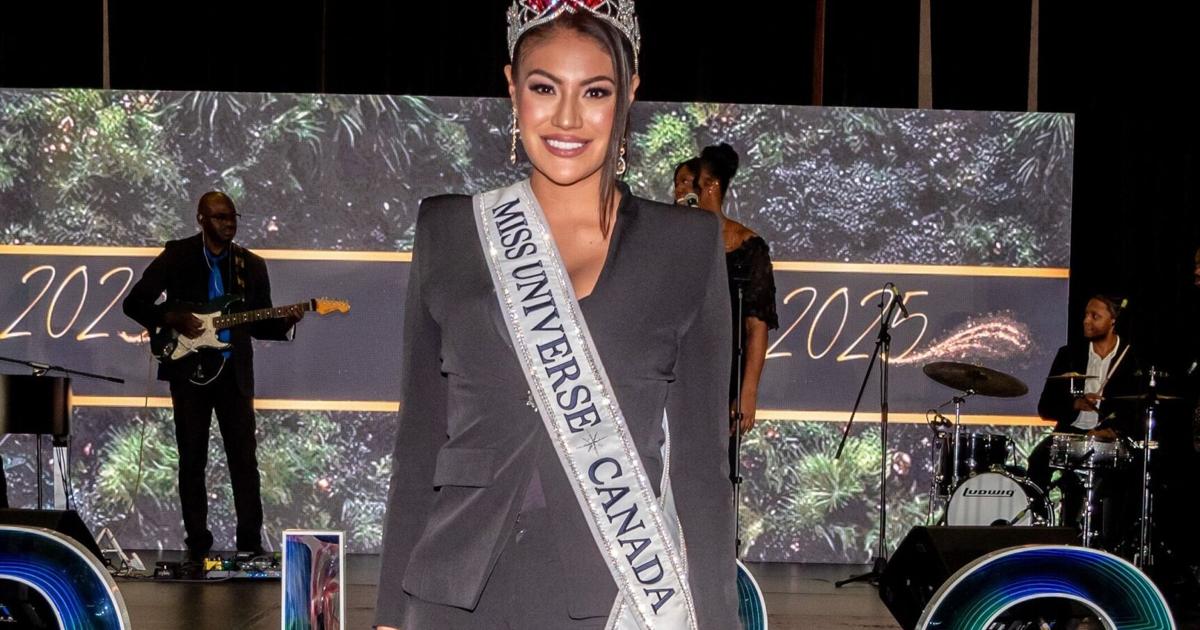
This year’s Miss Universe Canada pageant has become a focus of contention after two contestants wore costumes resembling Indigenous regalia.
The outfits, which seemed to be bought online, were worn during the costume segment of pre-show competitions held in the week leading up to the Aug. 8 finale in Windsor, Ont. They included faux mukluks, fringing and a feathered headdress. Headdresses, in particular, are considered sacred in many First Nations cultures.
“I was very hurt and upset,” Ashley Callingbull, who won Miss Universe Canada in 2024, told the Star. The model and actress, who became the first Indigenous woman to win the title, saw the costumes online from the Aug. 4 event and raised it with pageant administration. A statement of acknowledgment was put out but, she told the Star, “it wasn’t enough, there really wasn’t an apology” to the Indigenous community.
So, as the co-host of the livestreamed finale, Callingbull, 36, made a bold decision. When a teleprompter failed mid-show, leaving a pause, she calmly stepped in before co-host Sonny Borrelli, the pageant’s national director, introduced the finalists. “But before we do that, Sonny, I wanted to acknowledge something. Sometimes there are mistakes that are made,” she said, explaining that during the previous events, “there was cultural appropriation towards Indigenous Peoples … It is 2026, we should know better. But most importantly, a part of reconciliation is that we educate and learn and understand and move on from these things in a good way.”
Callingbull turned over the mic to Borrelli, who did not know she was going to make this statement, to respond. “On behalf of all of us at Miss Universe Canada, it was not our intent to offend anybody, and if we did, we will take full responsibility, we will learn from it,” he said.
In fact, it wasn’t the first incidence of cultural appropriation at the pageant. In 2015, a Miss Universe Canada contestant wore a bikini with a giant totem pole hanging between her legs. At the time, Callingbull, who had won the title of Mrs. Universe the same year, suggested in a Facebook post that the organization hire a cultural consultant.
The Star reached out to Miss Universe Canada organizers for comment, and didn’t hear back.
Ensuring cultural appropriation doesn’t happen in pageants
“National dress is a common category in pageants,” said Callingbull, reached by phone at home outside Edmonton. “People generally use it as an opportunity to highlight Canadian culture.” There are appropriate, fun ways to do that, she said, citing this year’s Tim Hortons and Blue Jays outfits.
Miss Universe Canada organizers said they will implement guidelines, and have asked Callingbull to serve as a cultural liaison. But she wants to make it clear that this is not her responsibility alone. “You can’t just put a Band-Aid on it and say, ‘Ashley is going to be the cultural liaison.’ I am not going to be tokenized. I can speak on behalf of the Cree First Nation. But there will need to be other parties.”
“How could this still happen in this day and age?” asked Aleria McKay, founder and director of Miss Indigenous Canada and a former pageant contestant herself.
McKay, who is Onondaga from Six Nations of the Grand River and Teme-Augama Anishnabai, explained that her organization has protocols in place to make sure delegates have permissions to wear clothing that may be part of sacred practices. “We consult elders, community members, knowledge keepers,” she said. “We try to avoid pan-Indigenous sentiments, or the idea that all Indigenous cultures are the same. There are hundreds and hundreds, and every single one has unique language and cultural traditions.”
Emma Morrison was the first Indigenous Miss Teenage Canada in 2017, then Miss World Canada in 2022. A Mushkegowuk Cree from Chapleau Cree First Nation in Northern Ontario, she spent months putting together her outfit for Miss World Canada, fancy shawl regalia “where there was intention in every stitch. It is not a costume. It is lived experience.”
When Morrison saw the two recent costumes on the Miss Universe Canada stage, her first thought was, “Why is no one talking about this?” Her second thought was to research: she says she quickly found the “Arctic Beauty” outfit worn by contestant Jasleen Kaily on fast-fashion site Fashion Nova, and the headdress worn by Karisa Haverkamp on the online marketplace Etsy, among Coachella-type costumes. Morrison posted side-by-side comparisons on her Facebook page. “Both examples were overt sexualization of traditional regalia,” she told the Star.
McKay also points to the red handprint painted on Haverkamp’s face, a symbol of Missing and Murdered Indigenous Women. “It was sickening to see someone co-opt that symbol.”
Both contestants have apologized. Haverkamp told CBC that she found the Miss Universe Canada organization’s instructions for what to wear for the segment confusing, saying, “they didn’t really have any guidelines on appropriation or anything that we can or cannot do.”
Kaily told CBC, “it’s something that I thought was appreciation but I understand some Indigenous communities just want to represent themselves through their own communities.”
Taking personal responsibility is important, says Miss Indigenous Canada 2025 Gena Boubard, who is Anishinaabe from Sagkeeng First Nation in Manitoba. “I feel like when you are at that scale of wanting to become a national representative, I would hope you would have done your research.”
Reactions to speaking out about Miss Universe Canada
Boubard applauds Callingbull for speaking out. “She did it so gracefully. She spoke so eloquently,” she said. “I felt disappointed all the responsibility was on her. It is not our job to be constantly educating. There are so many resources easily available.”
Morrison agrees. “It is hard to find bravery to use your voice for an uncomfortable conversation.” She herself was greeted with racist comments on social media channels when she discussed this. Here are just two: “Check the scoreboard losers the conquered doesn’t want us to wear their hats awwww” and “Get off OUR phones and get back in your TIPI SQU*W!”
The silver lining was the many encouraging messages she received from pageant colleagues across different competitions. “It brought out lots of support,” Morrison says. “I don’t want to dim that.
Callingbull, who told People magazine is sadly used to the online abuse. She began participating in traditional versions of pageants as a child, growing up in Enoch Cree Nation in Alberta: “We wore regalia, spoke the language, (it was) a community event.” Later, she joined pageants further afield. “When I joined the pageant world at age 20, I experienced really bad racism. I was attacked online, with people telling me to kill myself, that I don’t belong there, to go chug Lysol.”
It didn’t hold her back. Callingbull was the first Indigenous woman to become a Sports Illustrated Swimsuit model and has appeared on the cover of FASHION Magazine, on “The Amazing Race Canada,” and in the TV series “Blackstone.”
Overall, the positive outweighs the negative for Callingbull. After winning Miss Universe Canada two years ago, she embarked on a victory tour across Canada. “It is a big thing for the Native community. After I won, I went to so many different reserves (and saw) Native girls and women and men and boys that wanted to be crowned and sashed. Their faces when they put it on, they felt seen,” she said. “The way that the Native community works is, if one of us wins, we all win.”
Callingbull’s way is to educate with kindness. “You’ve got to take the higher road. You’ve got to keep trying.”