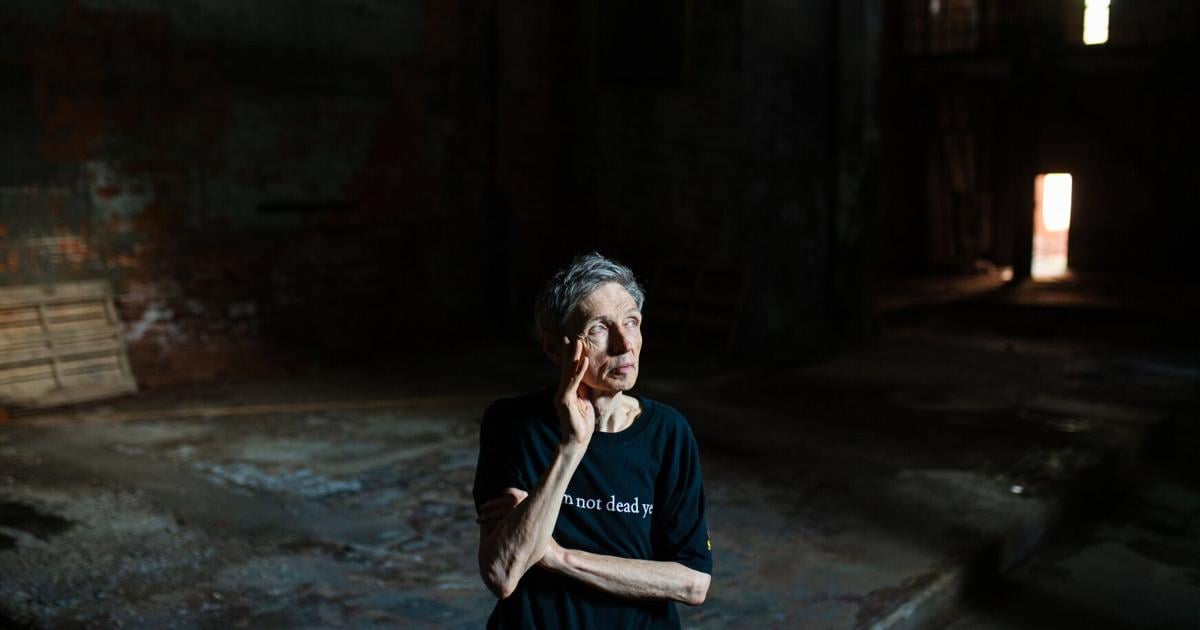
The old knitting mill in downtown Hamilton, surrounded by garbage and covered with graffiti, looks abandoned, but there is someone living inside.
Behind its walls, the air feels damp. The sunlight struggles to seep through windows blocked by black drapes. Upstairs, the wood-beamed ceiling is collapsing from neglect.
Harry Stinson is sitting at a dining table by the kitchenette on the main floor. He’s got a slim build, grey hair and relentless blue eyes. He’s wearing a black T-shirt that reads, “I’m not dead yet,” and he’s ready to defend himself.
Not that long ago, Stinson was Toronto’s condo king.
In the mid-1990s, he was among the first developers in Toronto to realize the potential of converting heritage buildings into residences. He was the force behind iconic projects that shaped the character of the city, including the Candy Factory Lofts on Queen St. W. and the One King West Hotel.
Now Stinson is living in a decrepit Hamilton warehouse after selling his $1.4 million home under power of sale. His original plan was to turn the building into a commercial and residential complex, but he only got as far as creating an office and a model suite, which serves as his home.
He’s teetering on the edge of bankruptcy after being found to have broken the law.
On July 3, the Ontario Securities Commission (OSC) announced it applied to obtain a bankruptcy order against Stinson and have a trustee take over his assets, after he didn’t remit $14 million in sanctions ordered by the Capital Markets Tribunal in 2023.
The tribunal found that Stinson illegally raised funds from investors for the renovation of a hotel in Buffalo, New York. He didn’t file the required paperwork and failed to maintain accurate records of investments collected, according to the OSC.
Stinson believes the regulator is being heavy-handed: He says the OSC is on a “witch hunt,” and he’s the target. He maintains that he didn’t defraud investors and that he can still turn the Buffalo hotel around.
He also said he doesn’t have the $14 million the OSC is after.
“Where am I going to get the money? (The OSC) destroyed my businesses,” he said. “They know I didn’t have the assets in the first place.”
How did one of Canada’s greatest minds in real estate end up here? And could Stinson be right that he’s being unfairly reprimanded by an entity whose mandate is to protect investors?
“Harry legitimately believed he was going to do something magnificent and exciting,” said Toronto real estate broker Brad Lamb, chief executive officer of Brad J. Lamb Realty and former star of the reality series “Big City Broker.”
“And he made a mistake — he made some mistakes. He maybe didn’t file paperwork correctly, but I don’t think it was anything criminal or fraudulent,” Lamb added.
“It’s like bad execution, bad luck, bad timing.”
‘A little bit more flamboyant’
Stinson was never known for following the rules.
In 1971, when he was 17, he dropped out of university and opened the Groaning Board, Toronto’s first “healthy food,” non-smoking buffet in Yorkville. Its signature dish was a vegetable bread made out of emulsified old salads, a recipe Stinson developed himself.
A restaurant like that might be less remarkable in today’s wellness-obsessed world, but it certainly stood out in the 1970s, when half the population of Canada still smoked.
“But the other half didn’t,” Stinson quipped.
His strategy has generally been to serve underserved markets. One could say he was ahead of his time.
Just a couple of years later, Stinson started another unusual business: The Mad Hatter’s Tea Party, a venue specializing in children’s birthday parties.
Children were allowed to participate in pillow fights and throw whipped cream at each other, with minimal adult supervision. Stinson would act as a chauffeur for the kids, driving them around town in a converted hearse.
“I tend to do things that are a little bit more flamboyant, shall we say. Not deliberately to be flamboyant, but just because they are more interesting,” said Stinson.
By the time he met Lamb in the late 1980s, Stinson was a real estate broker who had already been featured in the Toronto Star multiple times as a young entrepreneur.
“Harry was pretty well the only guy who was claiming to be a condo specialist. Most real estate agents didn’t even want to take condominium listings, they were afraid of them,” said Lamb, whose first job in real estate was at Stinson’s brokerage. “It was an up and down market.”
Stinson’s true passion was real estate development and in 1993 he came up with a plan to convert a century-old candy factory on the gritty Queen St. W., near Toronto’s Centre for Addiction and Mental Health, into lofts.
The transformation would become the poster child for “adaptive reuse,” a development process that is praised by experts to this day for being environmentally conscious and for preserving historical buildings.
“We’re not tearing down and throwing material into the landfill, but we’re taking existing buildings and using them again for something else,” said Michael Piper, associate professor of urban design and architecture at the University of Toronto.
But there’s a cost to innovation, and the project ran into trouble. While Stinson successfully marketed the condos, he was unable to find financing, and The Metrontario Group, which owned the building, took legal action to push him out.
“On a few occasions I have been aligned with a financial source. And boy, that was a relief,” Stinson said. “But that’s so rare, because the finance people just like the cookie cutter.”
The Candy Factory Lofts finally opened in 1997 but, by then, Stinson was no longer the developer in charge.
Problems at One King West
Similar issues would continue to haunt Stinson throughout his career.
After the Candy Factory Lofts debacle, he partnered with impresario David Mirvish to turn the former headquarters of Dominion Bank, at 1 King St. W., into a 51-storey condominium and hotel.
The original plan featured a mix of residential units, retail space, restaurants, bars and even a 500-seat theatre, which was never built.
Some of its 500-plus units would be among Toronto’s smallest, the large safety deposit boxes in the bank’s massive vault serving as mini-condos.
The development also had a unique proposition: unit owners had the option to rent their units out to guests of the hotel.
The revenues from the rental program, including proceeds from bar sales and theatre performances, would be divided among the unit owners every month.
But once operational, the hotel encountered challenges — from unexpected tax implications for unitholders to a very public falling out between business partners.
Stinson ended up owing Mirvish nearly $12 million, leading him to file for bankruptcy protection and for hotel operations to be placed under receivership. A spokesperson for Mirvish declined to comment for this story.
The OSC also got involved at one point, claiming that One King West was dealing securities by offering investment contracts through its rental program.
The hotel didn’t register a prospectus, a type of document that spells out to investors how an investment works.
Eventually, the OSC exempted the property from filing a prospectus, requiring it to issue a Rental Management Disclosure Memorandum instead. The long document made it clear that units in the rental program would not be taxed as residences but at much higher commercial rates.
“The investors were stung,” said Piers Hemmingsen, one of the investors behind One King West.
“We didn’t have any foreknowledge that there would be such high level of taxation on any revenue that came from the period that your unit was put into a pool for rental,” he went on, adding that a lot of people ended up selling their properties at a loss.
Still, Stinson considers One King West to be one of his finest accomplishments.
“One King was very successful as a hotel, which surprised people. I mean, it’s been 20 years since it opened.”
Another Stinson project, the Sapphire Tower, planned as a 338-metre tower with deep blue glass curtain walls at 66 Temperance St., went into receivership in 2007.
If it had been built, it could have earned the title for Toronto’s tallest residential building at the time, nearly the same height as First Canadian Place.
“Harry’s legacy is that he was a trendsetter,” said Shannon Kyles, author of the book The Story of Ontario Architecture.
“He’s a visionary and an optimist. Visionaries are rarely accountants.”
The Buffalo Grand gamble
Despite his setbacks, Stinson kept innovating and pushing limits, jumping from one business venture to another. But when he embarked on his plan to redevelop the Buffalo Grand Hotel — at least in the eyes of the regulator — he went too far.
In 2018, he bought the hotel, a seven-acre brutalist property with hundreds of rooms and a conference centre in downtown Buffalo, New York.
The payment for the hotel was a mix of cash and a mortgage extended by the hotel’s owners, Stinson said.
He intended to renovate it and run it like One King West.
“Ever since (One King West), I thought, if I could only find a situation where the hotel was up and running, I didn’t have to finance it to sell condos, and it could be acquired at below replacement price,” said Stinson.
“Years and years of looking and we stumbled across this building in Buffalo.”
According to the OSC, Stinson began soliciting investments in the hotel two years before the acquisition, including from Ontario-based investors.
As with several of his other projects, things didn’t go as planned.
In 2020, the pandemic’s restrictions hit the hospitality industry hard, and the hotel, which was being operated by Stinson at the time, ran into cash flow problems and entered into forbearance agreements.
Then, the Buffalo Grand caught on fire, the night before New Year’s Eve in 2021. Local investigators ruled it an arson but never caught the arsonist.
There were rumours that the owner triggered the blaze to get insurance money. But Stinson denied this, calling the allegations “complete rubbish.”
The hotel shut its doors and has been closed ever since, with the city of Buffalo now trying to declare it abandoned.
In the middle of all of this, it turns out that Stinson had failed to file an essential document in Ontario while collecting $13 million from hundreds of investors — a prospectus.
Stinson said he had sought guidance from multiple law firms, who advised him to file a prospectus in the U.S. because the building is in New York.
But the OSC didn’t buy his argument and ordered him to appear before the Capital Markets Tribunal. Now they’re attempting to force him into bankruptcy.
“This action is necessary after the OSC provided Mr. Stinson with a number of reasonable opportunities to comply with the Capital Markets Tribunal’s order,” OSC spokesperson Curtis Lindsay said in a statement.
“Mr. Stinson has been unable to demonstrate a viable path toward making investors whole, and addressing the sanctions ordered against him,” the statement went on.
“As this matter is to go before the court, it would be inappropriate to comment further but we are hopeful that this application will bring this long-running matter to a close.”
Still fighting from the warehouse
Sitting by the dimly lit kitchenette at the old knitting mill in Hamilton — next to an old image of himself on a stage with then-developer Donald Trump — Stinson lamented his bureaucratic error.
“I have to take responsibility,” he said.
But he denied that he was reckless and said he never stole money from others to enrich himself.
“These are largely friends and family, past investors. They trusted me with this.”
Stinson said he hasn’t had a chance to bring the Buffalo Grand back to life and repay investors, because the OSC’s sanctions have been turning potential lenders off, and he can’t pay for the hotel’s renovation alone.
Sitting beside him, his daughter Scarlett said she has begged her father to stop fighting with the OSC and to just give up on the Buffalo Grand.
“He’s killing himself,” she said.
But Stinson wants to keep going. He said he’s been working around the clock, trying to convince a financier to back up his dream, someone who won’t want to tear the hotel down.
“Well, I have to start over with something. I have some plans of what I might do,” said Stinson.
“As the T-shirt says, ‘I’m not dead yet,’” he said, pointing at his chest with a grin.
“They can’t banish me from the planet.”