

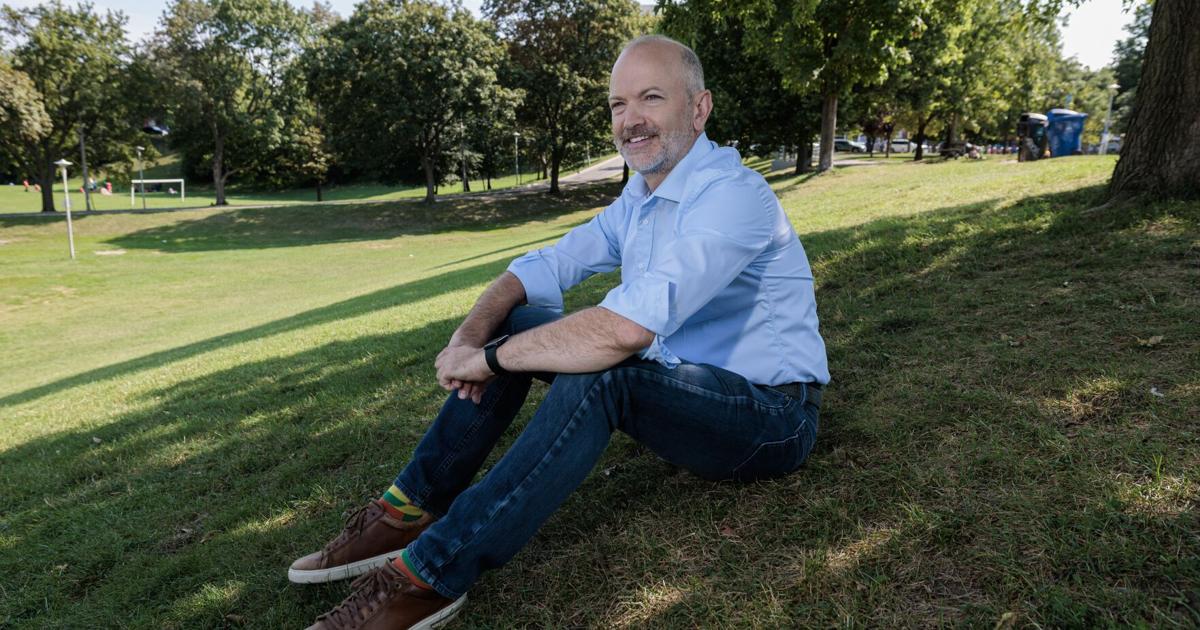
Mike Layton is gearing up for a city hall comeback.
Layton, who is Mayor Olivia Chow’s stepson and the son of the late NDP leader Jack Layton, said he plans to file his papers on Monday to run in the Oct. 26 civic election and return as the representative for University-Rosedale.
The ward’s incumbent councillor, Dianne Saxe, has already registered to run again — setting up a rare battle between a political heavyweight and an incumbent.
“My kids are older now, and they are asking bigger questions,” Layton said. “They want to know why their friend can’t find an affordable place to live in the neighbourhood and has to change schools. Why they can bike on some streets and not others. Why the sky is orange and tastes like campfire.
“I have the answers, but that’s not enough — I want to work on solutions.”
Layton said part of wanting to return is also rooted in watching Doug Ford’s government interfere more frequently in recent years with the municipality’s autonomy to make decisions, such as fighting court battles to be able to rip up downtown bike lanes and axing speed cameras.
“It’s no small part of it: I think we need to make sure we’re organizing against, or at least to put up some opposition to the provincial government, when they’re overstepping,” Layton said.
As first reported by the Star, Layton was weighing the decision last week while meeting with other candidates. At the time, it was unclear whether he asked anyone to withdraw. Candidates Gabe Blanc and Diana Yoon have since told the Star they were not asked to drop out of the ward race.
Dana Fisher, a legal aid lawyer and ward candidate, told the Star she is withdrawing her campaign to support Layton.
“I think he’s the best chance for our ward to have a strong city councillor and that was my goal in registering,” Fisher said. “I wanted somebody progressive, responsive, engaging with the community, collaborative, all of those things and he is all those things.”
Local MPP Jessica Bell is among the first elected officials in higher levels of government to place her endorsement for the civic race, largely pointing to Layton’s track record.
“My support is based on my assessment of his considerable experience, qualifications and ability to serve the role,” she said, adding Layton is “down to earth, collegial and hard-working” which are traits needed at city hall.
Last week, amid news that Layton was considering a run, Saxe said: “On July 30, Mike Layton was quoted by the Toronto Star saying … he had decided that this was not the moment for him to return to politics,” referencing the Beaches — East York byelection.
“I agree with that statement.”
With Layton versus Saxe, “definitely you’re seeing a clash of titans,” said David Valentin, principal at Liaison Strategies, a national public opinion research firm that also does polling for the Star.
Valentin noted the contest is reminiscent of when incumbents were pitted against each other in 2018 after the province slashed council seats by nearly half.
Although it’s tough to beat a sitting councillor, it’s even tougher to go up against a prominent political name, said Valentin, whose firm has not polled the University-Rosedale race.
Layton was a city councillor for 12 years, originally representing the Trinity-Spadina ward, then won the 2018 incumbents showdown in University-Rosedale.
He started as part of the progressive opposition to then-mayor Rob Ford. Under John Tory, Layton had success pushing for affordable housing, actions to fight climate change — and bike lanes on Shaw, Harbord and College streets, but also on Yonge Street, Bloor Street and University Avenue, which Ford recently won a court battle to remove.
Layton pointed to several other files he championed or spearheaded, including: the city taking over 877 Yonge to provide supportive housing, helping the Kensington Market Land Trust buy its first building to protect longtime tenants from evictions, developing TransformTO, which is the city’s climate action plan, and launching a home energy retrofit program to cut greenhouse gas emissions and energy bills.
However, Layton declined to seek re-election in 2022 to focus on his young family.
“I haven’t regretted it for a minute,” he said. “I’ve been to every school play and dance recital. I’ve taken my girls tobogganing at Bickford Park, swimming at Christie Pits and biking to the Toronto Islands.
Prioritizing his family was partly why he chose not to run for MP in the Beaches — East York byelection, he said, after weighing the amount of time he would spend in Ottawa away from his kids.
The other part, Layton said, is because of the opportunity to work for a more progressive city council, given his record involves working under mayors who fell on the opposite side of the political spectrum.
“The upcoming election is a chance to elect a progressive mayor and council who can effect meaningful change,” Layton said. “And I want to help lead this movement.”
Saxe and Layton, environmentalists with similar priorities, will need to find their wedge issues in order to stand out, Valentin said.
Layton said his priorities include funding transit that “runs on time” and is affordable, building homes people can afford and keeping them community-owned, making homes “cheaper” to heat and cool with the city covering more of the upfront cost, and putting solar panels on “every rooftop possible.”
According to Saxe’s campaign website, her priorities include building affordable homes in walkable neighbourhoods, taking on climate change, building “efficient and accessible” public transit alongside “well-designed” cycling infrastructure and making sure the city is in “good repair” by “incorporating accessible design principles.”

