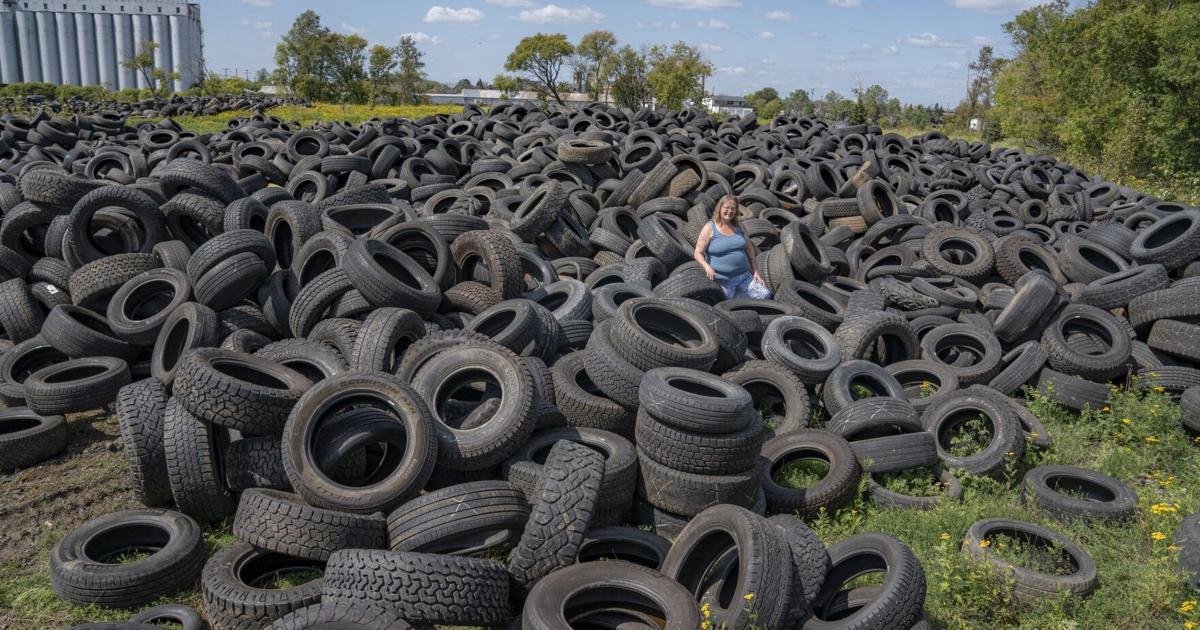
Ontario’s tire recycling industry — created in the years following the disastrous Hagersville tire fire in 1990 — is now struggling amid the Ontario government’s 2025 reduction in recycling targets and the subsequent piling up of tires across the province.
And at least one person in the industry fears the worst.
“Lots of these (tire) businesses have yards stacked with tires,” said Janice Woodbeck, a Thunder Bay hauler who owns Load Queen Services, servicing tire businesses in towns such as Dryden, Atikokan and Fort Frances. “With the wildfires, especially in northwestern Ontario, if they come close to these towns, once the tires go up, there’s going to be no putting them out.”
Thirty six years ago, the Hagersville fire burned for 17 days, forcing the evacuation of hundreds of nearby residents in the tiny village southwest of Brantford, in one of Canada’s worst environmental disasters.
In the ensuing years, the former Ontario Tire Stewardship (OTS) program ran recycling like clockwork, with tire haulers regularly picking up used tires from garages and dealers and driving them to recycling facilities where they are ground up into crumb.
Tire recycling is now run by producer responsibility organizations, or PROS, who essentially work for tire producers to ensure the companies meet their recycling obligations according to Ontario’s regulations.
Ford government lowered tire recycling target to 65%
And last year the Ford government lowered its tire recycling target to 65 per cent from 85 per cent, without fully explaining why. Emailed questions sent to the environment ministry by the Star were unanswered as of press time.
Woodbeck says she was recently told by the environment ministry to stop picking up tires from garages and retailers after she notified them that she had a stockpile of 20,000 on her property awaiting recycling — far beyond the 5,000 limit without getting approval from the province.
Beyond tires piling up across the province, numerous hauling companies say they’ve suffered a substantial loss of income and have had to layoff staff.
Recycling costs are borne by consumers, who pay an eco fee built into the price of a tire or added at checkout.
Meanwhile, some haulers say the tire backlog that has occurred under the current PRO-led recycling system has only made things worse.
Haulers say they can’t take tires to a recycler to be processed unless they can get an appointment through a PRO, a drastic change, they say, from when recycling was managed by OTS, which haulers said never interfered in the flow of tires.
“All these tires are paid to be recycled at time of purchase,” says Woodbeck’s partner, Charles MacLaurin, “and here we are with an epic stockpile of material.”
MacLaurin has worked in the industry since he was 16, from a time when there were no tire recycling obligations in Ontario, to the era when OTS managed recycling beginning in 2009, and now to a system run by competitive PROs.
“OTS was not perfect,” said MacLaurin, “but they never stopped collection because a target was met.”
The Ontario ministry of environment has said that it is trying to fix the problem and has proposed changes to recycling legislation to keep tires moving, such as a requirement that would ensure the timely pick up and processing of tires during busy tire changeover seasons.
The proposed regulations do not include increasing the recycling target.
Canada’s competition watchdog says those changes may not be enough.
In a submission to the province, the Competition Bureau said it has heard concerns that Ontario’s recycling system is not as competitive as it should be. It also said that more oversight may be needed from the Resource Productivity and Recovery Authority (RPRA) — which oversees recycling in Ontario — to fix the problem.
Ontario has one large PRO, eTracks started by Canada’s rubber industry, which manages recycling for about 70 per cent of Ontario’s tire producers. The other 30 per cent is split among PROs such as Ryse Solutions, YESS and Mobius PRO.
In the meantime, the RPRA said it continues to remind tire producers and their PROs to collect and process used tires in a timely manner, said Wilson Lee, RPRA’s chief of programs and public affairs, in an email.
Lowered recycling target leaves tires piling up
The problem, though, is that there are thousands more garages and tire dealers in Ontario with used tires that PROs don’t need anymore to meet the lowered recycling target.
Wilson said the government will decide whether to enact the amendments it has proposed by the end of the summer.
For many haulers, those changes may come too late.
Woodbeck has laid off five staff and sunk $100,000 of her own money into her business which she can’t recoup until she can take the tires on her property to a recycler and gets paid for her work.
Her local MPP is meeting with the environment ministry this week to request environmental compliance approval to allow her to legally store more than 5,000 tires on her land.
“We’ve used a lot of personal money to keep things going,” said Woodbeck. “That pretty much came to an end because I can’t afford to invest anymore.”
Alan Fleming, a veteran hauler working near Hamilton, echo’s Woodbeck’s concerns.
Fleming has hundreds of tires sitting on his rented property awaiting processing. And when he goes to a collection site now for a pickup, he says, there are 400 tires, instead of the typical 80 or so because of the backlog.
Some tire haulers say only cash can fix environmental disaster
“They’re full of water,” said Fleming. “So now I’ve got to handle every tire with extra weight in it, and do the physical work to get all the water out,” said Fleming. “That’s becoming more normal now. Now, let’s go to winter time, where it is even more work.”
Some haulers think Ontario’s tire crisis is an environmental catastrophe that can only be fixed with an influx of cash.
And some believe that a $30 million surplus from OTS — money amassed from consumer fees that was caught up in a year’s long tax dispute with the Canada Revenue Agency — should be used to clean up the mess.
The money is currently slated to be split between tire producers, according to a directive from the environment ministry.
“It’s a windfall for producers to get that back,” said a tire hauler who asked for anonymity to protect his hauling business. “Where’s the money going to come from to clean this up now?”