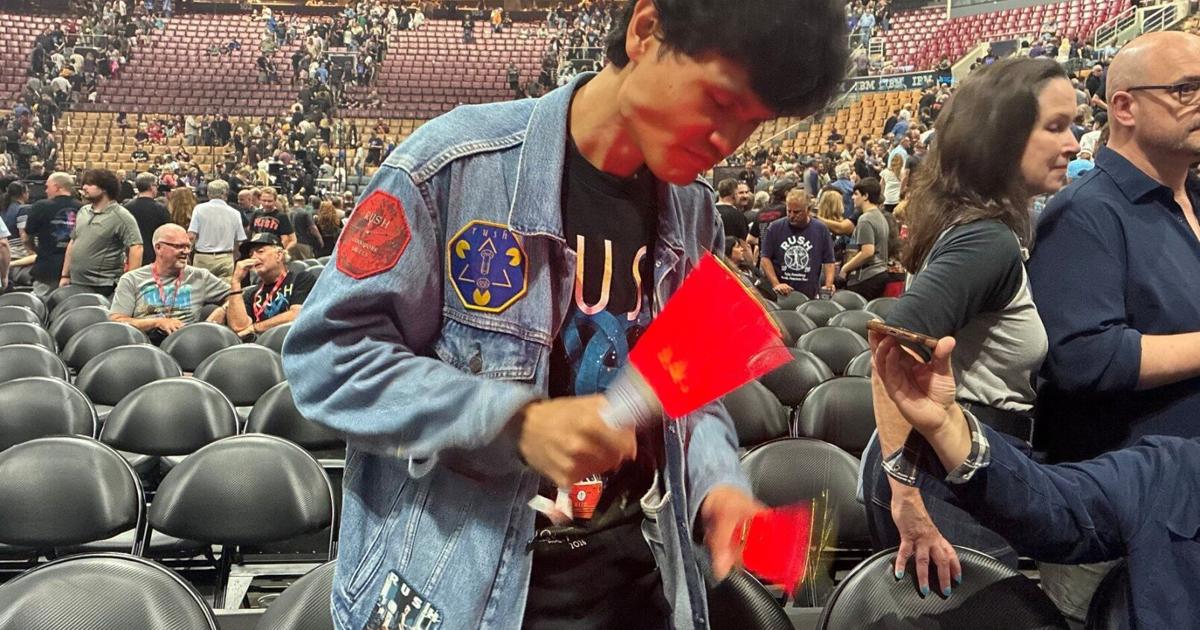
When it came to seeing Rush in their hometown, Singapore-based Henry Osman was willing to spend whatever it took.
The 32-year-old visual media producer had been waiting most of his adult life to witness Geddy Lee and Alex Lifeson back on stage together. So when the prog-rock band announced its Toronto shows, he planned a week-long trip across the world — spending a couple of thousand dollars on airfare and a hotel, about $1,600 on concert tickets and another $1,000 on Rush merchandise.
He also brought his father along for the overseas experience, venturing to St. Catharines, the childhood home of late drummer Neil Peart.
“My bank account is crying now,” Osman said outside Scotiabank Arena after the last night of the four Rush concerts he attended.
“But it’s OK. Money you can get back, time you can’t. And I wouldn’t trade this for anything else in the world.”
Osman is part of a growing number of music fans turning concerts into their big vacations. Once a domain for die-hards, concert tourism is increasingly becoming an adventure even casual fans partake in, planning entire trips around the artists they’ve always wanted to see live. Toronto is increasingly positioning itself as a destination for those travellers.
This weekend alone, K-pop phenomenon BTS is playing two sold-out shows at the 50,000-capacity Rogers Stadium, while pop star Ed Sheeran is performing three at Rogers Centre, a sports stadium that can accommodate about 40,000 people. Neither act is stopping in other Canadian cities and their shows are expected to draw countless visitors from outside Toronto, boosting spending on hotel rooms, restaurants and tourist attractions.
“They’re buying dinners and lunches, they’re buying merchandise,” said Megan Lynch, senior manager at consulting firm Nordicity.
“That’s why concerts are so important, because they’re bringing in so many new people to the city … it’s spending that would not be happening already.”
Earlier this year, Live Nation commissioned Nordicity to conduct a study that found the concert promoter’s new venue, Rogers Stadium, generated more than $500 million in economic activity during its inaugural 2025 season. That figure included $388 million in gross domestic product, or goods and services added to the economy that included its construction, and $115 million in federal and provincial tax revenue.
Andrew Weir, president and chief executive officer of marketing agency Destination Toronto, said the city wants to capture more of the music tourism dollars. More often, people are choosing where to travel based on music events, he said, buying a Toronto concert ticket first and then planning a multi-day stay around it.
“Someone might not have come here if not for Oasis or BTS,” Weir added. “But once they’re here, the economic touch of that trip goes so much deeper.”
Judy McClelland, a court clerk from Kingston, Ont., is one of those music fans who’s spending more on her favourite artist these days.
Last summer, she became a dedicated Sheeran fan after hearing his song on the “F1” film soundtrack and promptly booked a last-minute flight to Belgium to see him. Now she has tickets for all three of his Toronto shows. The seats cost about $450 each, and she booked a nearby hotel suite for three nights at around $700 per night.
“I’m just about to retire, so I think it’s time to do something for myself,” she said. “It will be my vacation for this year.”
But how much of that spending is new?
But quantifiable proof that concert tourism is consistently powering the Toronto economy is limited.
While Destination Toronto says Taylor Swift’s six nights at Rogers Centre in late 2024 generated an estimated $282 million in economic impact, that kind of impact is difficult to replicate. Swift’s Toronto run stretched over 10 days and attracted an unusually large number of visitors.
But the Greater Toronto Hotel Association said it has seen recent evidence of how other massive stadium shows may be drawing more music tourists. During Bruno Mars’ five concerts at Rogers Stadium in May, local hotel and short-term rental occupancy was up seven per cent during the week of most of his shows, which could be at least partly attributed to the pop singer’s fans.
“It is not just concerts – May is a strong month with business events, the Jays and the city is alive with great activity,” said the hotel association’s president Sara Anghel.
Economists also caution against getting too confident that concerts are a significant net positive.
Rachel Battaglia of RBC Economics points out that not all concertgoers are created equally and data tracking international spending in Canada is harder to come by.
David Soberman, a marketing professor at the University of Toronto’s Rotman School of Management, said the potential benefits have yet to play out for Rogers Stadium, and the new venue’s seasonality and its plan to be torn down after five years, complicate those factors.
“The higher the actual utilization of that stadium, the more likely you’re going to see a build-up of cafes, restaurants and maybe even hotels in that area,” he said.
“We haven’t yet seen that because the stadium was, frankly, put up very quickly.”
Those uncertainties haven’t slowed plans to expand other concert venues in the city.
At the end of next summer, RBC Amphitheatre will temporarily close to undergo a multi-year renovation led by its owner, Live Nation Canada. The venue’s summer capacity will expand by several thousand seats, while weatherproofing the space will allow for a 9,000-seat indoor venue in winter. A partial reopening is set for 2029, with full-year operations planned for 2030.
With more shows, the revamped venue could more frequently attract fans like Nova Scotia resident Jennifer Peeples, who’s flying to Toronto twice over the coming month to see Sheeran and country star Zach Bryan. Peeples said she travels often with her husband to live music destinations as a shared opportunity to disconnect from her grueling shift work as a nurse. She guesses the Sheeran show will cost them about $2,500, helped by savings on a discounted flight.
“It’s a little impulsive trip,” she said. “But we got a great deal.”