Quick, think of the artist who best defined 2010s popular music.
Did you picture Adele? Taylor Swift? Drake? Stratford’s own Justin Bieber?
Ed Sheeran, 35, could easily be named among those titans of industry. The affable Brit has sold more than 150 million records filled with catchy, docile hits, and written songs for the likes of U.K. boy band One Direction and K-pop superstars BTS.
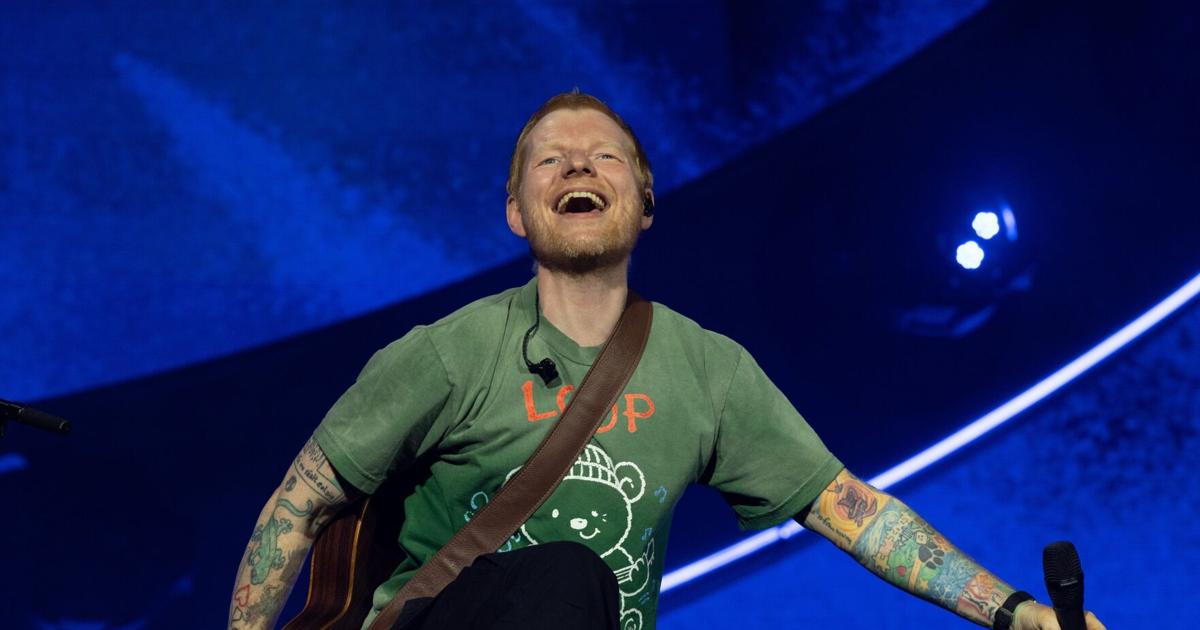
Eight albums and six global headlining tour cycles in, Sheeran’s looper-based stage act is not as novel as when he first burst onto the scene as an earnest, slightly scruffy singer-songwriter. But in his first of three shows at Rogers Centre on Thursday night, part of the 59-date “Loop Tour,” Sheeran demonstrated his enduring ability to entertain.
Despite the trappings of the massive stadium, there’s little pretence to his show. Most of the nearly three-hour performance is Sheeran and Sheeran alone, with only a handful of songs featuring the slinky instrumentals of the five-piece Irish folk band Beoga.
As Sheeran explained, all of it was performed live onstage without any backing tracks, utilizing a multi-pedal loop station that was occasionally flashed onscreen to pull back the curtain on the looping, building arrangements. He thumped the bridge of his guitar to mimic a bass drum, beatboxed to add to the backbeat and adorned certain melodies with a keyboard.
“It’s made live, on the spot, controlled by my feet — and in the end, it’s deleted,” Sheeran said in his opening monologue, in which he demonstrated the technology. “It won’t be the same tomorrow.”
In a testament to both his internal metronome and the cleverness of the format, a chunk of keystone tracks truly popped when constructed from the ground up, including “I See Fire,” “Castle on the Hill” and “Don’t.”
Others didn’t quite flourish, either because of unevenly booming acoustics (“Sapphire”), frenetic verses that got lost in the shuffle (“You Need Me, I Don’t Need You”) or one too many loops lining the mix (“Azizam”).
Sheeran pulled back on the spectacle when the moment warranted it. The swooning, gentle “Perfect” and the bluesy “Thinking Out Loud” were among the oh-so-romantic tunes that brought out the flashlights for a shimmering sea of song. It’s in those moments where his voice, emotive, controlled and smooth, shines through.
Elsewhere, he encouraged the crowd to take synchronized flash photos to make the night “sparkle” (during “Camera”), and crossed a retractable bridge that connected the modest main stage and the round, well utilized second stage.
With a set list this packed — a hefty 28 songs in all, not including the five-in-one medley of songs that Sheeran wrote to be performed by other artists — there’s little missing. The R&B-tinged “Sing” and the snappy “Runaway,” both from his sophomore studio album, were the only real tracks of note left out.
To make up for those omissions, Sheeran took requests from fans, who could scan a QR code as they filed into the stadium and suggest songs they wanted to hear. In the first of three such Torontonian exercises, he chose a raw nautical metaphor for depression (“Boat”), an ode to a dead chicken (“Little Bird”) and a choral meditation on a late industry collaborator (“Visiting Hours”).
In short, if you came to hear your favourite Ed Sheeran songs, you got what you paid for, plus a half-spontaneous selection of fan favourites.
Sheeran is not the dominating cultural force he once was; his songs are not nearly as frequently heard on the radio, nor is his name as synonymous with superstardom as it used to be.
In fact, he hinted at taking an extended hiatus from life on the road, suggesting that he’s “not gonna tour for a while” once this one comes to a close.
But for now, he can still fill a stadium and sing a slew of amenable, wholly inoffensive tracks with a mix of vigour and his trademark sheepish energy, and for that he deserves considerable credit.
Hayden Godfrey is a Toronto-based contributor to the Star’s Culture section, covering rock and pop music.