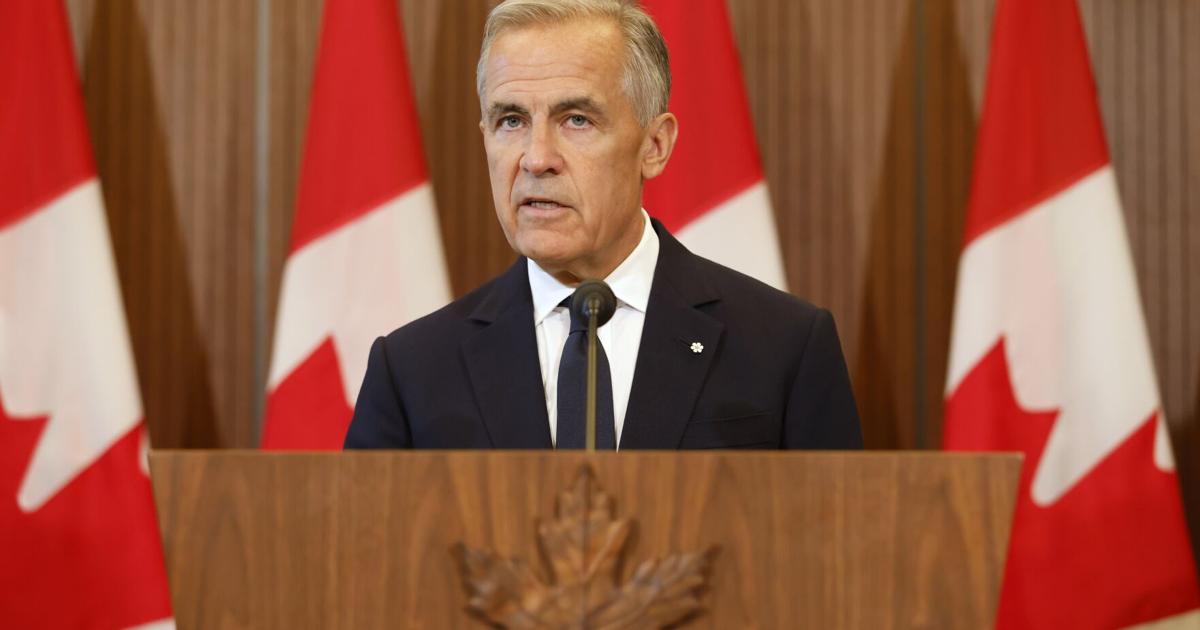
OTTAWA—The United States tried to undermine Canadian sovereignty with last-minute demands attacking Canada’s auto sector, cultural protections and the ability to make trade deals with other countries, Prime Minister Mark Carney said Saturday, describing a last-minute “power play” from the Donald Trump administration that has left trade talks in limbo.
Canada, Carney told reporters in Ottawa, is now back in a trade war with the U.S. that “was not our choice” but comes after “good faith” efforts were met with the offer of a “bad deal.”
The Carney government is preparing “dollar for dollar” retaliation for after Labour Day in response to the Americans’ new 50 per cent tariffs on $28 billion in Canadian exports, which went into force after Canada walked away from trade talks late Friday.
It’s an outcome that “certainly isn’t good news” for the Canada-U.S.-Mexico agreement that covers the majority of Canadian trade with America and is due for a renegotiation this year, Carney said.
This is a new attack on Canada, he added at the end of a defiant news conference. “You’re at war when you get attacked.”
Lamenting how close Canada and the U.S. were to a deal, Carney said the gap between partnership and competition, “unfortunately, has remained too wide in recent days,” which forced his decision to end discussions.
U.S. President Donald Trump’s negotiating team wanted “unacceptable” restrictions on Canada’s ability to execute other trade deals, Carney explained, listing a suite of last-minute demands he said Canada could not accept. Those included trying to exempt medium- and heavy-duty vehicles — like the Ford trucks set to be produced in Oakville this year — from auto tariff relief, and demands that Canada drop French-language online content rules.
“We cannot accept what they’ve offered, and we cannot give what we’ve asked,” he told reporters, after describing the demands as “unfair, uneconomic” and saying they “called into question the reliability of any deal.”
Carney’s decision met with a chorus of support
His decision to pull out of trade talks with the Trump administration, which comes after he faced political pressure to land a deal with few concessions, was met with a largely united show of defiance from premiers and industry leaders.
The collapse of talks late Friday ushers in a sharp escalation in bruising U.S. tariffs that Carney has vowed to push back against with a “dollar for dollar” retaliation, for which he said more details will soon be made public.
A 50 per cent U.S. tariff on $28 billion worth of Canadian goods took effect at midnight — with business leaders warning about the pain ahead for Canada’s economy and Carney promising relief measures to come.
According to federal government analysis cited to the Star, 56,000 jobs are directly affected by that new round of tariffs.
Speaking to reporters on Saturday, Premier Doug Ford said he didn’t like the deal with the U.S. that was on the table earlier this week, and he was glad Carney didn’t sign what was offered. “We never started this fight, but I can assure you, we’re going to win this fight,” the premier said in Toronto before a virtual first ministers meeting on the trade war.
“We have to use every tool in our toolbox,” Ford said, making an apparent reference to his suggestion that Canada leverage its exports of electricity and critical minerals to the U.S. The premier, in a letter to Carney earlier this week that his office shared Saturday, also suggested hitting Trump-supporting states harder.
Carney on Saturday said Canada’s response will be “concentrated” in sectors like “steel, dairy, appliances, agricultural equipment, pulp and paper,’ and electronics, as well as those hit by the existing sectoral levies and the new wave of 50 per cent tariffs.
He did not rule out Ford’s suggestion of using energy and critical minerals as leverage, only saying, “We’ll see.”
“Canada fuels American growth, supplying 99 percent of their natural gas imports, 85 percent of their electricity imports, 60 percent of their crude oil imports,” Carney said. “I don’t think they want us to stop sending any of that energy.”
Ford said, “Donald Trump is trying to inflict pain on every Canadian,” and we should “inflict pain right back until he realizes that we’re his number one customer in the world.”
“President Trump, he can’t be trusted,” Ford added. “Simple as that.”
B.C. Premier David Eby, Nova Scotia’s Tim Houston and Quebec’s Christine Fréchette also blasted the U.S. Saturday, offering their support for the prime minister’s move.
“It’s the definition of an abusive relationship,” said Eby, warning the U.S. that there’s no shortage of other markets for Canadian products, including B.C.’s softwood lumber.
“We’ve got lots of other dance partners out there.”
Meanwhile, Alberta Premier Danielle Smith broke ranks, saying she was “deeply disappointed” a deal could not be reached and urging Ottawa to “restart negotiations as soon as possible.”
“Alberta has always advocated for a tariff-free relationship, and will continue to do so,” Smith said. “No one benefits from a trade war. Tariffs and counter-tariffs hurt businesses, workers and families on both sides of the border, while weakening one of the most important economic and security relationships in the world.”
Conservative Leader Pierre Poilievre said in a statement that he was “disappointed that the United States has chosen to impose further unjustified tariffs on Canada” that “threaten the jobs and livelihoods of families right across our country.”
“Canadians must stand united to defend our country against these unfair attacks on our jobs and businesses,” he wrote. “Canada cannot accept one-sided tariffs that will deindustrialize our country. Nor can we accept a bad deal.”
It was a stark difference in tone from his Ontario MP Jamil Jivani, a close friend of U.S. Vice-President JD Vance. Jivani said in a social media post that Carney and Ford have from the beginning “put their political self-interests ahead of Canadian workers.”
In an interview with the Star, he accused the two leaders of spending “a lot more time stoking anti-American sentiment” rather than building relationships with their counterparts.
“I feel like the relationship side of this wasn’t really being worked on the way it should have been.”
U.S. blames Canada as industry groups brace for impact
By Saturday afternoon, Trump, who had expressed optimism about a deal hours before talks collapsed, had not yet commented on the breakdown or Carney’s response.
In a Saturday morning interview with Fox News, U.S. trade negotiator Jamieson Greer said “it’s hard to say” when talks with Canada will resume, but “we don’t have new talks planned with the Canadians” at the moment.
“We’re moving forward with measures that respond to Canadian retaliation,” he said. “After a year of that retaliation, we’ve said ‘enough,’ and so we’ve taken countermeasures.”
Canada “always had the best deal, and they still would have an even better deal, but they didn’t want that,” Greer said.
The head of the association representing Canada’s aluminum producers on Saturday blamed U.S. Commerce Secretary Howard Lutnick for the last-minute breakdown in the talks, telling the Star the tough-talking former finance executive had tried to reopen several already-settled parts of the tentative agreement.
“The whole deal soured up when Lutnick got into the room and started relitigating,” said Jean Simard, CEO of the Aluminum Association of Canada and a member of the federal Canada-U.S. advisory council.
Flavio Volpe, head of Canada’s Automotive Parts Manufacturers’ Association, agreed.
“I don’t believe in coincidences,” Volpe told the Star. “Howard Lutnick entered the room and the breathing room got tighter on automotive.”
He said the U.S. offered a tariff reduction in autos from 25 to 15 per cent, but tried to exclude medium and heavy truck production later in the week, which would have hit Ford’s investment in Oakville, as well as GM’s Oshawa assembly plant — “explicitly targeting two of the seven automotive assembly plants in Canada.’”
Asked whether Lutnick scuttled the talks in the final days, Carney would only say the Canadian team was united, but “you cannot say that about the United States administration.”
Candace Laing, the CEO of the Canadian Chamber of Commerce, called the new 50 per cent tariffs “a body blow to North American competitiveness in this self-defeating trade saga.”
“A whopping, non-absorbable tariff is not sustainable or viable for business,” Laing said in a written statement.
But Unifor national president Lana Payne said that accepting the U.S. demands could have set a dangerous precedent with the renegotiation of CUSMA still looming.
“Would we be in a place where we had to give up too much leverage at the first table and then the U.S. would be demanding more concessions at the second?” Payne told reporters Saturday.
“It was roll over, or draw a line in the sand, and we chose to draw a line in the sand.”
With files from Tonda MacCharles, Stephanie Taylor and Robert Benzie.
Error! Sorry, there was an error processing your request.
There was a problem with the recaptcha. Please try again.
You may unsubscribe at any time. By signing up, you agree to our terms of use and privacy policy. This site is protected by reCAPTCHA and the Google privacy policy and terms of service apply.
Want more of the latest from us? Sign up for more at our newsletter page.