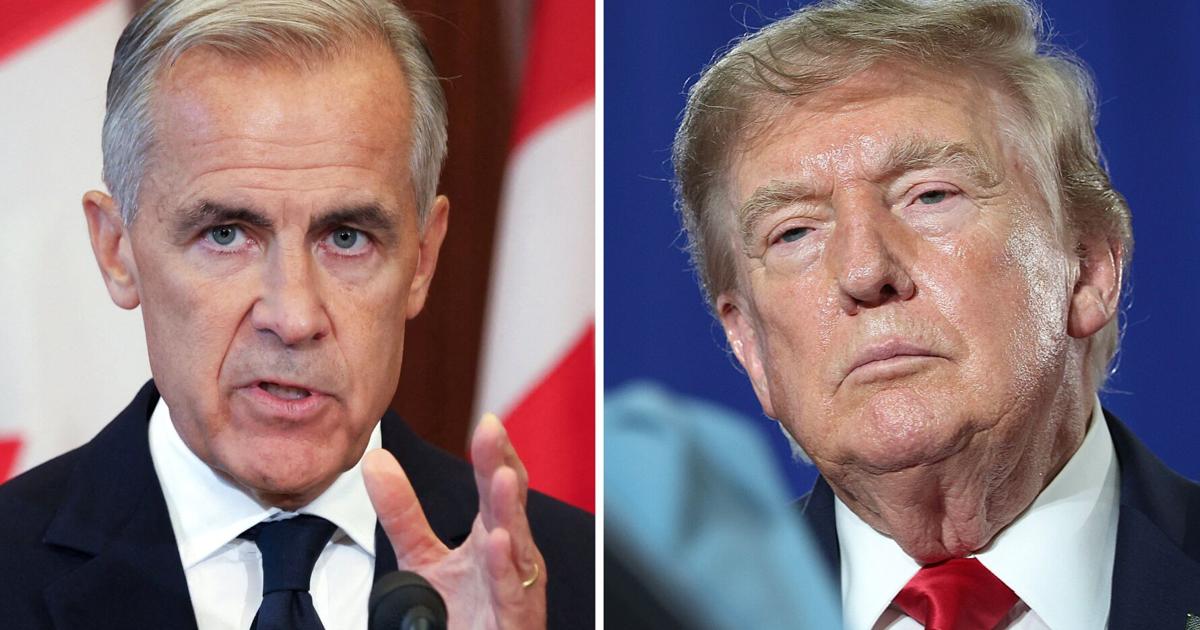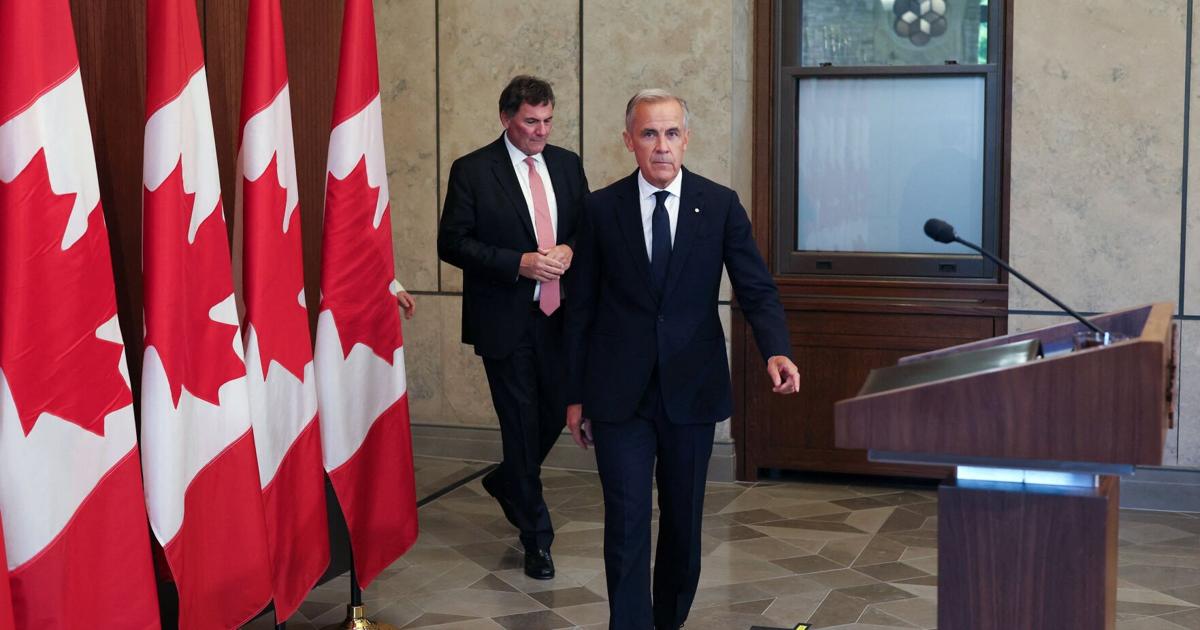
Prime Minister Mark Carney says he has suspended trade negotiations with the United States, meaning new 50 per cent tariffs that U.S. President Donald Trump had threatened to impose at midnight on $28 billion worth of Canadian goods will come into effect. This file is no longer updating.
Updated 3 hrs ago
Donald Trump’s negotiators saved Canada from making a big mistake


Commerce Secretary Howard Lutnick speaks during an event with U.S. President Donald Trump in the Oval Office of the White House, Thursday, Aug. 6, 2026, in Washington.
Alex Brandon/The Associated Press file photo
Canadians may owe Howard Lutnick a debt of gratitude.
It was a final-hours intervention by the U.S. Commerce Secretary, who’s peculiarly belligerent toward Canada even by the standards of Donald Trump’s White House, which seemed to coincide with new American demands that scuppered the tentative trade agreement between the two countries.
If so, he did Canada a service by reminding Mark Carney and his negotiators who they were dealing with — and saving us from a bad deal that probably would’ve only looked worse down the road.
Before things went completely off the rails on Friday, there were already plenty of indications — including from industry sources who were tracking the talks — that Ottawa was on the verge of giving up far too much for what it would get in return.
Trump appeared to have successfully moved the goalposts with his threat of new 50 per cent tariffs on a range of products, leaving Canada so determined to avoid those that it was willing to live with less relief from his existing tariffs than it had previously demanded. Modest cuts to the levies on our automotive and steel exports, among others, would have locked in rates still too high for those industries to be viable in the long run.
Meanwhile, Canada would’ve had to give up what leverage it had, including both counter-tariffs and the provincial bans on U.S. booze that have gotten under Trump’s skin. Plus, we appeared poised to scrap Buy Canadian procurement policies, giving U.S. companies relatively unfettered access to government contracts here, even as Canadian access to the U.S. market remained restricted.
And then there were whatever other concessions might have impeded Canadian sovereignty, which seemed to apply at least to our leeway to set our own technology policies.
It’s wild that the Americans seemingly weren’t willing to live with that package, which would’ve given Trump reasonable cause to declare victory, and instead wanted additional concessions that even a Canadian side plainly eager for a deal couldn’t abide. Details about what those demands were will probably leak out over the coming days, but Carney’s slightly cryptic descriptions of them on Saturday — including even less relief than expected for the auto industry, and even more importantly, limits on our trade dealings with other nations and impediments to our cultural and linguistic sovereignty — made them sound absolutely toxic.
But the most striking and telling lines, in both Carney’s late-night statement when the talks fell apart and in his Saturday press conference, were less about the specific demands than about the fact that signing this deal would inevitably mean more of them to come.
Or, as the Prime Minister put it, apropos dealing with this White House: “We recognized that sometimes its signature was written in pencil.”
This seemed a belated realization, especially given that we just went through something similar with the Gordie Howe International Bridge. But it was an absolutely crucial one.
The worst thing about the agreement, as it was taking shape this week, wasn’t the concessions themselves — it was what the willingness to make them would signal to Trump and the people around him.
This is a president who (egged on by people like Lutnick, who see some sort of advantage for themselves in conflict) will try to exploit any sign of weakness. And that’s exactly what Canada seemed to be showing this past week.
There was desperation in the Canadian willingness to live with all sorts of unfavourable conditions in order to avoid the newest round of tariffs, which seemed to suggest we weren’t strong enough to stick to our guns — to live with no deal, rather than a bad one. It all but invited more threats to our sovereignty, around natural resources or tech or who knows what else, within a matter of months.
In a span of 12 hours, first with the initial statement and then with Carney’s coolly defiant press conference (both of which promised dollar-for-dollar counter-tariffs), that impression was mercifully done away with.
That resolution isn’t something to celebrate, exactly. Not when several of our biggest industries remain stuck with tariffs that will discourage investments for the foreseeable future, and especially not when many smaller Canadian companies — makers of electronics, furniture, clothing, etc. — will now face 50 per cent tariffs on roughly $28 billion of annual U.S. exports.
The nice thing about our federal government being in relatively good fiscal shape, especially relative to the U.S., is that it has the capacity to provide relief that should help keep those companies afloat.
Still, there will be a lot of pain, and even more uncertainty, and it’ll be felt in communities across the country where these businesses are part of the fabric. And who knows how this will escalate.
But if not happy, it’s warranted to at least feel relieved today.
While we may never go back to our old relationship with the U.S., we also have less than two-and-a-half years of this Trump term left. And as much unpleasantness as that may involve, it’s not worth giving up long-term control of our destiny for temporary and partial reprieves.
Thank goodness Trump’s White House decided to push its luck before it was too late.

Updated 1 hr ago

Business leaders warn U.S.-Canada trade war will kill businesses, raise risk of retaliatory ‘hell’

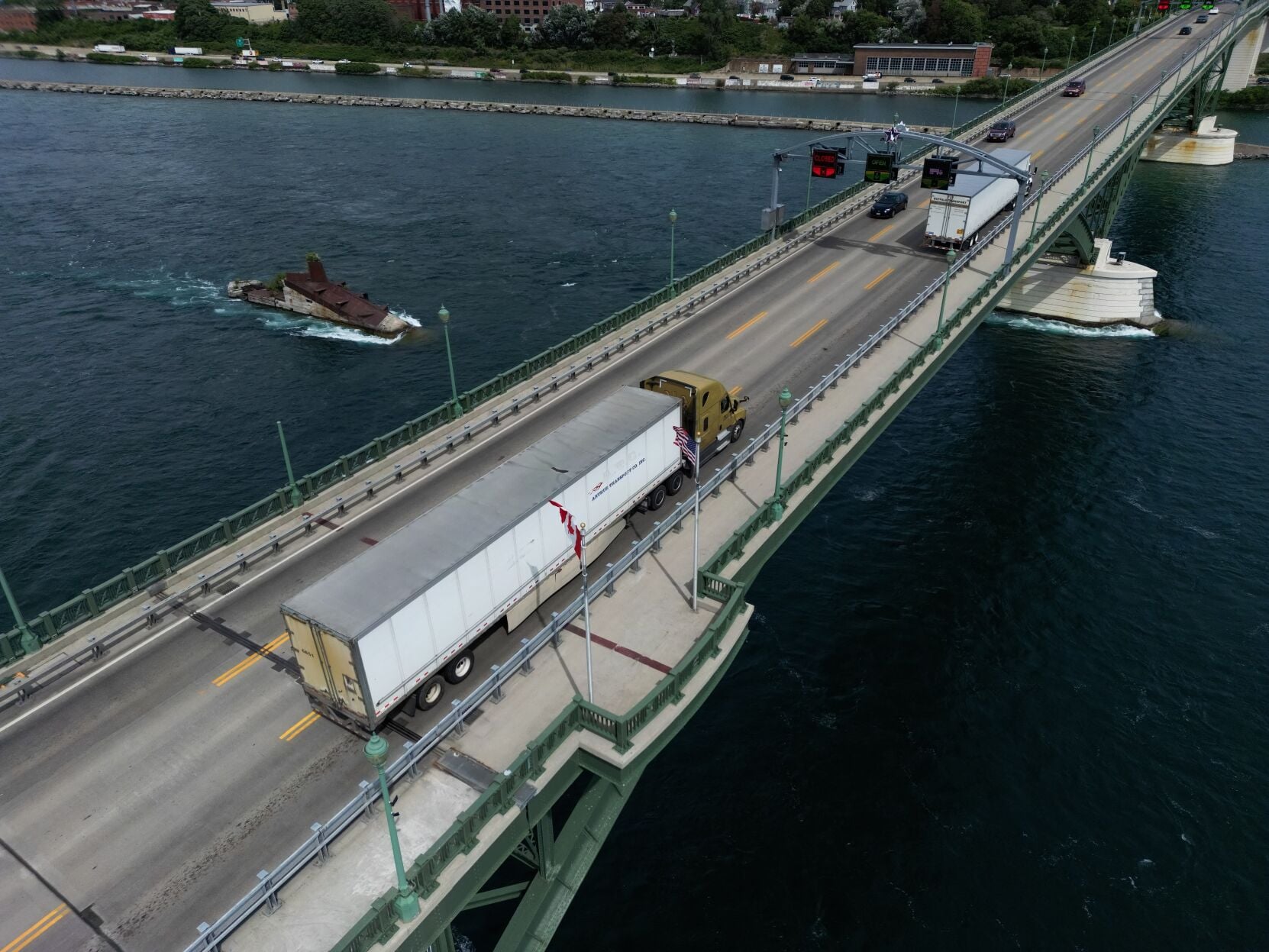
Trucks passing over the border at the Peace Bridge, one of the many border crossings that will be affected by the collapse of U.S.-Canada trade talks.
Cole Burston/AFP via Getty Images
Business organizations on both sides of the border reacted with a mixture of concern and disappointment after Canada and the U.S. failed to reach a trade deal late Friday night and a new 50 per cent tariff kicked in on a wide range of Canadian exports.
They also warned the Canadian government needs to be careful with retaliatory measures to make sure it doesn’t cause even more economic damage.
Dan Kelly, head of the Canadian Federation of Independent Business, said the new tariff will be a death knell for many small Canadian exporters.
“This is deeply troubling for thousands of small Canadian exporters. A full 40 per cent of small exporters sell items on the new … list of items facing 50 per cent tariffs,” Kelly wrote on X. “Many CFIB members have said this will end their U.S. sales and some have reported this will kill their businesses.
In an interview, Kelly urged the Canadian government to be careful with its retaliatory measures, so they don’t end up hurting small Canadian businesses even more.
“I do want to remind everybody that retaliatory tariffs are their own hell,” said Kelly.
Talks collapsed late Friday after Prime Minister Mark Carney blamed “last-minute changes” made by the U.S. to its proposed terms, saying they were “unfair, uneconomic, and called into question the reliability of any deal.”
Candace Laing, the CEO of the Canadian Chamber of Commerce, called on the Canadian government to be decisive but precise in its retaliation.
“If Canada responds, it should do so with a strong hand — surgically, strategically and in close consultation with business. We should be careful not to inflict more economic damage on ourselves in the process,” said Laing.
The U.S. Chamber of Commerce called on the two sides to get back to the bargaining table.
“We urge U.S. and Canadian negotiators to return to the table and finish the job — a trade deal that addresses U.S. tariffs and Canadian retaliation. The alternative is an escalating cycle of tariffs that will raise costs and impede economic growth,” said Neil Herrington, a senior vice president at the U.S. Chamber of Commerce.
Added pain for the alcohol industry, lumber, agriculture and more
For Canadian spirits producers now subject to a 50 per cent U.S. tariff, the collapse of the talks came as a bitter disappointment.
“Canada’s spirits industry produces $2 billion in spirits a year, and a billion of that is sold in the U.S.,” said Cal Bricker, CEO of Spirits Canada. “We employ 48,000 people in this country who will be impacted by these actions.”
Bricker argued the federal and provincial governments should lower alcohol taxes to help cushion the blow for producers.
American booze producers, who had been hoping a deal would get provincial liquor monopolies to start restocking their products, decried the breakdown.
“It is unfortunate that the Canadian provinces’ continued refusal to return U.S. spirits products to store shelves over the past year and a half has contributed to this outcome,” said Chris Swonger, president of the Distilled Spirits Council of the U.S. “We encourage policymakers on both sides of the border to pursue a negotiated solution.”
The Ontario Chamber of Commerce backed Carney’s decision to call Canadian negotiators home.
“Either way, Friday was destined to be a bad day for North American businesses. Behind one door, we had the high costs of permanent tariffs, making a mockery of CUSMA, and a truce that would only last until the U.S. president’s next tantrum. Behind the other, we had the madness of a continuing trade war,” said OCC CEO Daniel Tisch.
Canada’s lumber industry now faces a 50 per cent tariff on several products, as well as an existing 10 per cent duty across the board, and ongoing U.S. legal challenges.
“While the outcome was not surprising, it remains deeply concerning,” said Ian Dunn, CEO of the Ontario Forest Industries Association. “The North American forest product sector continues to struggle against fierce competition from China, Central and South America, and other international jurisdictions. Applying tariff after tariff on a highly integrated North American industry will only accelerate capital flight and deter regional investment.”
The Canadian Federation of Agriculture said the escalating trade dispute will have a devastating impact on both countries’ farmers and food supply.
“The breakdown in negotiations and escalation of new tariffs create uncertainty at a time when farmers are already facing significant challenges, including rising input costs, market volatility, and increasingly unpredictable weather,” said CFA president Keith Currie.
The U.S.-based Computer and Communication Industry Association, which had lobbied U.S. negotiators to help get rid of Canada’s Online Streaming Act and Online News Act, called on both countries to return to the table.
“We are disappointed that the United States and Canada were unable to reach an agreement before the deadline. Additional tariffs risk imposing significant costs on businesses and consumers on both sides of the border, underscoring the need for both governments to return to the negotiating table,” said CCIA vice president Jonathan McHale.
While Canada had reportedly agreed to either change or eliminate the Online Streaming and Online News Act, the head of the association representing TV, Film and online production companies praised the federal government’s decision to walk away.
“The federal government stood up for Canada by refusing to agree to an inequitable trade deal. We look forward to working with the government to ensure that, whatever happens next, the Online Streaming Act, a key pillar of Canadian cultural and digital sovereignty, is defended,” said Reynolds Mastin, CEO of the Canadian Media Producers Association.
Updated 12 mins ago
Last-second U.S. demands would have restricted Canadian deals with other nations, PM explains
flag sponsored: false
article_type:
pubinfo.section:
cms.site.custom.site_domain : thestar.com
sWebsitePrimaryPublication : publications/toronto_star
bHasMigratedAvatar : false
firstAuthor.avatar :

“This is a new attack on Canada.”
PATRICK DOYLE THE CANADIAN PRESS
OTTAWA—The United States tried to undermine Canadian sovereignty with last-minute demands attacking Canada’s auto sector, cultural protections and the ability to make trade deals with other countries, Prime Minister Mark Carney said Saturday, describing a “power play” from the Donald Trump administration that has left trade talks in limbo.
Canada, Carney told reporters in Ottawa, is now back in a trade war with the U.S. that “was not our choice” but comes after “good faith” efforts were met with the offer of a “bad deal.”
The Carney government is preparing “dollar for dollar” retaliation for after Labour Day in response to the Americans’ new 50 per cent tariffs on $28 billion in Canadian exports, which went into force after Canada walked away from trade talks late Friday.
It’s an outcome that “certainly isn’t good news” for the Canada-U.S.-Mexico agreement that covers the majority of Canadian trade with America and is due for a renegotiation this year, Carney said.
This is a new attack on Canada, he added at the end of a defiant news conference. “You’re at war when you get attacked.”
Lamenting how close Canada and the U.S. were to a deal, Carney said the gap between partnership and competition, “unfortunately, has remained too wide in recent days,” which forced his decision to end discussions.
U.S. President Donald Trump’s negotiating team wanted “unacceptable” restrictions on Canada’s ability to execute other trade deals, Carney explained, listing a suite of last-minute demands he said Canada could not accept. Those included trying to exempt medium- and heavy-duty vehicles — like the Ford trucks set to be produced in Oakville this year — from auto tariff relief, and demands that Canada drop French-language online content rules.
“We cannot accept what they’ve offered, and we cannot give what they’ve asked,” he told reporters, after describing the demands as “unfair, uneconomic” and saying they “called into question the reliability of any deal.”
Carney’s decision met with a chorus of support
His decision to pull out of trade talks with the Trump administration, which comes after he faced political pressure to land a deal with few concessions, was met with a largely united show of defiance from premiers and industry leaders.
The collapse of talks late Friday ushers in a sharp escalation in bruising U.S. tariffs that Carney has vowed to push back against with a “dollar for dollar” retaliation, for which he said more details will soon be made public.
A 50 per cent U.S. tariff on $28 billion worth of Canadian goods took effect at midnight — with business leaders warning about the pain ahead for Canada’s economy and Carney promising relief measures to come.
According to federal government analysis cited to the Star, 56,000 jobs are directly affected by that new round of tariffs.
Speaking to reporters on Saturday, Premier Doug Ford said he didn’t like the deal with the U.S. that was on the table earlier this week, and he was glad Carney didn’t sign what was offered. “We never started this fight, but I can assure you, we’re going to win this fight,” the premier said in Toronto before a virtual first ministers meeting on the trade war.
“We have to use every tool in our toolbox,” Ford said, making an apparent reference to his suggestion that Canada leverage its exports of electricity and critical minerals to the U.S. The premier, in a letter to Carney earlier this week that his office shared Saturday, also suggested hitting Trump-supporting states harder.
Carney on Saturday said Canada’s response will be “concentrated” in sectors like “steel, dairy, appliances, agricultural equipment, pulp and paper,’ and electronics, as well as those hit by the existing sectoral levies and the new wave of 50 per cent tariffs.
He did not rule out Ford’s suggestion of using energy and critical minerals as leverage, only saying, “We’ll see.”
“Canada fuels American growth, supplying 99 percent of their natural gas imports, 85 percent of their electricity imports, 60 percent of their crude oil imports,” Carney said. “I don’t think they want us to stop sending any of that energy.”
Ford said, “Donald Trump is trying to inflict pain on every Canadian,” and we should “inflict pain right back until he realizes that we’re his number one customer in the world.”
“President Trump, he can’t be trusted,” Ford added. “Simple as that.”
B.C. Premier David Eby, Nova Scotia’s Tim Houston and Quebec’s Christine Fréchette also blasted the U.S. Saturday, offering their support for the prime minister’s move.
“It’s the definition of an abusive relationship,” said Eby, warning the U.S. that there’s no shortage of other markets for Canadian products, including B.C.’s softwood lumber.
“We’ve got lots of other dance partners out there.”
Meanwhile, Alberta Premier Danielle Smith broke ranks, saying she was “deeply disappointed” a deal could not be reached and urging Ottawa to “restart negotiations as soon as possible.”
“Alberta has always advocated for a tariff-free relationship, and will continue to do so,” Smith said. “No one benefits from a trade war. Tariffs and counter-tariffs hurt businesses, workers and families on both sides of the border, while weakening one of the most important economic and security relationships in the world.”
Conservative Leader Pierre Poilievre said in a statement that he was “disappointed that the United States has chosen to impose further unjustified tariffs on Canada” that “threaten the jobs and livelihoods of families right across our country.”
“Canadians must stand united to defend our country against these unfair attacks on our jobs and businesses,” he wrote. “Canada cannot accept one-sided tariffs that will deindustrialize our country. Nor can we accept a bad deal.”
It was a stark difference in tone from his Ontario MP Jamil Jivani, a close friend of U.S. Vice-President JD Vance. Jivani said in a social media post that Carney and Ford have from the beginning “put their political self-interests ahead of Canadian workers.”
In an interview with the Star, he accused the two leaders of spending “a lot more time stoking anti-American sentiment” rather than building relationships with their counterparts.
“I feel like the relationship side of this wasn’t really being worked on the way it should have been.”
U.S. blames Canada as industry groups brace for impact
By Saturday afternoon, Trump, who had expressed optimism about a deal hours before talks collapsed, had not yet commented on the breakdown or Carney’s response.
In a Saturday morning interview with Fox News, U.S. trade negotiator Jamieson Greer said “it’s hard to say” when talks with Canada will resume, but “we don’t have new talks planned with the Canadians” at the moment.
“We’re moving forward with measures that respond to Canadian retaliation,” he said. “After a year of that retaliation, we’ve said ‘enough,’ and so we’ve taken countermeasures.”
Canada “always had the best deal, and they still would have an even better deal, but they didn’t want that,” Greer said.
The head of the association representing Canada’s aluminum producers on Saturday blamed U.S. Commerce Secretary Howard Lutnick for the last-minute breakdown in the talks, telling the Star the tough-talking former finance executive had tried to reopen several already-settled parts of the tentative agreement.
“The whole deal soured up when Lutnick got into the room and started relitigating,” said Jean Simard, CEO of the Aluminum Association of Canada and a member of the federal Canada-U.S. advisory council.
Flavio Volpe, head of Canada’s Automotive Parts Manufacturers’ Association, agreed.
“I don’t believe in coincidences,” Volpe told the Star. “Howard Lutnick entered the room and the breathing room got tighter on automotive.”
He said the U.S. offered a tariff reduction in autos from 25 to 15 per cent, but tried to exclude medium and heavy truck production later in the week, which would have hit Ford’s investment in Oakville, as well as GM’s Oshawa assembly plant — “explicitly targeting two of the seven automotive assembly plants in Canada.’”
Asked whether Lutnick scuttled the talks in the final days, Carney would only say the Canadian team was united, but “you cannot say that about the United States administration.”
Candace Laing, the CEO of the Canadian Chamber of Commerce, called the new 50 per cent tariffs “a body blow to North American competitiveness in this self-defeating trade saga.”
“A whopping, non-absorbable tariff is not sustainable or viable for business,” Laing said in a written statement.
But Unifor national president Lana Payne said that accepting the U.S. demands could have set a dangerous precedent with the renegotiation of CUSMA still looming.
“Would we be in a place where we had to give up too much leverage at the first table and then the U.S. would be demanding more concessions at the second?” Payne told reporters Saturday.
“It was roll over, or draw a line in the sand, and we chose to draw a line in the sand.”
With files from Tonda MacCharles, Stephanie Taylor and Robert Benzie.
Updated 3 hrs ago
Donald Trump’s war on Canada will fail — just like last time

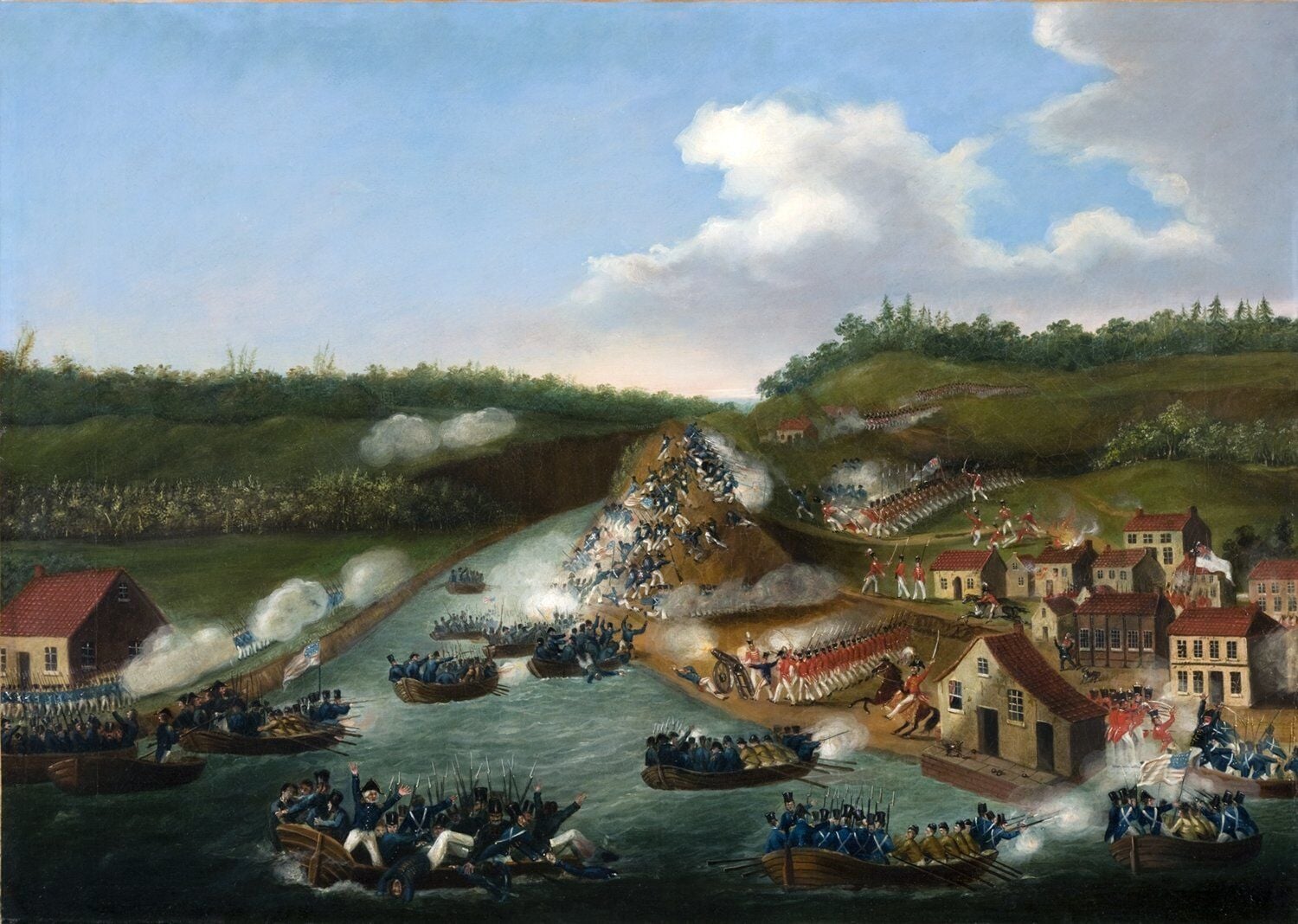
The last invasion of Canada by the U.S. — depicted here in “The Battle of Queenston Heights” by War of 1812 eyewitness James B. Dennis — became a debacle for the Americans. This one will, too.
Niagara Falls Public Library
When U.S. Brigadier-General Winfield Scott stepped off his rowboat, brandishing his sword, he hoped to set foot on land that would soon become American. Instead, he misjudged the depth of the Niagara River and promptly sank into the mud and silt. His men pulled the hapless general out of the river, but the invasion would only go south from there.
The United States, 200 years on, is launching another invasion into Canada: one meant to capture our industry, steal our resources and subjugate our government to the will of its madman-in-chief.
“You’re at war when you get attacked,” Prime Minister Mark Carney said Saturday. “We got attacked.”
Things are going to get tough. But we are lucky that we finally have certainty.
For the past week, Canadian negotiators have been feverishly trying to do the impossible: secure a trade deal with an administration which doesn’t see Canada as a real country.
We still don’t know what that final deal looked like, but the details we do know are horrific. Canada would have signed a document normalizing America’s tariffs on our lumber, steel, and aluminum, albeit at somewhat lower rates. It would have prioritized the American automotive industry over ours, encouraging more capital flight south. It would have undermined our ability to regulate Big Tech, making us more vulnerable to his brand of paranoid populism.
As the deadline approached, anxiety ran rampant. Industry and labour leaders I spoke to wondered whether the deal was harm reduction or outright capitulation. I spoke to one Liberal MP who relayed the misgivings in governing caucus: that maybe Carney had lost perspective on what costs we were willing to bear to get a deal.
We will not have to do that cost-benefit analysis because, in the zero hour of negotiations, Trump did what he always does: he asked for more. Canada discovered, yet again, that when Trump agrees to terms, his “signature is written in pencil,” Carney said. (More like crayon.)
Trump’s team wanted new language which would keep the sky-high tariffs on a Ford factory in Oakville. They wanted to restrict our ability to trade with China. They wanted to blow a hole through our ability to protect and promote French-language media.
So Carney recalled his negotiators, and now the trade war is on.
Even if it came at the last minute, the clarity around Trump’s true intentions is a strategic asset. We know now, with no ambiguity, that Trump does not want efficient supply chains, nor mutually beneficial co-operation.
Donald Trump believes he can fuel America’s economy by stealing his supposed allies’ industries. He is skulking around the parking lot, siphoning gas from empty cars.
Yes, 15 per cent tariffs sure beat 50 per cent tariffs. But the terms of Trump’s deal made very clear that even those lower tariffs would be designed in such a way to coax auto manufacturers and steel producers to decamp to the United States.
In walking away, we have preserved our ability to fight back and go elsewhere.
Canada is stronger, more united, more ambitious than we were a year ago, Carney said. The outpouring of response from the country proves he’s right.
The United Steelworkers applauded that Carney “was right to hold the line.” Unifor President Lana Payne wrote to me that “if there was a time to draw a line in the sand, it is now.” Business Council of Canada President Goldy Hyder backed Ottawa: “No deal is better than a bad deal.” Conservative Leader Pierre Poilievre rightly denounced Trump’s offer to “deindustrialize our country.” NDP leader Avi Lewis and Bloc Québécois leader Yves-François Blanchet both called on Carney to turn down the deal before the deadline. And the premiers, with the exception of crypto-separatist Danielle Smith, have declared themselves ready to fight.
This level of solidarity is unparalleled and essential. And it gives us clarity of purpose.
We should not plan to return to the negotiating table. We should not count on friendly and constructive negotiations around modernizing CUSMA. Washington’s best offer was insulting terms of submission — and those terms weren’t even enough to placate his cabinet of quacks and lunatics, who demanded more at the last minute.
We should, instead, brief our allies on this trade terrorism, encouraging them to stop holding out for Trump’s mercy. We should fight back not just through matching Trump’s tariffs, but by building the things here that we used to allow to get done there. We need factories to turn raw steel into I-beams, mills to transform our lumber into planks, factories to make our own tanks and planes. Despite Trump’s delusional bragging, our abundant natural resources mean we are better positioned to do that than he is.
As Carney noted Saturday, “Canada fuels American growth.” It’s time we fuel our own growth.
But in the near term, things will be tough. It is unfair that we face more years of belt-tightening, given the 2020s have already been defined by chaos and high costs.
But maintaining solidarity is essential. “The new US tariffs are designed to hurt us and divide us,” Carney said. “They’re a miscalculation.” Canadians, he said, lift each other up.
Donald Trump is about to discover, as he sinks deeper into the mud and silt in the Niagara River, that nobody is coming to pull him up.
Updated 8 hrs ago
Head of auto parts industry association also lays blame on Lutnick
The head of the association representing the automotive parts industry also said the abrasive Lutnick was at least partly to blame for the breakdown in talks. “I don’t believe in coincidences. Howard Lutnick entered the room and the breathing room got tighter on automotive,” said Flavio Volpe, CEO of Canada’s Automotive Parts Manufacturers’ Association.
The tariff reduction from 25 to 15 per cent didn’t include medium and heavy truck production, which would have hit Ford’s investment in Oakville, as well as GM’s Oshawa assembly plant, Volpe added.
“There were broad strokes of a deal earlier in the week, and then they went right away and said ‘my interpretation of this is something that’s explicitly targeting two of the seven automotive assembly plants in Canada.”
Updated 4 hrs ago
Mark Carney has cemented his post as leader of the anti-Trump resistance


“You’re at war when you get attacked,” Prime Minister Mark Carney said Saturday. “We got attacked.”
Dave Chan/AFP via Getty Images, Win McNamee/Getty Images
Prime Minister Mark Carney walked away from a U.S. trade deal Friday night. In doing so, he has cemented his post as the leader of the international resistance to U.S. President Donald Trump.
That may be of little consolation to Canadian alcohol, dairy and automobile producers who are now facing new 50 per cent tariffs on goods exported to America, or indeed to any other tariff-hit industries and companies struggling through the trade war.
But it matters to Canada in a longer-term calculation.
The Carney government has had a two-track strategy to get out of this mess of Trump’s making.
The first track has obviously been to strike a trade deal with Washington that lowers or eliminates tariffs. The prime minister was elected by a Canadian public in 2025 that judged him the best party leader to land that agreement.
But he walked away from an agreement, he said, because “we cannot accept what they’ve offered, and we will not give what they have asked.”
The strategy’s second track has been to overhaul and insulate the Canadian economy from unfriendly American economic influence by pivoting the south-facing flow of Canadian exports to other markets, particularly in the east (Asia) and the west (Europe).
Carney on Saturday revealed there had been last-minute changes to American tariff levels on vehicles made with Canadian-made content, which would have hurt the Canadian automobile industry.
But the Trump administration also attempted to attack the second track of Canada’s strategy by, in Carney’s words, restricting “our ability to have other trade deals.”
“One thing that we certainly were not going to accept was any restriction on our ability to execute those deals.”
Trump has yet to publicly comment on the breakdown in trade talks, but U.S. Trade Representative Jamieson Greer told reporters that Canada was offered “the best treatment of any major exporter to our market.”
Without going into detail, he said Canadian negotiators made “new demands and walkbacks of other commitments” that had “upended the careful balance reached in the past days.”
An attack on Canadian sovereignty
Doing a deal under the conditions Carney described would clearly have undermined Canada’s pivot to new markets by putting Carney firmly under the thumb of the U.S.
As the prime minister described it, he was faced with a trade agreement that was suddenly transformed into an attack on Canadian sovereignty, an attempted psychological annexation that could have turned Canada into an American client state, a sort of North American Belarus.
It does, however, jive with Trump’s repeated 51st state taunts when he returned to the White House.
And Trump’s National Security Strategy said of America’s neighbours in the Western Hemisphere: “We want other nations to see us as their partner of first choice, and we will (through various means) discourage their collaboration with others.”
So Carney’s accounting of the behind-the-scenes talks shouldn’t come as a total surprise.
And the fact that Canadian negotiators walked away rather than acquiesce should be seen less as a show of Canadian defiance than of Carney’s consistency.
The prime minister forecast some of the issues his negotiating team might face as early as last January when he delivered his oft-cited Davos speech.
In it, he made global headlines for voicing the grievances his fellow world leaders were still only mumbling to themselves. The speech established himself as the intellectual leader of an emerging anti-Trump rebellion—at the time populated mostly by European leaders angered by Trump’s threats toward Greenland.
“When we only negotiate bilaterally with a hegemon, we negotiate from weakness. We accept what’s offered,” he said, referring to Trump’s America.
“This is not sovereignty. It’s the performance of sovereignty while accepting subordination.”
In that January speech, Carney called for middle-power countries to be bold and band together.
In the interim, he’s been busy constructing that coalition with trade deals, defence agreements and official visits to countries from Switzerland to Saudi Arabia. He’s proceeding with construction of an oil pipeline from Alberta to the B.C. coast and green-lighting major transportation, energy and mining projects across the country.
But in the final hours of Friday night, when it looked like a deal was there to be signed, there was a real sense that it would show up Carney as a leader who had quivered, mid-pivot, under pressure from Trump.
‘We got attacked’
What was reportedly on the table included a 25 per cent tariff on a limited amount of Canadian steel and aluminum exports to the U.S., down from 50 per cent; a 15 per cent tariff on automobiles, down from 25 per cent; concessions to U.S. technology companies; and an agreement to put U.S. booze back on the shelves of provincial liquor stores.
Manitoba’s NDP Premier Wab Kinew said Carney had warned that a deal could fall through if the American liquor was not returned.
“I wouldn’t say that he was begging us,” Kinew said of Carney. “But what is a step before begging?”
From not-quite begging, Carney is now marching Canada away from the negotiating table and toward what he freely and unreservedly admits is economic “war.”
“You’re at war when you get attacked,” Carney said Saturday. “We got attacked.”
He looked serious and concerned, but not frightened. Like a man without a deal, but a man with a plan.
Carney made his reference to war, and then returned to the work of marshalling Canada’s response. It will include retaliatory tariffs against the U.S. and $25 billion in government support for affected industries and workers, the details of which will be revealed next week.
“We’ll support these businesses for as long as it takes — in other words, beyond the life of this U.S. administration,” Carney said.
At the same time, Canada won’t waver from the job of building up a more robust domestic economy while signing new trade deals and seeking new partners and new markets for Canadian goods.
“Building at home and diversifying trade abroad is not our plan B. It has been our plan A from the start,” Carney said.
But he left the distinct impression that this high-stakes pivot away from the U.S. now takes on a vital new urgency.
Updated 8 hrs ago
American business groups also concerned about failed trade talks
Business groups south of the border were also concerned about the talks blowing up. “We urge U.S. and Canadian negotiators to return to the table and finish the job—a trade deal that address U.S. tariffs and Canadian retaliation. The alternative is an escalating cycle of tariffs that will raise costs and impede economic growth,” said Neil Herrington, a senior vice presidentat the U.S. Chamber of Commerce.
Updated 8 hrs ago
Unifor president says Canada had no choice but to walk away from trade talks
In an interview on CBC, Unifor national president Lana Payne said Canada had no choice but to walk away from the talks. “What choice did we have? you either push back here, or you roll over,” Payne said.
“No-one wants to be in this place. We had a decent trade agreement with the United States. They blew that up.”
Updated 9 hrs ago
Quebec will retain its U.S. booze ban


Prime Minister Mark Carney, left, greets Quebec Premier Christine Frechette before a First Ministers Meeting in Charlottetown on Thursday July 23, 2026.
Darren Calabrese/The Canadian Press
Quebec Premier Christine Frechette, at a news conference, said she supported Ottawa’s move.
Frechette, asked if Prime Minister Mark Carney made the right decision in leaving the table, cited his concern over Canadian “sovereignty” that emerged over last-minute elements introduced by the U.S.
She said there was a “red line” that was not to be crossed, “and wasn’t.”
Frechette said it is too soon to say how many more jobs would be lost, but described the collapse of trade talks and a new escalation of the tariff war as a “very serious” situation.
She said would have preferred an agreement that brought certainty but said “the U.S. chose confrontation.”
As a result, she said, Quebec will retain its ban on U.S. booze sales in provincial liquor stores and its preferential tendering practices that exclude U.S. bidders.
In addition, she rolled out two new assistance programs for exporting businesses and their suppliers and contractors who will be hurt by the tariffs. Those included emergency assistance and interest-free loans.
Frechette said she will press the federal government to kick in new supports as well for impacted sectors and workers.
“I know it’s stressful” for the thousands of workers who may have woken up fearing they will lose work hours or their jobs as a result of the new wave of tariffs, she said.
“Our government will act to protect you.”
Updated 9 hrs ago
Author Stephen King weighs in on Trump’s Tariffs
In a post on X, author Stephen King let his opinions on the tariffs be known in no uncertain terms. “F—- Trump and f—- his tariffs. You don’t act like this to your friends.” (The author’s post spelled the epithet out in full.)
Updated 8 hrs ago
Premier Doug Ford urges Ottawa to inflict equal pain on U.S. with counter-tariffs
Premier Doug Ford said he never liked the deal with the U.S. that was on the table earlier in the week, as he hailed Prime Minister Mark Carney for walking away.
Ford, speaking to reporters, admitted the trade war is about to get more “painful” but he urged Ottawa to “use every tool we have” to inflict equal pain on the U.S. through counter-tariffs.
“We’re going to win this economic war,” said Ford.
In a letter Monday to Carney, Ford had cautioned him against making too many concessions and said he should be ready to hit back hard. Ford specified energy, electricity and critical minerals as potential leverage, said he hoped all premiers would be on the same page. But he also wants Ottawa to drop regulations like the industrial carbon tax or emission regulations to level the playing field for Canadian manufacturers in competition with American businesses that don’t face the same rules.
Ford said he had been on the phone continually in the last few days including up to 11:45 PM Friday night with Carney, who called to tell him the talks were off and tariffs were imminent.
But Ford said he heard a constant refrain all week that it was going to be “a bad deal” across the board from CEOs in the auto and steel sectors, from associations representing autos and parts manufacturers, and from Unifor’s president.
Updated 9 hrs ago
Conservative MP Jamil Jivani feels Ford and Carney have been ‘stoking anti-American sentiment’
flag sponsored: false
article_type:
pubinfo.section:
cms.site.custom.site_domain : thestar.com
sWebsitePrimaryPublication : publications/toronto_star
bHasMigratedAvatar : false
firstAuthor.avatar :
High-profile Conservative MP Jamil Jivani, who represents an Ontario riding home to many autoworkers on the front lines of the ongoing trade saga, says he had hoped a deal was possible and was “cautiously optimistic” an agreement might come together, but cited concerns over how the Carney government has managed its relationship with the U.S.
“I feel like the relationship side of this wasn’t really being worked on the way it should have been and then it went into this kind of technocratic negotiating stage and by the time that stage was set for completion, the relationship side issue kind of flared up again.”
“The whole thing deserved more effort and more attention in my view.”
Jivani, who in a statement after midnight said both Carney and Ford had put “their political self-interest ahead of Canadian workers,” explained in an interview on Saturday he felt both “have spent a lot more time stoking anti-American sentiment,” which benefit both politically, rather than working on building relations with the U.S.
“In fact, they point fingers at people like me, and many others, who have been out there saying, ‘This is an important relationship, please work on this.”
Jivani, who has made several trips to Washington and has a personal friendship with Vice-President JD Vance, whom he says is one of his primary contacts in Washington outside of Greer, says most of his advocacy on the Canada-U.S. relationship was prior to negotiations ramping up, convening meetings with business leaders and conveying perspectives from industry, energy and unions.
Over the past four weeks, he confirmed he had communicated to both Vance and Greer to convey “the priorities of Canada,” adding it is clear he speaks for his constituents, not the prime minister.
Jivani says he has not spoken with Carney despite repeated asks.
“Like, I know that the fact that I have a direct line to the White House, I thought was important to use it to get people an audience as much as I could. But the reality is, like once the negotiating window starts, there’s only so much I can do.”
Jivani says he believes Canada can work toward a “better arrangement” with the U.S, which he observes is what Canada’s negotiating team was trying to achieve, but says tariffs are nothing new when it comes to global trade.
“Did NAFTA have tariffs when it was signed? Like are tariffs a new thing? I don’t think tariffs are the primary issue right now. I think it’s the degree of tariff that people are concerned about,” he said.
“Maybe they found that they didn’t want to sign the deal yesterday,” he added of the Canadian side. “I, again, argue that if they had spent more than just a couple of weeks working on this, we would have had a better chance to find the right deal. And that is my primary contention, is that this did not get the time and attention it deserves.”
Updated 9 hrs ago
Premier Doug Ford advised Carney and Leblanc not to accept bad trade terms in letter
The pressure on Prime Minister Mark Carney had mounted last week as the talks intensified.
Premier Doug Ford in a letter last Monday to Carney and his lead trade minister Dominic LeBlanc advised them not to accept bad terms in the negotiations in Washington.
The letter, released to the Star Saturday, said:
“While we share the goal of an agreement that brings relief and certainty to workers and businesses, we must be clear that no deal is better than a bad deal that would only embolden the United States to continue seeking concession after concession.
“Recent actions by the United States to threaten the imposition of tariffs under section 338 are clearly intended to gain leverage in negotiations. Canada must remain united and prepared to defend its interests.
“We cannot allow arbitrary deadlines, shifting justifications, or escalating tariff threats to weaken our resolve. Should the United States proceed with section 338 tariffs, Canada must be prepared to respond decisively and proportionately, including through a coordinated dollar-for-dollar, tarif-for tariff response, and the continuation of existing countermeasures. We cannot back down in the face of economic coercion.”
Ford again urged Carney to regard western Canada’s assets as national leverage and underscored that the reliable supply of energy and critical minerals “remains two of Canada’s most significant strategic advantages.”
Ford said that electricity, energy, and critical minerals, infrastructure “should be viewed as Team Canada assets that contribute to Canada’s broader negotiating leverage.”
If talks failed, he urged that “additional retaliatory tariffs on imports from politically significant states to the current administration’s base of support, like Alabama, Arkansas, Florida, Iowa, Missouri, Montana, Texas, and Wisconsin products from these states should face the full force of Canada’s response.”
Updated 9 hrs ago
Nova Scotia Premier Tim Houston calls Trump a ‘difficult person to deal with’


Nova Scotia Premier Tim Houston attends a photo-op at the Ontario legislature in Toronto on Monday, March 2, 2026.
Chris Young/The Canadian Press
The tough talk from Canadian premiers is continuing with Nova Scotia’s Tim Houston saying on CBC Trump “is a difficult person to deal with” and “enough is enough.”
“It’s a person that kind of shakes your hand, but with their fingers, you know, crossed behind their back,” he says of the U.S. President.
Still, he says the Canada-U.S. relationship is “long-standing” and “we’ll find a way to get through this.”
Updated 9 hrs ago
Howard Lutnick to blame for breakdown in trade talks, says Aluminum Association of Canada CEO
The head of the association representing Canada’s aluminum producers blamed U.S. Commerce Secretary Howard Lutnick for the breakdown in the talks, saying the tough-talking former finance executive had tried to reopen several already-settled part of the tentative agreement.
“The whole deal soured up when Lutnick got into the room and started relitigating,” said Jean Simard, CEO of the Aluminum Association of Canada. “This is all about Lutnick trying to relitigate things.”
Updated 8 hrs ago
Carney says Canada is in a trade war, doesn’t rule out using critical minerals, energy as leverage

Prime Minister Mark Carney speaks about Canada’s response to new U.S. tariffs as Canada-U.S. Trade Minister Dominic LeBlanc and chief trade negotiator Janice Charette listen during a news conference on Parliament Hill in Ottawa on Saturday, Aug. 22, 2026.
Patrick Doyle/The Canadian Press
Prime Minister Mark Carney didn’t rule out using critical minerals or energy as leverage with the U.S., saying “we’ll see” while touting his work to diversify trading partners.
Yes, Canada is in a trade war, Carney said in French while speaking to reporters, but “this was not our choice.”
“This is a new attack on Canada. You are attacked when there’s a war,” he says.
Updated 10 hrs ago
U.S. demands included Canada imposing tariffs on other countries, Carney says
Carney says part of U.S. demands were for Canada to impose tariffs on other countries and trying to “restrict our ability to have other trade deals.” He says that would make sense if you integrated markets and it was in the joint interest of both countries, “as opposed to being told to do something or being restricted from doing something else.”
He says it was a “power play” from the U.S. and Canadians “weren’t satisfied.”
“We’ll make our decisions about who we want to trade with and how, and including on how we work with the United States and other partners,” Carney says.
Updated 8 hrs ago
Pushback from premiers did affect Carney’s tariff decision, he says

Prime Minister Mark Carney speaks about Canada’s response to new U.S. tariffs during a news conference on Parliament Hill in Ottawa on Saturday, Aug. 22, 2026.
Patrick Doyle/The Canadian Press
Prime Minister Mark Carney says pushback from premiers over the last few days did not affect his decision, but says their reluctance to commit to putting American booze back on shelves before seeing details of a deal was “reasonable.”
“We were still negotiating the deal, and as it turns out, as I’ve just described, that the Americans changed a number of those terms, introduced new elements, made it uneconomic, and so we’re not asking the premiers to do anything today except work together to support our businesses and build the country strong,” he said.
Updated 10 hrs ago
Canada provides U.S. with 99 per cent of its natural gas imports
A notable line from Carney’s speech is his listing of how much energy Canada sends to the U.S. – 99 per cent of their natural gas imports, 85 per cent of their electricity imports, 60 per cent of their crude oil imports, he said.
“I don’t think they want us to stop sending any of that energy,” Carney said.
Premier Doug Ford has urged the prime minister to consider using energy as leverage in negotiations.
Carney didn’t rule out using critical minerals or energy as leverage, saying “we’ll see” while touting his work to diversify trading partners.
Premier Doug Ford has urged the prime minister to consider using energy as leverage in negotiations.
Updated 10 hrs ago
Carney says Americans wanted to restrict Canadian protection of language, culture
The prime minister is now taking questions and is asked what the last-minute U.S. demands were.
Carney says American negotiators “at the last hours” tried to “restrict our ability to have other trade deals.” On autos, the U.S.’ offer on tariff level was too high, but they also tried to exclude from the deal heavy medium- and heavy- autos, “a big change” that had “no rationale.”
He also says the Americans wanted to restrict Canadian protection of language, culture, and “in effect, our sovereignty.”
Asked about what the latest developments mean for CUSMA talks, he says in French, “it certainly isn’t good news.”
But, “the situation is clear” now and Canada has a “new perspective” because of the breakdown in negotiations.
Updated 8 hrs ago
Retaliatory measures will come into force after Labour Day, Carney says
In his statement Saturday, Prime Minister Mark Carney said Canada was looking for “tariff-free access to the U.S. for the vast majority of Canadian businesses,” greater stability in the trade relationship, and to “significantly reduce U.S. tariffs on our key strategic industries so that Canadian businesses in these sectors would have the best access of any in the world.”
Canada has made offers to the U.S., the prime minister said, including dropping “remaining retaliatory tariffs on strategic sectors, particularly steel, aluminum, and autos, if the United States substantially lowered theirs to levels that made it economic for Canadian companies to export to the United States.”
“In exchange for a fair deal, we would encourage our provinces to return U.S. alcohol to the shells, and we would take administrative measures to protect supply management without changing the system itself, the U.S. quotas, or the tariffs that would apply,” he said.
Carney added there had been important progress in recent weeks, and Canada believed they were moving toward a deal, but “in recent days, the United States proposed new terms that were uneconomic, unfair, and undermined the net benefits for Canada, and called into question the reliability of any deal.”
“In short, they asked too much, and they offered too little,” said Carney. “More fundamentally, the cumulative effect of U.S. demands revealed the limits of their commitment to a true economic partnership.”
Canada was opposed to any deal that undermines sovereignty or key industries, and will match the new tariffs “dollar for dollar” with a focus on sectors such as steel, dairy, appliances, agricultural equipment, pulp and paper and electronics, he said.
Carney said the retaliatory measures will come into force the Tuesday after Labour Day and details will roll out in the coming days.
“Let me be clear: we take this step reluctantly, reluctantly because we recognize that some of these measures will raise costs and reduce choice for Canadians. Reluctantly, because we recognize that some U.S. companies and some U.S. states are innocent bystanders in a dispute that they did not want. Reluctantly, because this trade dispute is preventing Canada and America from doing so much good that we could do together,” the prime minister says. “But at the same time, we take this step confident that it is in the best interest of Canada, and that by rejecting a bad deal, by standing up for Canada, by focusing on what we can control, we will build Canada strong for all.”
Carney touts his government’s work on major projects, housing, energy and defence, and said Canada will continue to “build at home” and diversify international trade
Updated 2 hrs ago
‘We got attacked’: Carney says retaliatory tariffs on U.S. to take effect next month
By Catherine Morrison and David Baxter The Canadian Press
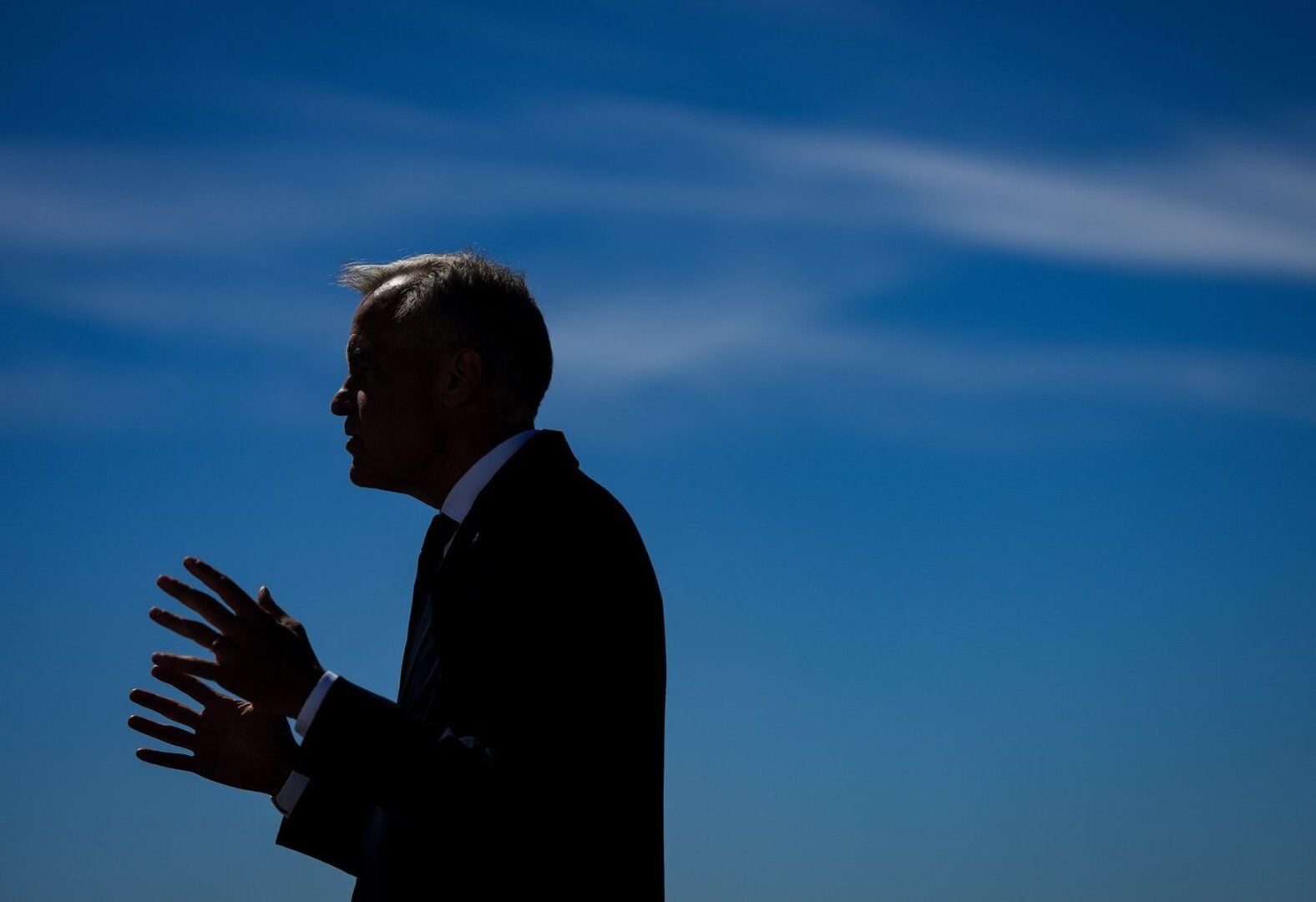
Prime Minister Mark Carney is silhouetted as he gives a statement after touring Global Container Terminals’ Deltaport facility, at Roberts Bank in Delta, B.C., on Thursday, July 30, 2026.
Darryl Dyck/The Canadian Press
OTTAWA – Prime Minister Mark Carney says retaliatory tariffs will hit the U.S. starting next month after Canada walked away from what he called a “bad deal.”
The U.S. introduced new 50 per cent tariffs on billions of dollars in Canadian exports on Saturday after trade talks failed.
“We got attacked,” Carney told reporters on Parliament Hill Saturday when asked about the escalating trade war.
Carney suspended talks with the United States late Friday and summoned his negotiators back to Ottawa.
“We cannot accept what they’ve offered, and we will not give what they’ve asked,” he said.
The prime minister was joined by Canada-U.S. Trade Minister Dominic LeBlanc and Canada’s chief trade negotiator Janice Charette.
Carney said Canada will match Washington’s new tariffs dollar-for-dollar and that the levies will be targeted at sectors such as steel, dairy, appliances, agricultural equipment, pulp and paper and electronics. He said more details on those retaliatory measures, as well as supports for affected sectors, will be announced in coming days.
The counter tariffs are set to come into force on Sept. 8, the day after Labour Day.
“We take this step reluctantly,” Carney said, adding that some of the measures will raise costs and reduce choice for Canadians.
The prime minister also said he recognized that some U.S. companies and states are “innocent bystanders” in the dispute, which he said is preventing Canada and America from “doing so much good that we could do together.”
“But at the same time, we take this step confident that it is in the best interest of Canada and that by rejecting a bad deal, by standing up for Canada, by focusing on what we can control, we will build Canada strong for all,” he said.
Carney met virtually with his cabinet Saturday, followed by a meeting with premiers, where he said the provinces need to keep working together.
Carney said that the U.S., “at the last hours,” introduced efforts to restrict Canada’s ability to have other trade deals. He called the move a “power play,” that became an issue of sovereignty.
“We believe in free trade, with a partner of choice in many respects with countries around the world, and the Americans wanted to restrict that,” he said. “Unacceptable.”
Asked by a reporter if the U.S. was asking Canada to impose tariffs on other countries in conjunction with them, Carney said “there were elements of that in certain sectors.”
“There were elements where we would see the merit of that as part of a comprehensive deal that made sense for Canada,” he added.
Carney said the U.S. also added terms near the end of discussions to remove tariffs on some specific vehicles, specifically Ford trucks, as well as restrict Canada’s protections of language and culture.
“In effect, our sovereignty,” said Carney.
Carney said the government will outline Canada’s plan for counter tariffs and measures to support Canadian workers and businesses in the coming days.
“We’re going to hit back, and we are going to provide tariff protection where we can where it’s relevant,” he said. “We will do whatever it takes to support these businesses.”
The new U.S. tariffs target $28 billion in Canadian goods ranging from hockey sticks and honey to essential oils and dairy products.
U.S. Trade Representative Jamieson Greer said Friday that the U.S. and Canada had “declined” to finalize a tentative agreement, and laid the blame entirely on Canada.
“Despite the U.S. offer to Canada to receive the best treatment of any major exporter to our market, new demands and walk-backs of other commitments by Canada have upended the careful balance reached in the past days,” said Greer.
“In addition, Canada is continuing to maintain its prolonged retaliation against the United States, including, among other things, flat-out prohibitions on certain American goods and services.”
Greer told reporters the failed deal represented a “missed opportunity,” noting that the U.S. was offering significant tariff reductions on steel, aluminum, autos and lumber in exchange for concessions from Canada.
He said the deal also included an economic and national security partnership, as well as the announcement of formal U.S.-Mexico-Canada agreement negotiations.
Greer told Fox News Saturday that there are no new talks planned with Canada. He said the U.S. was moving forward with measures that respond to Canadian retaliation.
The Trump administration did not extend CUSMA in July. That triggered an annual rolling review of the trade deal for up to a decade, at which point it would expire if all three countries cannot come to an agreement for an extension.
Mexico and the United States have launched official CUSMA negotiations, but Ottawa and Washington have not started such talks.
Asked by a reporter Saturday what the most recent breakdown in trade talks meant for CUSMA negotiations, Carney said in French that it’s not good news.
Carney also said, however, that Canada has a clearer perspective because of these negotiations.
Earlier Friday, U.S. President Donald Trump said a deal with Canada was “moving along,” though LeBlanc told reporters there was still “more work to do” to seal a trade deal.
Trump has not yet posted on social media since the deal fell through. The president had only posted about construction of the White House ballroom.
After days of silence, Ontario Premier Doug Ford said on social media late Friday that the prime minister has his “full support” for a strong response.
“As we fight to protect Canadian sovereignty and economic security, everything needs to be on the table,” said Ford. “Ontario is ready to do its part.”
Ford suggested to Carney in a letter Monday that Canada respond to new tariffs with a dollar-for-dollar approach.
“We cannot back down in the face of economic coercion,” he said in the letter.
Ford also said electricity, energy and critical minerals infrastructure should contribute to Canada’s negotiating leverage. He said the federal government should also consider retaliatory tariffs on imports from “politically significant states to the current administration’s base of support.” He named Alabama, Arkansas, Florida, Iowa, Missouri, Montana, Texas and Wisconsin.
“Products from these states should face the full force of Canada’s response,” he said.
Speaking to reporters Saturday, Ontario Premier Doug Ford urged his counterparts across the country to stick together in the face of tariffs imposed by the United States government.
Ford said all premiers must stand united for Team Canada, and he says there cannot be an outlier.
He gave Prime Minister Mark Carney credit for standing up for Canada by standing up to U.S. President Trump and said employers, workers and unions in Ontario’s steel and auto sectors agree the U.S. government had put forth a bad deal.
“I’m glad he didn’t sign that deal because it was a bad deal,” Ford told reporters Saturday.Ford said Trump can’t be trusted, that he changes the deal and “keeps moving the goal post.”“President Trump is the type of person that would steal your lunch money the first day. He’d steal the toque off your head the second day and the third day he’d steal your running shoes.”
Carney seemed reluctant Saturday to include energy and critical minerals as a bargaining chip in negotiations. Carney has previously suggested that Canada’s reputation as a reliable supplier could take a hit if it started using energy exports as leverage in trade talks with the United States.
“We have a range of other options to protect our industry,” the prime minister told reporters Saturday. “We have considerably ramped up development of critical minerals … much less of that development has been related to the United States than it would have been if we were not having these trade issues.”
This report by The Canadian Press was first published Aug. 22, 2026.
— With files from Sarah Smellie in St. John’s
Updated 8 hrs ago
Carney calls out Trump administration for changing rationale behind tariff agenda
Prime Minister Mark Carney is now addressing Canadians, saying his team “worked intensively and in good faith with the United States to negotiate a new comprehensive trade deal.”
We’ve been pragmatic, patient, and persistent. We pursued every opportunity to reach an agreement that protects Canadian workers and their families, that strengthens our economy, and that respects Canadian sovereignty,” he said.
But, he added, “we’ve been under no illusions” and “we recognized from the start that America has changed.”
“Our goal has always been to get the best deal for Canadians, never a deal at any price or on any time frame,” Carney says.
He says a “mutually beneficial trade agreement is possible” but America’s “attention and dedication” has wavered.
“The gap between partnership and competitor, unfortunately, has remained too wide in recent days,” Carney said.
“We cannot accept what they’ve offered, and we will not give what they’ve asked.”
He calls out the Trump administration for continually changing the rationale for its tariff agenda, “from fentanyl to taxes on U.S. tech giants to certification of U.S. aircraft to the sharing of tolls of a bridge that Canada built and paid for, to our dairy policy, to provincial decisions not to sell American alcohol during the trade war, to a television advertisement that quoted Ronald Reagan, to smoke from wildfires while they threatened our communities.”
Updated 11 hrs ago
Canadian Federation of Agriculture said the escalating trade will have a devastating impact
The Canadian Federation of Agriculture said the escalating trade war will have a devastating impact on both countries’ farmers and food supply.
“For generations, Canadian and American farmers have worked as partners, supplying food, feed, fertilizer, equipment, and other essential inputs that support a strong North American food system,” said CFIA president Keith Currie.
“The breakdown in negotiations and escalation of new tariffs create uncertainty at a time when farmers are already facing significant challenges, including rising input costs, market volatility, and increasingly unpredictable weather.”
Updated 11 hrs ago
Watch Live: PM Carney gives update after pulling out of U.S. trade negotiations
By Star staff
Prime Minister Mark Carney is holding a news conference on Parliament Hill in Ottawa after Canada and the United States failed to reach a trade agreement before a late Friday deadline and Canada said it was suspending negotiations.
Updated 11 hrs ago
Ontario Chamber of Commerce backs Carney’s decision to call negotiators home
The Ontario Chamber of Commerce backed Prime Minister Mark Carney’s decision to call Canadian negotiators home.
“Either way, Friday was destined to be a bad day for North American businesses. Behind one door, we had the high costs of permanent tariffs, making a mockery of CUSMA, and a truce that would only last until the U.S. president’s next tantrum. Behind the other, we had the madness of a continuing trade war,” said OCC CEO Daniel Tisch. “The Canadian government negotiated with a good faith that was not returned, and was even willing to allow Trump to maintain unjustified tariffs without retaliation to give our economy time to diversify. … The Ontario Chamber will continue to work with our U.S. business partners, who like us seek fewer barriers to trade, not more.”
Updated 12 hrs ago
Jamieson Greer tells Fox News “it’s hard to say” when talks with Canada will resume
Speaking in public for the first time Saturday morning, top U.S. trade negotiator Jamieson Greer tells Fox News “it’s hard to say” when talks with Canada will resume, but “we don’t have new talks planned with the Canadians” at the moment.
“We’re moving forward with measures that respond to Canadian retaliation,” he said. “After a year of that retaliation, we’ve said ‘enough,’ and so we’ve taken countermeasures.”
Without offering details, he said the U.S. offered Canadians a cut in sectoral tariffs on steel, autos and lumber but their offer was rejected.
“They’ve always had the best deal, and they still would have an even better deal, but they didn’t want that,” Greer said.
Updated 14 hrs ago
Quebec Premier says U.S. has ‘once again chosen confrontation’ after trade talks break down

Quebec’s Premier Christine Fréchette released a statement on X Saturday morning after Canada’s trade talks with the U.S. collapsed Friday night.
“The American administration has once again chosen confrontation. The new tariffs apply to our companies and small and medium businesses in all regions of Quebec. They will have a direct impact on our economy and quebecois workers.”
Fréchette vowed to protect the province’s economy, adding she would meet with her cabinet Saturday to implement measures to support those impacted by the new U.S. tariffs.
Updated 4 hrs ago
A deal with Donald Trump isn’t the end of instability. It’s just the start of it
By Stephanie Carvin, Contributor

President Donald Trump’s approach to negotiation is to make instability the point, not a temporary condition, writes Stephanie Carvin.
AP Photo/Jacquelyn Martin
Last week U.S. Vice President J.D. Vance made headlines when he told a closed-door fundraiser that Prime Minister Mark Carney had tried to “out-tough” U.S. President Donald Trump in negotiations. He also praised MP Jamil Jivani as a helpful advocate for trade and dismissed Official Opposition leader Pierre Poilievre as a “non-entity.”
Another of Vance’s points received less attention but was arguably more ominous: “the whole point of this is to change Canada’s behaviour,” he said, and shift the country “in a Trumpian direction.”
The recent trade talks mark only the end of the beginning of negotiations with the Trump administration. We should expect the U.S. to continue using its economic leverage to dominate Canada, potentially forcing our country into a customs union-like arrangement in which Washington dictates the terms.
The danger, however, is larger than any eventual trade agreement. For most of the postwar era, Canada could tolerate extraordinary economic integration with the United States because that dependence existed within a remarkably stable political relationship. Canadians could assume disagreements would be negotiated according to mutually understood rules, rather than that integration itself would be weaponized.
In 1957, renowned sociologist Karl Deutsch described this relationship as a “security community” — one in which large-scale violence had become almost unthinkable. Its members believed common problems “must and can be resolved by peaceful change,” bound by a sense of community, mutual trust and common interests.
What would Deutsch think today? Trump’s occasional threats of physical domination of the Western Hemisphere, including Canada, are a twisted corollary to the Monroe Doctrine — the “Donroe Doctrine.” Fortunately, the military threat to Canada remains low: our disputes with the United States will almost certainly still be settled through negotiations.
However, the character of those negotiations has changed. Canadians — correctly — believe the threat to our sovereignty is high. The stability and fair dealing that made a security community possible have been undermined and replaced by the weaponization of integration and instability.
This is why it is shocking to hear Canadian business leaders speak of returning to normalcy with the U.S. Calls to get “this tariff war behind us,” convince Washington that existing arrangements are “good for America,” or secure permanent access to the U.S. market seem detached from what the Trump administration is telling us. The avoidance of normalcy is precisely what gives it leverage. Instability is not a problem it is trying to solve; instability is the point.
The sooner Canadian businesses understand that the assumptions which governed continental integration for decades no longer hold, the better. Even if Democrats retake Congress or the White House, it is far from certain they will abandon tariffs and economic coercion now that these tools have been normalized. The rhetoric may change; the actions may not.
Full economic disentanglement from the U.S. is neither possible nor desirable, and trade diversification will not happen overnight. But Canadian businesses must stop wishcasting for a world that no longer exists. That means developing markets overseas and building resilience at home, recognizing that diversification may sometimes matter more than efficiency and that privileged access to the American market can no longer be the organizing principle of Canadian economic policy.
The old bargain was that Canada could accept the vulnerabilities of deep integration because that integration existed within a stable relationship governed by rules, institutions and mutual restraint. Trump has altered that deal — and it is likely he will alter it further.
Updated 21 hrs ago
Alberta premier Danielle Smith says she’s ‘deeply disappointed’ a trade deal could not be reached
Smith posted to X early Saturday morning.
“Alberta has always advocated for a tariff free relationship, and will continue to do so. No one benefits from a trade war. Tariffs and counter-tariffs hurt businesses, workers and families on both sides of the border, while weakening one of the most important economic and security relationships in the world.”
The full statement:
Updated 21 hrs ago
Premier of B.C. David Eby releases a statement after trade talks suspended
Eby said on X:
“British Columbians will always stand with Canada. Our politeness should never be mistaken for weakness. We’ll always defend ourselves. We didn’t ask for this, but we’ll keep fighting for as long as it takes.”
Updated 2 hrs ago
Businesses fear closure with no Canada-U.S. trade deal as industry reacts
By David Baxter The Canadian Press

President Donald Trump greets Canada’s Prime Minister Mark Carney during a summit to support ending the more than two-year Israel-Hamas war in Gaza after a breakthrough ceasefire deal, Monday, Oct. 13, 2025, in Sharm El Sheikh, Egypt. (AP Photo/Evan Vucci, Pool)
EV
OTTAWA – The collapse of trade talks between Canada and the United States, the imposition of 50 per cent tariffs on $28 billion worth of Canadian goods and Prime Minister Mark Carney pledging dollar-for-dollar retaliatory tariffs triggered swift reaction from the nation’s business community.
Candace Laing, Canadian Chamber of Commerce president and CEO, called the breakdown a “body blow to North American competitiveness in this self-defeating trade saga.”
“A whopping, non-absorbable tariff is not sustainable or viable for business,” she said in a statement. “For a small Canadian exporter operating on tight margins, this isn’t an abstract trade dispute. It means looking at your orders, your payroll and your employees and asking what you can still afford.”
Laing, who is a member of Carney’s Canada-U.S. relations advisory committee, added Americans will see their costs go up, while Canadians will see customers, investment and small businesses disappear.
The United States imposed 50 per cent tariffs on a range of Canadian exports Saturday, after the two countries could not reach a new deal before an extended deadline imposed by President Donald Trump earlier in the week.
Prime Minister Mark Carney said he suspended negotiations and directed Canadian negotiators to return to Ottawa. He also announced Canada will retaliate with matching dollar-for-dollar tariffs.
Carney said supports for Canadian businesses and workers will be announced in the coming days.
Unifor president Lana Payne, who is also a member of Carney’s advisory committee, said in a text message the Canadian negotiators made “the right decision by walking away.”
“We can’t trade good jobs for a bad deal. And it was clear the U.S. was continuing to push for untenable concessions,” she said.
“Trump’s never-ending list of concessions, threats and economic extortion are designed to break us and own us. We need to stand together. We need to fight together.”
Dan Kelly, Canadian Federation of Independent Business president and CEO, said on social media that this new American tariff is ”deeply troubling for thousands of small Canadian exporters.”
“A full 40 per cent of small exporters sell items on the new 10+ page list of items facing 50 per cent tariffs,” Kelly said.
“Many CFIB members have said this will end their U.S. sales and some have reported this will kill their businesses.”
Bea Bruske, president of the Canadian Labour Congress, said on social media that walking away from a bad deal “is the right choice for Canada.”
“The road ahead will be tough. But we’re all in this together. We must use our leverage to force Trump to back down,” she said.
“And we must focus on protecting workers and communities impacted by Trump’s trade war.”
Chris Swonger, Distilled Spirits Council of the United States president and CEO, said in a statement that continued “discriminatory treatment” of American spirits by most provinces has caused significant harm to the industry.
“We encourage policymakers on both sides of the border to pursue a negotiated solution that restores market access for U.S. spirits throughout Canada and returns spirits trade to a zero-for-zero tariff framework,” he said.
All provinces except Alberta and Saskatchewan have not been stocking American booze in response to the sectoral tariffs the Trump administration placed on steel, aluminum and autos at the start of his term.
This report by The Canadian Press was first published Aug. 22, 2026.
— With files from Catherine Morrison in Ottawa and Kelly Malone in Washington
Updated 22 hrs ago
Mark Carney releases statement on X
Prime Minister Mark Carney has released a statement on X.
Updated 21 hrs ago
Ontario Premier Doug Ford releases statement on X after trade talks suspended
The statement read:
“Team Canada needs to stand together more united than ever before.”
“The prime minister has my full support for a strong response—tariff for tariff, dollar for dollar. As we fight to protect Canadian sovereignty and economic security, everything needs to be on the table. Ontario is ready to do its part.”
Updated 2 hrs ago
A list of some of the Canadian exports the U.S. is hitting with a 50 per cent tariff
By The Canadian Press

Dairy products counter in a Levis, Que., market, Wednesday, Feb. 5, 2025. THE CANADIAN PRESS/Jacques Boissinot
jqb
OTTAWA – The United States is imposing a 50 per cent tariff on a range of Canadian exports starting Saturday, after the two countries could not reach a new deal before a deadline imposed by President Donald Trump.
Trump threatened the new tariffs in July to pressure Canada to move on a number of issues that were flagged as irritants to the U.S., including provincial bans on alcohol imports, tariffs on some American made auto exports and quotas on tariff-free U.S. dairy exports.
The federal auto tariffs and the alcohol bans, which remain in effect everywhere but Alberta and Saskatchewan, were both initiated in response to Trump’s initial tariffs on Canada in 2025.
The new U.S. tariffs were to take effect on Aug. 19, but Trump delayed the implementation by three days to allow more time for talks to reach a deal.
Just before midnight Friday, both Prime Minister Mark Carney and U.S. Trade Representative Jamieson Greer said those talks had broken off and a deal had not been reached.
The new tariffs will be applied to roughly five per cent of all of Canada’s exports to the United States, to a value of roughly $28 billion annually.
The tariffs are grouped by three executive orders loosely themed around motor vehicles, dairy and alcohol. But the content of each of U.S. President Donald Trump’s actual tariff lists are broader and not necessarily tied to those items.
Here’s a broad look at what will be affected:
- Milk and cream
- Whey and milk protein concentrates, including casein
- Bones and horn-cones
- Lactose, glucose, fructose and blended syrups
- Sugars, cane molasses
- Non-alcoholic beer
- Essential oils of peppermint
- Beer, wine, liquor, cider and other fermented beverages
- Essential oils of grapefruit
- Densified wood blocks, plates, strips
- Some wooden tableware
- Wood marquetry and inlaid wood, wooden articles of furniture
- Skewers and ice cream sticks, as well as bamboo products
- Basketwork and other articles
- Grease-proof paper
- Ice hockey and field hockey equipment, other than balls and skates
- Natural honey
- Down feathers
- Tortoise shell, whalebone, horns, antlers and other animal parts
- Tulips and other dormant flower buds, live orchids and mushroom spawn, tubers, mosses and lichen
- Vegetable, tree and shrub seeds
- A range of other vegetation and parts
- Perfumes containing alcohol and plant parts used in perfume
- Various essential oils
- Makeup preparations
- Doughs and other bakers’ mixes
- Bitters
- Synthetic paints and varnishes, printer inks
- Cements
- Candles
- Various fatty acids
- Vinyl floor tiles
- Non-plastic office supplies
- Plastic furniture fittings
- Household and toilet articles, tableware, kitchenware
- Dog leashes and saddles
- Luggage and other cases, such as for musical instruments
- Various fibreboard, laminate and plywood sheets
- Various paper, wallpaper, binders, paper pulp products
- Silk, yarn, carpet and other various textiles
- T-shirts, sweaters, trousers, dresses, gloves, coats and other clothing items of various materials
- Wigs, false beards, eyebrows of synthetic textile materials
- Glass packing materials
- Non-industrial diamonds, not set
- Various gold, silver and imitation jewelry
- A range of power tools and equipment
- Armoured safes, locks and lockboxes
- Brewery machinery
- Refrigerating or freezing furniture and equipment
- Vacuums
- Smartphones and other recording devices
- Devices containing semiconductors for data transmission and storage
- Cameras and projectors
- Radar equipment and antennae, optical fibre cables
- Motorcycles fitted with an engine capacity of 800 cc or greater
- Floating docks, vessels and rafts
- Furniture seats and parts made of wood, plastic and metal with a range of outlined uses and exemptions
- Chandeliers and lamps
- Toys, puzzles and models
- Video game consoles
- Christmas and other festival decorations
- Ice skates, golf and gym equipment
- Swimming pools, wading pools and parts
- Fishing rods and parts
- Paintings, drawings, collages, sculptures of various ages
- Postage stamps and other collectors’ pieces
- Antiques of an age exceeding 100 years but not exceeding 250 years
Updated 12 hrs ago
Canada vows dollar-for-dollar tariff retaliation, suspends trade talks with U.S.
By Catherine Morrison The Canadian Press
Canada-U.S. Trade Minister Dominic LeBlanc, left, and United States Trade Representative Jamieson Greer, speak to reporters in Washington, D.C., on Wednesday, Aug. 19, 2026.
Kelly Geraldine Malone/The Canadian Press
OTTAWA – A last-ditch effort to reach a new trade deal before a midnight tariff deadline failed Friday, as Prime Minister Mark Carney suspended talks with the United States and summoned his negotiators back to Ottawa.
The decision meant new 50 per cent tariffs on billions of dollars in Canadian exports to the U.S. took effect at 12:01 a.m., and Carney vowed Canada would retaliate with equal measures of its own.
“In recent weeks, we made important progress toward improving Canada’s position as having the best deal in the world with the U.S.,” Carney said in a statement just before Trump’s tariff deadline.
“However, that progress has not been enough to meet our objectives for Canadians.”
Canada-U.S. Trade Minister Dominic LeBlanc and chief negotiator Janice Charette have been in Washington for nearly two straight weeks trying to get to a deal, including multiple hours of talks with Greer on Friday.
“They have worked hard, in good faith, to defend the interests of Canadians throughout these negotiations up until the very last minute,” said Carney.
“However, last-minute changes in the U.S. proposed terms were unfair, uneconomic, and called into question the reliability of any deal.”
The new U.S. tariffs target $28 billion in Canadian goods ranging from hockey sticks and honey to essential oils and dairy products.
Details of what goods Canada will tariff in response are not yet available.
Carney also said the government will introduce measures to support Canadian workers and businesses in the coming days.
U.S. Trade Representative Jamieson Greer said Friday that the U.S. and Canada had “declined” to finalize a tentative agreement, and laid the blame entirely on Canada.
“Despite the U.S. offer to Canada to receive the best treatment of any major exporter to our market, new demands and walk-backs of other commitments by Canada have upended the careful balance reached in the past days,” said Greer.
“In addition, Canada is continuing to maintain its prolonged retaliation against the United States, including, among other things, flat-out prohibitions on certain American goods and services.”
Greer told reporters the failed deal represented a “missed opportunity,” noting that the U.S. was offering significant tariff reductions on steel, aluminum, autos and lumber in exchange for concessions from Canada.
He said the deal also included an economic and national security partnership, as well as the announcement of formal U.S.-Mexico-Canada agreement negotiations.
The Trump administration did not extend CUSMA in July. That triggered an annual rolling review of the trade deal for up to a decade, at which point it would expire if all three countries cannot come to an agreement for an extension.
Mexico and the United States have launched official CUSMA negotiations, but Ottawa and Washington have not started such talks.
Earlier Friday, Trump said a deal with Canada was “moving along,” though LeBlanc told reporters there was still “more work to do” to seal a trade deal.
Some of Canada’s premiers have already banded together with Carney following the announcement.
After days of silence, Ontario Premier Doug Ford said on social media late Friday that the prime minister has his “full support” for a strong response.
“As we fight to protect Canadian sovereignty and economic security, everything needs to be on the table,” said Ford. “Ontario is ready to do its part.”
British Columbia Premier David Eby said on social media that “our politeness should never be mistaken for weakness.”
“We’ll always defend ourselves,” he said. “We didn’t ask for this, but we’ll keep fighting for as long as it takes.”
Former Alberta Premier Jason Kenney also applauded the move, saying on social media that “Canada clearly made a serious, good faith effort to get greater stability and market access, and remains ready to find a fair, balanced agreement.”
‘But we are not cravenly surrendering in the face of constant economic and political aggression,” said Kenney. “Responding to the new U.S. tariffs with counter tariffs is exactly the right thing to do at this time.”
Susan Holt of New Brunswick said in a statement that her province stands strong and united with Team Canada as we fight for a fair deal.
“Now, more than ever, we need to double down on buying local and supporting New Brunswick businesses and workers.”
PEI Premier Rob Lantz also vowed on social media to continue working alongside the other premiers and the federal government, “to stand up for Canadian interests and make sure Prince Edward Island has a strong voice in the path forward.”
He added that the Team Canada approach has kept the country strong and united throughout negotiations, and Canadians need that same strength and unity now.
Alberta Premier Danielle Smith, on the other hand, said on social media she is “deeply disappointed” that Canada and the United States have not been able to reach a trade agreement.
“No one benefits from a trade war,” she said.
Smith also said she welcomed the federal government’s intention to provide relief for those businesses that are impacted.
“Alberta will continue to advocate for a strong tariff-free relationship between Canada and the U.S., and I will be urging the federal government to restart negotiations as soon as possible,” she said.
Candace Laing, president and CEO of the Canadian Chamber of Commerce and member of the prime minister’s advisory committee on Canada-U.S. economic relations, said in a statement that this will be a “body blow to North American competitiveness in this self-defeating trade saga.”
“A whopping, non-absorbable tariff is not sustainable or viable for business,” she said. “For a small Canadian exporter operating on tight margins, this isn’t an abstract trade dispute. It means looking at your orders, your payroll and your employees and asking what you can still afford.”
Laing said Americans will see their costs go up, while Canadians will see customers, investment and small businesses disappear.
Trump first threatened the new tariffs in July, and set a deadline of Aug. 19 to reach a deal with Canada on a number of issues. Shortly before that deadline, the president said he was pausing the planned tariffs while the two sides worked out the details of a trade deal.
The U.S. had cited a number of irritants to justify the threatened tariffs, including complaints about U.S. access to Canada’s dairy market and most provinces continuing to keep American alcohol off store shelves.
Canadian provinces pulled U.S. booze from store shelves last year after Trump imposed tariffs. The bans on U.S. liquor remain in place in all but Saskatchewan and Alberta.
Manitoba Premier Wab Kinew said earlier this week that Carney “effectively” told Canada’s premiers that there would be no deal without a pledge to put U.S. alcohol back on the shelves.
“I wouldn’t say that he was begging us, but what is a step before begging? So, I get it from his perspective,” Kinew said during a press conference in Winnipeg Thursday.
This report by The Canadian Press was first published Aug. 22, 2026.
— With files from David Baxter in Ottawa and Kelly Geraldine Malone in Washington
Updated 15 hrs ago
Jivani’s U.S. connections continue to create ‘clap back’ for Poilievre: strategist
By David Baxter The Canadian Press
Conservative Leader Pierre Poilievre walks with MP Jamil Jivani as he takes his place in the House of Commons before question period on Monday, April 8, 2024, in Ottawa.
Adrian Wyld/The Canadian Press file photo
OTTAWA – Some Conservative strategists said there is little to take away from U.S. Vice President JD Vance’s apparent mockery of Leader Pierre Poilievre in a fundraising speech this week.
In audio from a fundraiser in Southampton, N.Y., which was provided to The Canadian Press by a source who attended the private function, Vance referred to the Conservative leader as “this guy Pierre Poilievre or something” while praising Ontario Conservative MP Jamil Jivani as a “pretty effective advocate.”
Jivani and Vance are longtime friends, and Jivani has travelled to Washington on numerous occasions, including an April meeting with Canadian business interests and U.S. Trade Representative Jamieson Greer.
In the recording the vice-president praises Jivani for playing an active role in recent trade talks, while dismissing Poilievre as a “nonentity.”
Tim Powers, Summa Strategies chair and a former Conservative adviser, said Poilievre is being undermined, at least a little, by the repeated trips to the U.S. by Jivani and his tightness with the White House.
“The longer Pierre Poilievre avoids clipping his wings, I think it continues to demonstrate a bit of weakness for Mr. Poilievre and it doesn’t reflect well because every time Mr. Jivani flaps his wings in Washington, there’s usually some clap back he creates in Canada because of something he says or does,” Powers said.
“That doesn’t help the Conservative Party and that doesn’t help Pierre Poilievre.”
When asked on Friday about Vance’s comments, Poilievre said he asked all his MPs to use connections they have in the States to advocate for Canadian interests.
“I told all my members of Parliament to use every single contact they had to fight for Canada and Canadian jobs. And I reiterate that to any of our MPs or any Canadian,” Poilievre said during a news conference in Kitchener, Ont.
“If you have contacts south of the border, use those to put pressure, to fight, for tariff-free trade so that we can protect our industries and have renewed access to the biggest and most lucrative market anywhere on earth.”
Poilievre — who did not make a stop in the U.S. capital when he took a trip south of the border in March — publicly rebuked Jivani following his first visit to D.C. after the backbench MP told a right-wing news outlet he felt Canadians’ reaction to the trade war amounted to an “anti-American hissy fit.”
“He speaks for himself and I speak for the party,” Poilievre said on Feb. 17.
Dan Mader, founding partner of Loyalist Public Affairs and Conservative strategist, said he believes Jivani is trying to do the best he can with his trips to the U.S. and is using a key connection that he has.
As for Vance brushing Poilievre off as a “nonentity,” Mader said it’s not Poilievre’s job to be at the negotiating table.
“The role of leader of the opposition is to hold the government to account. I think Pierre is doing that in terms of reminding Canadians what the prime minister pledged and promised in the last election in terms of how he would approach these negotiations and the result that he could get,” Mader said.
“It’s the president and his administration who are negotiating for the U.S. I mean, the Democrats in Congress aren’t coming to meet with Carney and I think a lot of people would see that as inappropriate if they were.”
Vance also took shots at Carney during his remarks, including saying the prime minister tried to “out-tough” President Donald Trump.
While Poilievre has faced challenges since the last election, including floor crossers giving Carney a majority, Powers said he doesn’t think Vance playing to a fundraising crowd will stick.
“Vance is like an afternoon breeze. It blows, and then it goes. Who cares?” Powers said. “I mean, he’s talking to a fundraising audience. I’m sure he’s trying to get a few laughs.”
This report by The Canadian Press was first published Aug. 21, 2026.
— With files from Kelly Geraldine Malone in Washington
Updated Aug. 21, 2026 at 3:05 p.m.
A 15% U.S. tariff on Canadian-made cars could still crush auto sector, experts say

One analyst says a 15 per cent tariff might be better than 25 per cent, but says automakers would still end up asking themselves, “why are we still in Canada?”
Nathan Denette/The Canadian Press file photo
A 15 per cent tariff on Canadian-made cars entering the U.S. would still be a major problem for this country’s automotive sector even if it’s better than what we’ve been threatened with, industry analysts say.
According to reports from several U.S. publications, the U.S. has agreed to cut the tariff on Canadian-made cars from the current 25 per cent to 15, as part of a tentative trade deal this week.
The bigger problem, experts say, is that the tariff would likely apply to all non-U.S. content, including Canadian-made parts.
That means the effective tariff rate would still be anywhere from seven to eight per cent, said McMaster University engineering professor Greig Mordue, a former senior executive with Toyota Canada.
“It might be better than 25, but the reality is that 15 per cent is problematic. That’s still effectively seven or eight per cent, give or take,” said Mordue, who noted that’s roughly the same percentage of a car’s final cost as labour at an assembly plant. “No automaker is going to look at that and say ‘we’re going to pay for labour twice.’ They’d be looking at it and wondering ‘why are we still in Canada?’”
Applying the tariff only to parts which aren’t compliant with the Canada-U.S.-Mexico agreement on trade’s rules of origin — meaning Canadian and Mexican parts wouldn’t be tariffed — would make a much bigger difference.
Why a lower tariff won’t reduce danger to Canada’s auto sector
“That would bring the effective tariff on most cars made here down to almost zero,” Mordue said.
Jim Stanford, chief economist at the Centre for Future Work, said the lower rate doesn’t change the danger.
“Any incremental change in the rate is helpful, but this is absolutely still an existential threat to investment in the Canadian auto sector in the long run,” said Stanford, who was formerly an economist with Unifor’s predecessor union Canadian Auto Workers. “This is still very bad. In no way can this be called a victory or a sustainable solution for Canada’s auto industry.”
Even if the official rate gets knocked a few percentage points lower than 15, Stanford said the tariffs imposed by Trump would still crush investment in the Canadian automotive industry.
“Even reducing it a bit is not going to change the problem,” said Stanford. “This is still a game-changer.”
U.S. automakers having been moving some production south
Already over the last year, noted McMaster’s Mordue, the Detroit Three automakers Ford, GM, and Stellantis have begun transferring products and shifts to U.S. plants, with ripple effects throughout Canada’s automotive parts industry.
Honda and Toyota, which account for the bulk of cars assembled in this country, don’t have as much spare capacity in the U.S. as the Detroit Three do, said Mordue. But even they would eventually start shifting production out of this country if the tariff stands, he predicted.
“They’ve already paid $5 billion in tariffs. They can’t keep doing that forever,” said Mordue. “Governments can’t just assume that they’ll be fine because they haven’t closed things down yet.
The knock-on impact of the tariffs would hurt Canada’s automotive parts manufacturers just as much as it would hit assembly plants, said long-time industry watcher Charlotte Yates.
“The parts industry has so far done pretty well, comparatively. But this is going to disrupt that,” said Yates, president emeritus of the University of Guelph.
And if automotive plants and parts manufacturers close up shop, they’d likely be gone for good, Yates argued. An industry built upon six decades of free trade would have a hard time bouncing back quickly, if at all, she added.
“Once the auto industry goes into a tailspin, I don’t know how you restore it,” said Yates, noting that Canada’s steel and aluminum sectors also face a double whammy of their own sector specific tariffs, and seeing their auto industry customers suffering.
And if Canada is hoping that they can wait out the Donald Trump administration in hopes of seeing a more trade-friendly face in the White House after the next presidential election, that’s a years-long delay an already-reeling industry can ill afford, Yates said.
“Waiting two or three years and hoping a tariff gets undone is very risky.”
Error! Sorry, there was an error processing your request.
There was a problem with the recaptcha. Please try again.
You may unsubscribe at any time. By signing up, you agree to our terms of use and privacy policy. This site is protected by reCAPTCHA and the Google privacy policy and terms of service apply.
Want more of the latest from us? Sign up for more at our newsletter page.