One student may have to drop out of school.
Another is considering deferring his master’s degree.
And a third says the cost of staying in school is making it harder to cover his rent.
Across Ontario, post-secondary students say changes to the province’s Ontario Student Assistant Program funding are forcing them to rethink whether they can afford to stay in school.
Earlier this year, Ontario announced plans to inject $6.4 billion into post-secondary institutions over the next four years. But the announcement also came with changes to OSAP that will shift more student financial aid from nonrepayable grants to loans.
Prior to the new policy, students could receive up to 85 per cent in nonrepayable grants and 15 per cent loans. Now, they can only get up to 25 per cent in grants while loans have been shifted to 75 per cent of total financial aid.
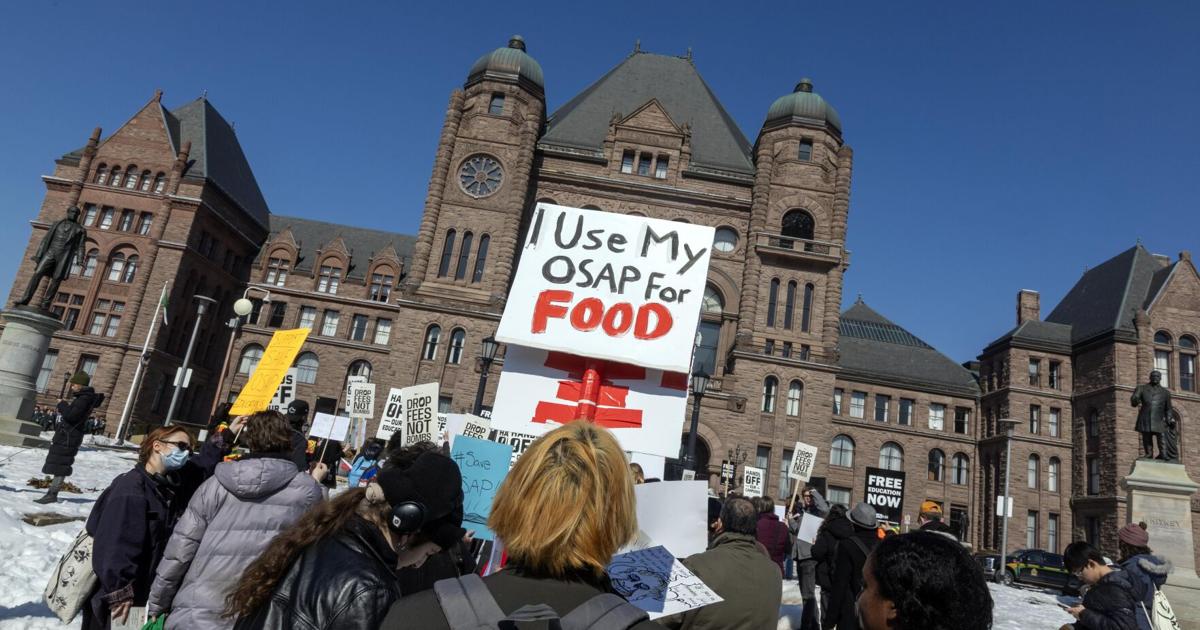
The OSAP changes sparked protests and walkouts across the province, with students and advocates warning that shifting aid from grants to loans will leave them with more debt and make post-secondary education less accessible, particularly for students already struggling with the cost of living.
The Ford government says the reforms are part of a broader effort to make post-secondary education more sustainable, while increasing overall funding for colleges and universities.
The reforms mark a return to the loan-heavy OSAP model that existed before the province, under Kathleen Wynne’s Liberals, reversed the balance between grants and loans in 2017.
Wynne’s expansion of grants was later scrutinized by the auditor general, who reported that the province had expected the changes to drive up OSAP’s net annual costs by roughly 50 per cent — to about $2 billion. According to the auditor general’s 2018 report, Wynne’s changes increased university enrolment by just one per cent, while college enrolment saw a two per cent increase.
The ministry says the new model will bring Ontario more in line with other provinces, while allowing the province to continue supporting students over the long term.
According to Alex Usher, president of Higher Education Strategy Associates (HESA), a firm that provides strategic consulting and policy analysis to governments, post-secondary institutions and agencies, says the Ford government’s move does bring it in line with most other Canadian jurisdictions.
“They’re not wrong when they say that the loan-grant mix they’re moving to is one that is shared by most of the anglophone provinces,” said Usher.
While the changes to the grant-to-loan ratio in particular have come under fire, Usher says the total amount of money students are getting won’t change.
“And that’s really what matters from the point of view of access.”
However, Usher points out that students borrow, on average, in three out of four years of their undergraduate programs, and the changes to OSAP funding could leave students who borrow throughout all four years of their studies with a significant financial burden.
For students who borrow throughout all four years of their studies, “You’re looking at an extra $15,000 in debt,” he said.
Usher added that shifting around the loan-grant mix doesn’t change much for “younger students who have a long time to (pay) back their investment.” But older students, who feel like they have less time to make back their investment, are more affected by the changes, he added.
The Star spoke to current post-secondary students about how the changes are shaping their education and future plans.
‘I’ll have something like $2,000 to get me through three months’
For students who are unable to work and rely on financial assistance to cover tuition and basic living expenses, the reduced grants may have made continuing their education financially out of reach.
Justin Bysma, a University of Windsor student who is on disability, says the changes to his OSAP funding have left him on the verge of dropping out of school as he’s now unable to afford living expenses.
“It’s been quite a drastic cut.”
Though his grant-to-loan ratio hasn’t changed much, he says his new financial assistance amount pales in comparison to what it was last term.
Prior to the changes, Bysma says he had up to $8,000 left over for expenses.
“But now after they take my tuition, I have something like $2,000 to get me through three months,” he said. “In the following three months, I’ll have about $1,000 to stretch.”
Bysma lives with his mother who is retired and on disability as well. His living situation, he believes, affected his financial aid amount as the province “expects her to put forward money for my education.”
“She can’t afford that,” he said. “We barely get by.”
He said he filled out the application as required with “virtually no changes to the previous year,” a period he also lived with his mother. He was surprised after finding out his total funding has shrunk from about $31,000 to just under $11,000.
“I’m one of many who will drop out, probably,” he said. “I don’t see me being able to stay in school without some kind of adjustment to my OSAP funds.”
‘I know who’s in charge, and I know they don’t care’
Besher Asmi, a fourth-year forensic psychology student at the University of Toronto, tells the Star that the recent OSAP changes have disrupted plans to pursue his master’s degree.
“When it was mostly grants, my loan for the first two years was $5,000 each year,” he said. “In this year’s loan-heavy OSAP, I got around $10,000 in loans and just over $3,000 in grants.”
A forensic psychology degree requires a master’s or PhD to work in the field, he explained. But the additional financial burden will force him to defer his degree while he works in an unrelated field in order to afford a master’s program without incurring more loans.
“When you account for inflation, and the fact that the loan amount is increasing, and the (grant) will not be a large enough amount, you just have to have a job and save up for a couple of years before even thinking about attempting a masters,” he said.
With forensic psychology degrees in high demand across Canada, Besher says that the government shouldn’t be putting hurdles in the path of those attempting to join the field.
“I know the people in charge, and I know they don’t care,” he said. “We have a problem with our prisons … we have reoffending problems. Isn’t this the in-demand degree that we need? And it’s not getting spared anyways.”
‘I’ll need a job’
Jadd Kabbani, a student in weld techniques at George Brown Polytechnic, says there is a noticeable difference in overall financial aid estimates. The decreased access, he says, has left him worried about falling behind on rent after receiving funding that fell far short of the amount he was expecting.
“It basically covered just tuition, and a bit extra,” he said. “Not enough to sustain a full-time enrolment in school. I’ll need a job.”
Though this is Kabbani’s first year receiving OSAP, he says he was told he would receive more than the $7,000 he ended up getting — half of which went toward tuition, while the rest was reserved for living expenses over the next four months.
“The fact that I’m in school is stopping me from working the hours I need to make up for the rent I need to pay,” said Kabbani.