STRATFORD—In Rosa Priore’s household, ragù reigns supreme. A dinnertime staple, it’s almost always simmering on the stove, its aromas wafting through the rooms of her family’s Neapolitan apartment.
Oh, how such a simple dish can evoke such warmth and comfort!
The same can be said of “Saturday, Sunday, Monday,” the latest Eduardo de Filippo gem to be mounted at the Stratford Festival by Antoni Cimolino, who closes out his tenure as artistic director with a comedy by the Italian playwright whom he has long championed.
Much like ragù, de Filippo’s play is simple and unpretentious. It’s a story that unfolds over three days, told over three acts and focused on a mostly unremarkable working-class family. The humour is homespun, the narrative complications entirely domestic, the language quotidian. But from these basic and altogether familiar ingredients, de Filippo has crafted a work that lands with the comfort and warmth of a motherly embrace. Translated from Italian into English by Cimolino and Donato Santeramo (this production running at the Avon Theatre is billed as a “new English version”), “Saturday, Sunday, Monday” is also one of the most beautiful plays to grace a stage this season.
“What the playwright and translators achieve marvellously is to capture the rhythmic patter of everyday life. It’s not just in the way the characters move through the Priores’ bustling, multigenerational home, filled with the sounds of shuffling footsteps, chopping vegetables and clanging dishes. It’s also in the humdrum rhythm of their daily interactions — in the furtive glances and fleeting remarks that carry the weight of full speeches.”
This rhythmic patter is essential to “Saturday, Sunday, Monday” because the play is all about routine and rupture — how we can so easily fall into the monotony of our daily lives, only to lose sight of the bigger picture and, most importantly, our relationships with each other.
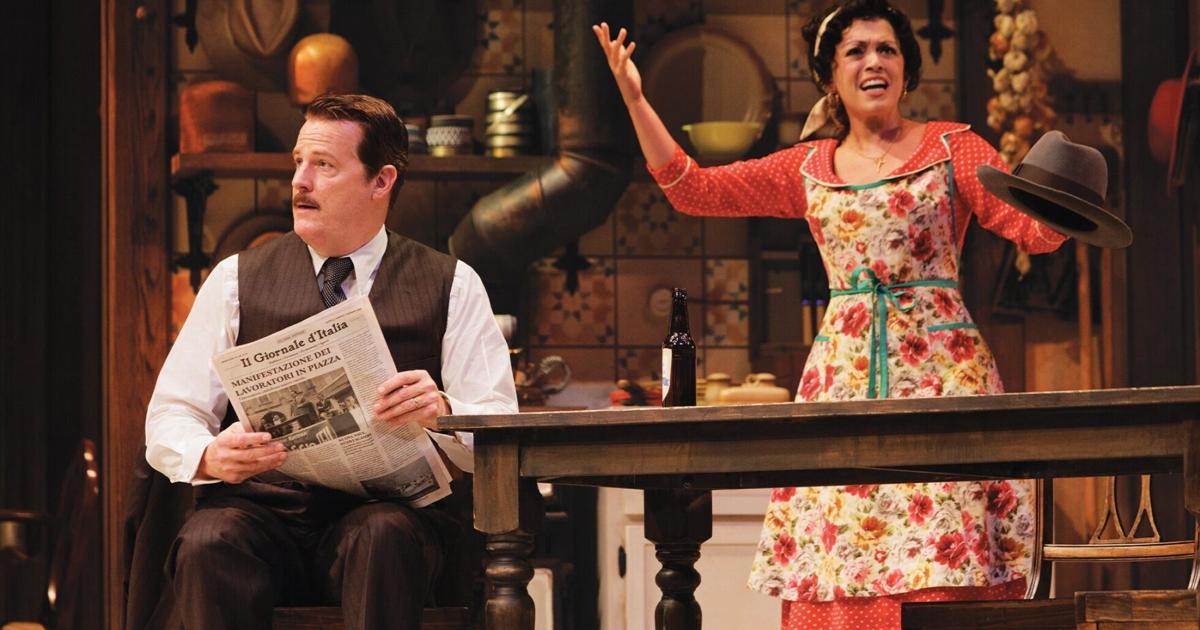
Such is the case with Rosa and her husband, Peppino. They’ve been married for years and have successfully raised three adult children. But when the play begins on a particular Saturday, the eve of a large dinner hosted by the Priores, it’s evident the middle-aged couple has lost its spark. Rosa is cold and curt toward her husband, offering little more than a few steely-eyed glances. Peppino, too, is distant and withdrawn.
Over the course of the three days (and three acts), de Filippo gently reveals the source of their souring relationship — how their inability to communicate with each other has allowed minor misunderstandings to fester into doubt and mistrust. It all comes to a head when Peppino falsely suspects that his wife is cheating on him with their neighbour, Luigi (Gordon S. Miller), a gentle-souled accountant caught in the crosshairs of Rosa and Peppino’s marital squabble.
The couple’s storyline forms the main arc of “Saturday, Sunday, Monday,” giving the play its shape. But it’s the other characters who round out the comedy and lend buoyant humour to the show.
A secondary plot follows the Priores’ youngest child, Giulianella (Katarina Fiallos), whose independent personality puts her at odds with her fiancé, Federico (Maher Sinno). Among the other denizens of the Priore apartment are Rosa’s mischievous father Antonio (Rod Beattie); Peppino’s siblings Raffaele (Geraint Wyn Davies) and Meme (Seana McKenna); and the family’s maid (Jenna-Lee Hyde).
In Cimolino’s production, some of the actors’ hard North American accents initially come across as jarring. Douglas Paraschuk’s set, with wide hallways and floor-to-ceiling windows offering expansive views of Mount Vesuvius, is also too large and, frankly, too American in its design for a play about an Italian middle-class family.
But Cimolino manages to fill the space effectively and make the apartment feel like a home. More crucially, he ensures that Rosa and Peppino’s relationship remains the play’s focus.
He’s aided immensely by Rose Napoli and Graham Abbey, who, in these central roles, are exceptional. Neither assigns blame to the character they play. No one is right, and no one is wrong, for there are no real winners or losers in Rosa and Peppino’s relationship.
As Peppino, Abbey makes the smallest choices speak volumes — his fingers nervously tapping on an armchair and his averted gaze darting around the room offer deep insights into his character. In the play’s climactic dinner party scene in Act 2, without delivering a single line, Abbey so clearly demonstrates how the man feels like a stranger in his own home, always on the outside looking in. In his Peppino, there’s Willy Loman, King Leontes and Hamlet, all wrapped into one.
Napoli, by contrast, offers a bigger, more extroverted performance. Part of that is because of how her character is written. But like Abbey, she always ensures that every choice is deliberate and considered. Together, the pair effortlessly convey the love between Rosa and Peppino and the immense hurt that grew from years of shared misunderstandings.
“Saturday, Sunday, Monday” ends quietly, not with twists or surprises, but with a gesture of reconciliation. It’s a play about forgiveness and, most of all, closure. For Cimolino, it’s a splendid production to close out his time at Stratford.
Error! Sorry, there was an error processing your request.
There was a problem with the recaptcha. Please try again.
You may unsubscribe at any time. By signing up, you agree to our terms of use and privacy policy. This site is protected by reCAPTCHA and the Google privacy policy and terms of service apply.
Want more of the latest from us? Sign up for more at our newsletter page.