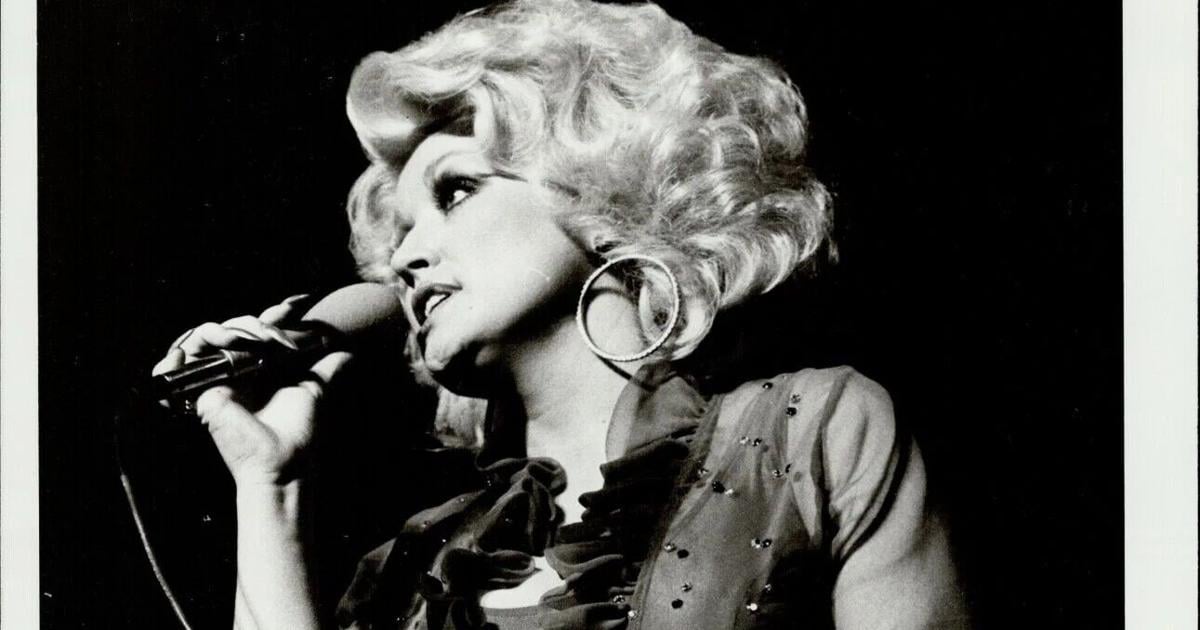
Almost half a century has passed since former Toronto Star writer Kevin Boland spent days in Dolly Parton’s orbit, but the extraordinary encounter still feels remarkably familiar.
It was the summer of 1978, and Parton was 32, a little more than a decade into her fame. She had released “Jolene,” but was still a couple years away from “9 to 5.”
Boland had been assigned to meet Parton, who died Tuesday at 80, as part of the promotion for an upcoming show at Toronto’s CNE Stadium. What began as a press trip to Maryland, with plans to watch her live, turned into a career highlight when he connected on a surprising personal level with the young music icon.
“I really got to her,” he said. “And I got news for you, she really got to me.”
It wasn’t often that happened, insists the 85-year-old former journalist, who worked at the Star beginning in the late 1970s. Throughout his career, he grappled with big egos as a sports reporter, but there was something unique about Parton and her knack for speaking incisively — “in one ear, and out the typewriter,” he calls it.
“Everything she said was right on the money,” he recalled. “She was so quick and so unguarded.”
Boland captures that magic in “Dolly in Wonderland,” which ran in the Aug. 20, 1978 edition of the Star. The piece takes readers from the front row of Parton’s Maryland concert to an in-depth interview where she recalls her Tennessee upbringing, rise to stardom, and even openly tackles a question about how such a pretty, young married lady doesn’t give into a cheatin’ temptation.
That Parton even answered the question surprised Boland, especially because he didn’t actually ask it. He said Parton had misinterpreted a different question and offered her candid response anyway.
“Anything you asked, she’d answer,” he said.
Boland credits part of his story’s success to one-time Star photographer Dick Loek, who snapped the striking image that ran alongside it of a glowing Parton kicking her leg high in the air.
“He was able to do things to set her up,” he said. “It was like a perfect team, the two of us.”
The story was splashed across the front page of the Star’s Entertainment section and caught the attention of executives at RCA Records — as well as Parton herself. She invited Boland to her CNE show later that month.
“I think they came and picked me up in a limousine,” he said.
The concert itself wasn’t quite as extraordinary. Boland said anyone who remembers the CNE venue can probably relate. Parton was placed on a tiny stage in the middle of the football field, belting her heart out to an audience a couple hundred feet away in the grandstands.
“She must’ve looked like a postage stamp to a lot of people,” he said. “But she would be the only person that could sell it.”
Looking back, Boland said he’s proud of the story that came out of his whirlwind experience.
“Gotta say,” he said, “it’s the best thing I ever did.”
Now, you can read Boland’s original 1978 story, “Dolly in Wonderland,” below.
Dolly in Wonderland
Even the butterfly king loves this little lady
Kevin Boland
Sunday Star
COLUMBIA, Md. – Adrift on an ice cream cone of light, an amber gash in the broadcloth of night, the butterfly traces a ribbon’s bow.
It is a monarch. A beauty. And, without so much as a by-your-leave, it is fixing to set down in the nest of blonde curls on top of Dolly Parton’s head. With a swish of her invisible magic wand and a dimples-deep smile, she shoos it back beneath the cover of darkness. Not a beat is missed in the hurtin’ song she’s wafting up the galleries of the Merriweather Post Pavilion.
There are 10,000 folks out there tonight. In spite of a day’s hard rain and the threat of more, they are here to see the nomad queen of country music, come to see her in all her regal raiment. They are swept away. Even the king of butterflies, most aloof of all God’s tiny creatures, loves this little girl from the Smoky Mountains of Tennessee.
And, swaddled in mauve chiffon, she is all prettied up for them. Her silk lounge suit, just a shade this side of royal purple, hugs her saucy rump, flares at the knees and ruffles up on top, diminishing the thrust of her breasts. On the third and pinky fingers of each hand, clusters of diamonds detonate with each burst from the arc lights. Her face, lipstick and rouge and glitter, is for all its artifices, full and open and womanly. But when she tells a story, as she does before each song, she’s the little nipper from Sevierville, pleased as punch the grown-ups are taking heed. She clasps her hands behind her back, rocks on her high heels, blinks her gypsy moth lashes with every rush of words.
Who could fail to love her?
Mention this to her, as was done in the hours before her show, and she fairly bubbles with good feelings. Her eyes, a brittle blue, are set to dance and her smile turns up to 150 watts. “Awww, do people really think that about little Dolly?” She wants to hear it again.
“Well I like to think it’s ‘cause they know I love ‘em back. I don’t try to put on the dog for them, other than just costumes and wigs and jewelery and stuff, which is all for show and they know it. I guess, when it comes down to the nitty-gritty, I’m real people, just like them. They can share their happiness with Dolly. And their sorrows. They know I understand.”
Her voice is high and small and there is much in it to suggest a toddler, nose pressed to candy store casing, wondering how best to spend the bright-shining penny in her little hand. This is the key to Dolly Parton. Though she has none to call her own and the years for bearing them are fast slipping away, it’s as clear as the stars over Smoky Mountains that her love rises and sets upon little people.
“The little bitty kids, like from one years old to 10 years old, they like me the best of all my fans.” She nods her head. Yes. Yes. Once, then twice more, she blinks. “I think they relate to me because my voice is tiny and comes from way up there. My name is Dolly and a lot of little girls have dolls, so I guess it’s really easy to connect the two. The little boys, well, I guess they’d like me for a big sister ‘cause I’d be good with ‘em. And my fancy clothes and hair and pretty things. Some folks figure them for being bizarre. And they are, too, you understand. But the little kids, for them it’s dress-up time. Like Cinderella.”
To be sure, there are comparisons.
She was born Jan. 19, 1946 in a farmer’s cabin, the fourth of a dozen children of Avie and Robert Lee Parton, poor as the dirt from which they scratched their living. There was no electricity, no plumbing and no hope of getting any.
Being poor in the high country amounted to nothing, so to speak, because poverty was the constant that marked the weary trail from cradle to pauper’s gave.
“We didn’t miss what we didn’t have ‘cause we didn’t know we had nothing.” Odd, that, as she says this, her hands are in front of her, palms up. “It didn’t mean a darn thing until people started telling us about what some folks had.”
Though she has told the story a thousand times or more, though she wove the experience into her most-cherished song, there is hurt in her little girl’s voice when she talks about the coat of many colours. From scraps of clot, her mother pieced it together for going to school, love sewn in every stitch. And how they laughed at playtime. Sometimes, when she sings “Coat of Many Colors,” she weeps.
“The littlest thing would make us happy,” she says, her smile back in place. “When you ain’t got a lot, it don’t take all that much. Like Christmas, the girls all would get a little pink doll with the little rubber bands in the legs and arms, with the little red-dot eyes. They cost about a dime. And the boys would get a knife. We didn’t have any money and there’s a batch of kids, but we always had apples and oranges for Christmas.”
When she thinks back on those days, the vision she summons first is of a little mischief-maker who had more hiding places than a chipmunk. “Lots and lots of them. All over the mountain. Little nooks and crannies where I’d squirrel away and write my songs. One special one where I’d go a lot, was down by the creek, a little thicket where I could be away from everyone else.
“I used to live in fairytales, I guess. We didn’t have a TV or radio, so us kids would play out stories in the Bible. We would be disciples, you know, and we’d preach. I was fascinated by the beauty of nature, flowers and butterflies and birds. Well now, I guess I was six or seven but, even as a little kid, I’d just wander off in the woods and fields, you know, pickin’ flowers and chasin’ butterflies and hummingbirds and stuff.”
She dreamed, too, of a day when she would dress like a princess. “I’ve got about 12 closets at home in Nashville which are full,” says the woman, lounging now in tight black slacks, tube top and oversized floral shirt. “Maybe 2,500 outfits, but I give a lot to my family. And there’s a lot of benefit auctions country people throw. I like to help out.”
Some may perceive her as a dumb blonde, she agrees, but this is one country girl who’s nobody’s fool. “I have a good man to keep a good eye on the books and I have a good man to keep an eye on the road,” she chirps, “and I keep a good eye on both of them.”
Like others stifled by the poverty of the Smoky Mountains, she could have up and left as soon as her young legs could carry her. But blood runs thick in Dolly Parton.
“My oldest sister married when I was 10 and, what with mama sick a lot from workin’ so hard, I was like the mother hen. I was 18 and finished high school when I went to the big city. Just about the saddest day in my life, I reckon, and I was scared, but not so scared I wasn’t gonna do it.
“I believed that I could do it and I knew that I would stay straight. I was used to havin’ nothin’ so I knew I wasn’t going into anything worse.”
The clan gathered in the back yard to wave Dolly off in the car that took her to the bus station. “It was worse for the kids. All the kids loved me because I told them stories. They all tried to sleep with me and I was real attached to them. My mom was crying and my daddy, who was more scared than I was, was telling me not to get into cars with strangers.”
She wept all the way to Nashville.
“You know, 18 years of something you’re used to and then, all of a sudden, you’re going into something you know nothin’ about. I cried for nights afterwards, living by myself. I used to think, oh, what a great pleasure it’ll be when I’m 18 and I can sleep the whole night through without fixing the baby’s bottle or hearing the kids cry. Then, when I got away, I would have given anything to be with them again.
“But I made a vow to myself on the bus, that I wouldn’t go home until I’d seen some results, until I had something to tell about that would make everybody happy.”
Confidence? She prefers to call it faith.
“I’m not a fanatic but I have my beliefs. I’ve always had this inner spring. I knew, no matter what, I could always turn to God.
“Somehow, even as a little child, I was a little different. I just say it’s God. It gave me nerve, it gave me courage, it gave me strength. It also gave me the intelligence to know what to do. It gave me the endurance and all the things you have to have in order to achieve something.”
Right away, she got a deal for $50 a week from a song publisher. Not long afterwards, a spot on a morning TV program. Soon she had a contract with Monument records, and then, in 1967, she hired on with Porter Wagoner who introduced her to RCA. She put in the years but pretty soon she had bigger fish to fry. With kinfolk reaping benefits, she formed the Travelin’ Family Band.
One country chart-climber followed another but Parton could sense the shift of Middle America toward a broader definition of western music. They were tuning in Linda Ronstadt and Emmylou Harris, hunkered down to a sound more raw and vital.
This was 1976 and Dolly Parton decided to move. Gypsy Fever, a new band. A new management, a new booking agency, a new public relations firm, a new promoter. She’d be known the length of the land or she’d know the reason why not.
Since she made the decision to gain a wider appreciation of her music, she’s been on the cover of every major magazine — including — this fall, Playboy. But don’t expect her to doff her duds inside, not by a longshot. If she’s not on television, as she was in a recent Barbara Walters special, someone’s talking about her. Here You Come Again, last year’s album cut in the midst of 40 weeks on the road, sold a million. RCA expects a similar response from her new album and single Heart Breaker. All this comes to Toronto, by bus, sometime Thursday. And she’ll be at the CNE Stadium the following night.
But, though life has taken this girl out of the country, she insists the country will not be taken out of this girl.
“I’m not leavin’ country,” she almost pleads. “I mean everybody knows I’m country. I know I can do that real well. So I’m trying to prove now that I can do it and I can do other things. I don’t think I should be caught in a circle. I’ll always stand for country but I can do lots of other things and I will.”
The project sparking most interest is the album she intends to cut with Ronstadt and Harris. Though they recorded some songs earlier this year, “we never did get back to it. We realized we didn’t have near what we needed for the variety we wanted.” And, though, Ronstadt and Harris revere Parton, there’s more to getting out an album than three friends getting together. “You’re talking about three artists, three companies, three management firms. A lot of different things. It ain’t easy.”
Meanwhile, there are movies, and once she gets the hang of this actin’ business, one about her life.
“The first movie, it’ll probably be something similar to ‘The Goodbye Girl’ or ‘Annie Hall,’ something that’s me. I don’t intend to take any lessons. They saw me as a natural and I told them that’s a good thing because if they was going to do a movie with me, they’d have to do it natural. I’ll have to play my kind of person, so I can say the words my way.”
There’ll be trouble in the clinches.
That first day in Nashville, she met Carl Dean at the Wishy-Washy Laundromat. Love bloomed. She became his bride two years later. Carl Dean is a private man and the thought of anything more than a brotherly kiss — make believe or not — does not sit well with him. “Which I can kinda understand, ‘cause if it was him, I wouldn’t want him kissin’ anybody on the mouth.”
He’s really not the jealous type, Dolly assures her visitors. “He’s certainly not going to lose any sleep over whether I kiss somebody.” Pause. “He’ll probably beat my ass off, but he won’t lose any sleep.” The line breaks up the room.
And it begs the obvious question.
Dolly Parton is so good-looking, she ought to have a licence to go out. She’s young and the world is at her tiny feet, sweet-talkin’ fancymen popping up at every bend of the long, long road away from home. Is she ever, ever tempted?”
“Well, let’s put it this way. People usually respect me. I think people know if you respect yourself. That’s not to say that I wasn’t ever moved by somebody. I often meet people who really turn me on but I try to keep good sense.
“If I like you, I can tell you that I like you. I can kiss you on the cheek or I can hug you or I can just say ‘I really like you, you know.’ I like men ‘cause I can be a person with them, forgetting if I’m a girl or a boy, just a person. If there’s other things they like about me, well that’s natural. That’s male-female.”
“But talkin’ is as far as we can go, I’m afraid. I know we can’t go to bed because I don’t want to get involved in case, you know. I get really involved. I don’t want to have a heartache somewhere, knowing I can’t be with a person that really turns me on.
And besides, it’s not way for girl to act who wants to go to Heaven.
“I would like to be remembered as a person who used her God-given talent, did everything humanly possible to make it worth believin’. I’d like to be thought of as a person that was serious but had a lot of fun, a person that tried to get everything out of life. And if that’s not enough, well, tell St. Peter I don’t want to go, anyway.”
And what will heaven be like?
In the eyes of Dolly Parton there is a faraway look. Her face is solemn and, in your heart of hearts, you know this is how the angels will look when judgment comes. And then, quickly, she comes back to earth.
“Like Hawaii, the first time I saw it.”