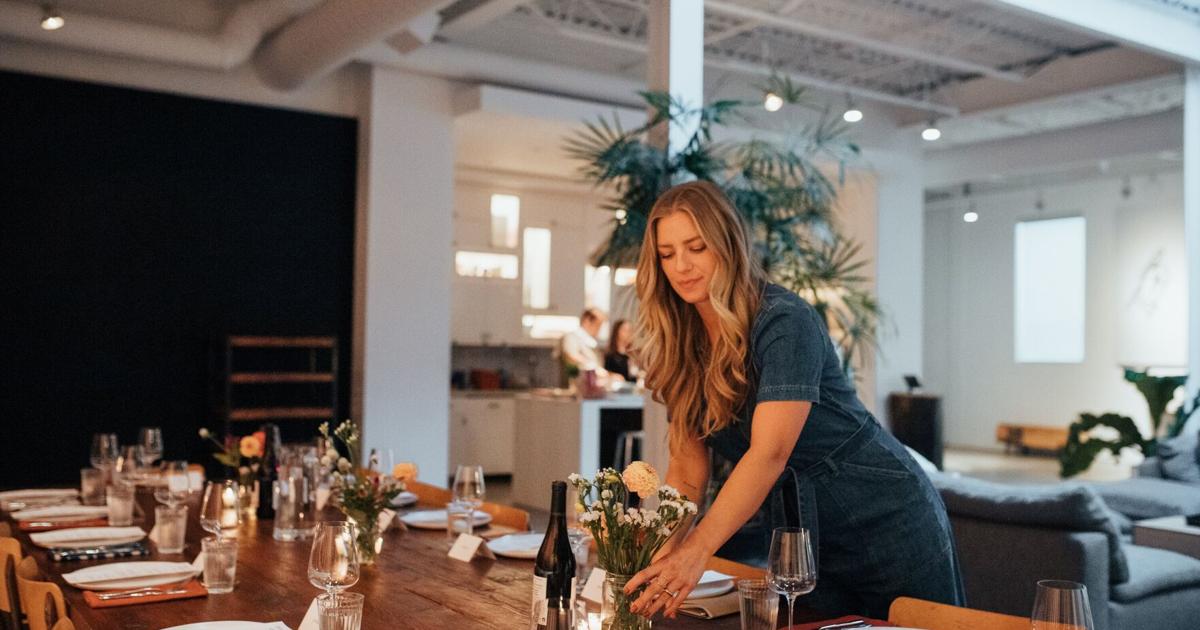
Jess Janz has made a living out of bringing people together over a meal. Since 2017, she’s hosted more than 1,000 guests at 64 dinner parties — 99 per cent of them new to her and each other.
She called the project Dinner With Strangers, and has since expanded it to other kinds of gatherings, like singles events and parties for brands including Pinterest, OpenTable and Staub. Last month, she published her first book, the already bestselling “The Table Where We Meet,” in which she chronicles the lessons she’s learned from hosting all those dinners. (Here’s one: Always assign seats with name cards, no matter if everyone or no-one knows one another, so the last guest to walk in never feels like they’re stuck with whatever spot’s left.)
Dinner With Strangers began almost by accident, hatched in a hair salon in Toronto’s east end where Janz met Ryan Cantelon, then a hairstylist and now her business partner. “It wasn’t like, ‘Oh, we see this gap in the market, and we see a way to help,’” said Janz. “It was almost self-indulgent. We were like, ‘What if we did this? What would that open up?’ So we just hosted a dinner and saw what happened.”
That first dinner party was chaos from the beginning. The salon didn’t have a kitchen, so they cooked the food at Cantelon’s house instead, juggling dietary restrictions and the “50 million different things that we were making.”
By 6:45 p.m., with guests due at 7, panic set in. “We looked at each other with deer-in-headlights eyes, like, is this the worst idea we’ve ever had?”
It wasn’t. Janz invited four friends, Cantelon invited four friends, and suddenly, different kinds of people who would have never otherwise crossed paths were sharing a table: a high-powered investment banker across from a bike courier who was studying to become a youth worker.
There was one rule: no talking about work. “It creates an immediate, shared discomfort in the room; whether we know it or not, we do these subconscious rankings of authority,” said Janz. It’s something she feels acutely herself. The rule “gives permission to the people who don’t find their jobs fulfilling to put that aside and talk about the things that do light their world up.” That’s what she believes made those dinners so magical.
“I have this distinct memory of looking around with my elbows on the table, thinking, ‘How do I do this as my job?’” said Janz. “It wasn’t a business feeling. It was just, ‘How do I do this all the time? I need this in my life.’ And then I was like, ‘Ha-ha, as if.’”
A guest at one of her early dinners happened to be a wedding photographer and shot snaps of the evening. Janz posted a seven-second TikTok of the photos and it went viral overnight. By the morning, she had about a thousand messages from strangers wanting in. “It was one of those universe things,” she said. “I didn’t know what I was doing, and it just happened.”
Before hosting became her bread and butter, Janz spent years working retail and restaurants, which she now sees as foundational training. She credits it for quick problem-solving under pressure and anticipating what people need before they know it, like clearing plates and refilling water glasses.
Janz likens hosting a dinner party to a great many things, including a theatrical performance, a kind of invisible choreography. “We would call it pushing the canoe into the water. Then you start the event, and it’s this big dance that happens.” She also compares entertaining to movie sound design: “If they’ve done their job, you don’t even realize the music is happening. But if it’s bad, you’ll notice.”
What really makes an evening sing is the conversations. At any given house party, Janz says she’s the one in the kitchen having a philosophical sidebar chat until 2 a.m. “I’ve always been curious about people,” she said. “I’m not an academic, I’m not a sociologist, but I think we can learn so much from … the stories of others.” Her advice for making dinner table conversation flow: skip generic questions — “what’s your favourite movie?” can be a dead end — and instead tee someone up to tell a story, because stories are what makes two strangers feel like they know each other. Try, “What’s something that makes you lose all track of time?” or “What is a decision you’re glad you made?”
Not every interaction has to be deep. Janz believes social connection can be low-stakes and still meaningful, like saying hi to your neighbour and addressing them by name, or striking up a conversation with your grocery-store cashier. “Small talk is necessary,” she said. “Just engaging with people is a beautiful thing.”
After nearly a decade of hosting, Janz says her dream dinner party looks simpler and more stripped down than ever. It’s “unhurried and un-performative and anti-networking,” she said. “Put our phones down and be present with each other. That’s what I’m craving more than anything.”
Jess Janz’s Top 5 Hosting Tips
How to gather people together — and make sure they have a great time — like a pro.
Give a warm welcome
Set up an obvious self-serve drink station, and put a welcome cocktail or mocktail directly in guests’ hands the moment they arrive. “That does a lot,” said Janz. If your space is confusing to navigate, put up a small sign pointing toward the bathroom to remove any awkward guesswork.
Make a start on the charcuterie board
Before guests arrive, eat a few olives (and put the pits in the designated bowl) and take a slice of brie “so people don’t feel like they’re the first to mess up the display,” said Janz. This encourages them to dig in right away.
Let go of the Pinterest fantasy
Janz calls herself “an OK cook” at best, and she refuses to let that — or an un-Instagrammable living room — get in the way of hosting. Order pizza. Do a potluck. Ask everyone to chip in $20 for takeout. “Don’t let this idea that it must look a certain way be a barrier to having people over.”
Remove the group’s fallback topic of conversation
Janz’s “no work talk” rule for Dinner With Strangers works to stimulate conversation by stripping away a communication crutch. She suggests applying the same logic in other settings: no talking about volleyball with the volleyball team, no talking about motherhood with your mom friends. “Take out your go-to topic and see what happens.”
Give your party a purpose
Borrowing from Priya Parker’s popular guide, The Art of Gathering, Janz swears by naming the purpose of a gathering out loud, instead of leaving it vague, and embracing what Parker calls “unapologetic exclusivity.” That might mean gathering your Bravo-obsessed friends for a Real Housewives debrief over wine (too bad, non-watchers!) or inviting your new neighbours for a “welcome to the street” BBQ.