The school year is about to start — but teacher and support staff contract talks are nowhere near finished.
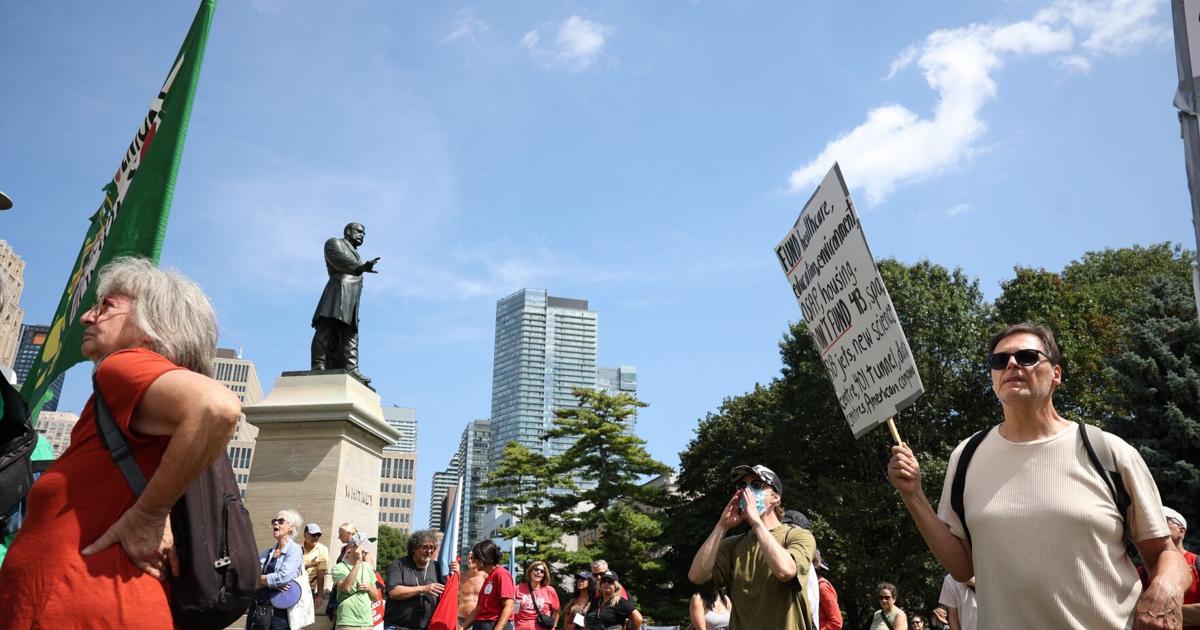
On Saturday — just two days before all agreements expire Monday — education unions took part in rallies held across the province. And they’re planning their own in-school day of solidarity Sept. 16.
While it is not unusual for negotiations to continue into the fall and new year, this time around they have stalled at the outset, with the province and most education unions duelling over what is to be discussed at central and local tables under Ontario’s two-tier bargaining system.
They now await labour board rulings, which could take weeks or months. With no strike votes taken as yet, and with no real talks, job action or strikes can’t happen anytime soon.
“It’s truly frustrating. We have been talking about bargaining for quite some time; we did ask to bargain early,” said Joe Tigani, president of CUPE’s Ontario School Board Council of Unions, referring to a call by education labour leaders to begin talks last March instead of June.
“Our members are going into the fall knowing that we’re short-staffed” and under-resourced, he added. “Kids have less; workers have to do more with less.”
Under the province’s bargaining system, big-money items such as salaries and benefits are discussed between the unions, and the province and the association representing directors of education, with more administrative issues left for union locals and individual boards.
“At this early stage of bargaining, the first step is to determine what issues will be negotiated at central or local tables. Those decisions are still underway, with some unions choosing to bring this matter to the Ontario Labour Relations Board,” said Emma Testani, press secretary to Education Minister Paul Calandra.
“We respect their decision to do so and at all times are ready to continue discussions on the scope of central versus local issues before proceeding to the next stage of negotiations.”
Tigani hopes the labour board process “will be done in a reasonable time frame, which will allow us to get back to the table and engage in some meaningful conversation … We will be looking ahead and planning for all eventualities into the fall and into the spring.”
He added, however, that “if the government continues to do everything they can to stall the process and not want to engage, then I guess we may have a look at other options to get them to engage in the bargaining process … I mean, if it’s March of 2027 and the government still is trying to figure out a way to not bargain, I think we’re having a very different conversation.”
While the province is spending more on education, unions and school boards have argued it has not kept up with inflation most years, and doesn’t match their actual costs.
But with $30.6 billion in core education funding this year, Testani said “our government continues to make historic investments in education to protect student learning, strengthen classrooms and ensure students and teachers have the supports they need to succeed.”
She said that funding increases since 2017 have hit 30.8 per cent, “outpacing inflation of 27.1 per cent over the same period.”
Rob Kristofferson, a labour studies expert and professor at Wilfrid Laurier University, said the decision on what is negotiated centrally and locally is important.
“They unions have talked about surplus and redundancy rules” around jobs, he said, “and they feel those issues can be very unique to local boards and are not suitable for centralization. I gather the government is going in the other direction.”
Kristofferson, who is also president of the Ontario Confederation of University Faculty Associations, said with the labour board decision “this could drag on for a few months before we get much indication which way it’s going to go.”
However, he added, “democracy can be messy and time-consuming, but it’s certainly a valuable thing that we need to preserve. We can’t just do everything in the sake of efficiency or uniformity; we need to have our local communities, parents and teachers locally who understand those environments much better than some remote government at Queen’s Park, and they should be participating in the decision making about their local institutions.”
For now, there is no threat of a strike or lockout hitting schools. Bargaining has to begin in earnest before the sides can apply for conciliation, and if no deal is reached after that, a no-board report can be issued allowing a strike or job action 17 days later.
The day of solidarity planned next month is expected to be like one held last spring, with union members sporting similar colours, or union leaders speaking publicly about the issues.
David Mastin, president of the Elementary Teachers’ Federation of Ontario, says it’s a show of unity for all 275,000 teachers and education workers in the province.
Error! Sorry, there was an error processing your request.
There was a problem with the recaptcha. Please try again.
You may unsubscribe at any time. By signing up, you agree to our terms of use and privacy policy. This site is protected by reCAPTCHA and the Google privacy policy and terms of service apply.
Want more of the latest from us? Sign up for more at our newsletter page.