For a few days, Chris Swonger saw some light at the end of the tunnel.
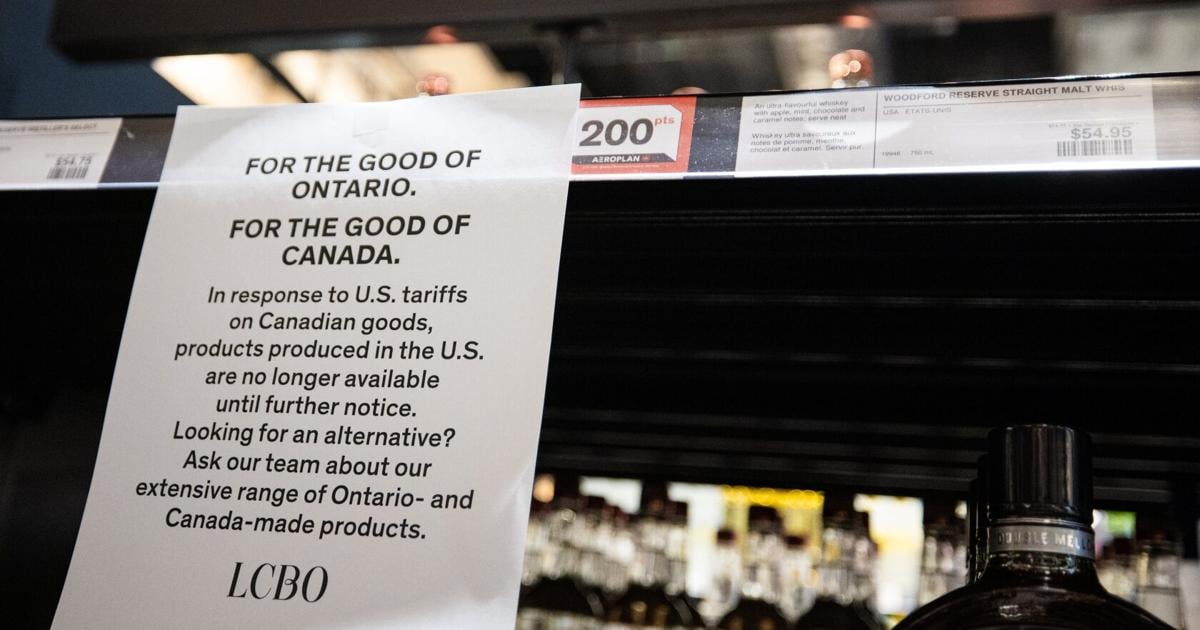
The head of the association representing U.S. distillers was optimistic a trade deal with Canada was at hand in mid-August, and that American liquor, wine and beer would soon be back on the shelves at the LCBO and other provincial monopolies.
Then came word that Prime Minister Mark Carney was pulling Canadian negotiators out of last-minute talks, and a tentative deal was off. So, too, was any momentum towards ending a boycott of U.S. products by most provincial monopolies which has been in place for 18 months.
That late night announcement Aug. 21 was a crushing disappointment for Swonger and his members.
“They’re just devastated. We’d built up excitement. We were hearing provinces were getting ready to stock our products again,” said Swonger, CEO of the Distilled Spirits Council of the United States. News that the talks were off came via Carney’s social media post, Swonger added. “We found out just like everybody else.”
Ahead of the talks’ collapse, the LCBO had started sending U.S. products from its warehouses to stores, in anticipation of being given the greenlight by the Ontario government to start selling them again. This week, industry sources said, the provincial liquor monopoly has begun shipping them back to its warehouses. The LCBO says it typically sells just under $1 billion worth of American products a year.
The boycott, which began earlier in U.S. President Donald Trump’s trade war against Canada, has cost American distillers hundreds of millions of dollars in sales so far, Swonger said.
“We’ve lost 73 per cent of our exports to Canada. It was a $200 million (U.S.) market annually for us. Now it’s $60 million,” said Swonger, noting that Alberta and Saskatchewan still import American alcohol. At today’s exchange rates, that means that over 18 months, the boycott has meant a $291 million (Canadian) hit to the American liquor industry.
For American wineries, the hit has been even bigger, with numbers provided by California’s Wine Institute showing a $522 million (U.S.) drop in exports to Canada over the same period. That’s $723.7 million loonies, if you’re counting.
“We are disappointed that an agreement has not yet been reached to end what has been one of the most significant market disruptions for the U.S. wine industry in generations,” Steve Gross, CEO of Wine Institute, an association that advocates for California wineries, said in a written statement. “We urge both governments to continue negotiations and work toward a resolution without further delay.”
The provincial boycotts couldn’t have come at a worse time for U.S. alcohol producers, who were struggling with changing consumption patterns even before the trade war started, said bourbon author and educator Fred Minnick.
“The fact is, the Canadian bans happened simultaneously with the younger generation not consuming as much,” said Minnick, noting that some distilleries have scaled back production, and some barrel-making facilities have closed.
“The Canadian bans have absolutely impacted the decisions made to slow down production. They have to forecast sales for four to eight years from now. It’s a part of the equation for sure. But if everything was rosy in the domestic market, they’d probably say ‘OK, we can keep going,’’’ Minnick said.
Late last year, Jim Beam announced it was halting production at its flagship distillery in Clermont, Ky. for all of 2026. Brown-Forman, which makes several U.S. whiskeys including Jack Daniel’s, permanently closed its barrel-making facility in Louisville, Ky. last year. In mid-September this year, a major barrel-making facility in Alabama, which was previously owned by Brown-Forman, is closing permanently.
There’s no question, said Minnick, that the provincial boycotts have had an economic impact, especially in Kentucky.
“This has been very bad for Kentucky bourbon producers. And it has definitely cost some people their jobs,” said Minnick.
Bourbon makers, like other U.S. alcohol producers, are also taking a hit from the financial struggles of local and national distributors in the U.S., Minnick said. He pointed to the July insolvency filing of Republic National Distributing Company, which owed unsecured creditors, including booze conglomerates, more than $400 million (U.S.) at the time it filed for Chapter 11.
Most U.S. distillers, said Minnick, are optimistic that Canadians will one day have American-made whiskey back on the shelves. While there might be some lingering anti-American sentiment, he predicts that bourbon sales will bounce back in fairly short order.
“Canada is a great market for American whiskey, and I anticipate very strong sales when it opens up again,” said Minnick.
Still, the Distilled Spirits Council’s Swonger acknowledged, the industry can’t just take Canadian goodwill for granted, even when bourbon, Tennessee whiskey and Tito’s vodka come back to store shelves in Canada.
“I think it’s going to take some time. I appreciate and understand the strong pride and national emotions. It will take a lot of work…to reconnect.”