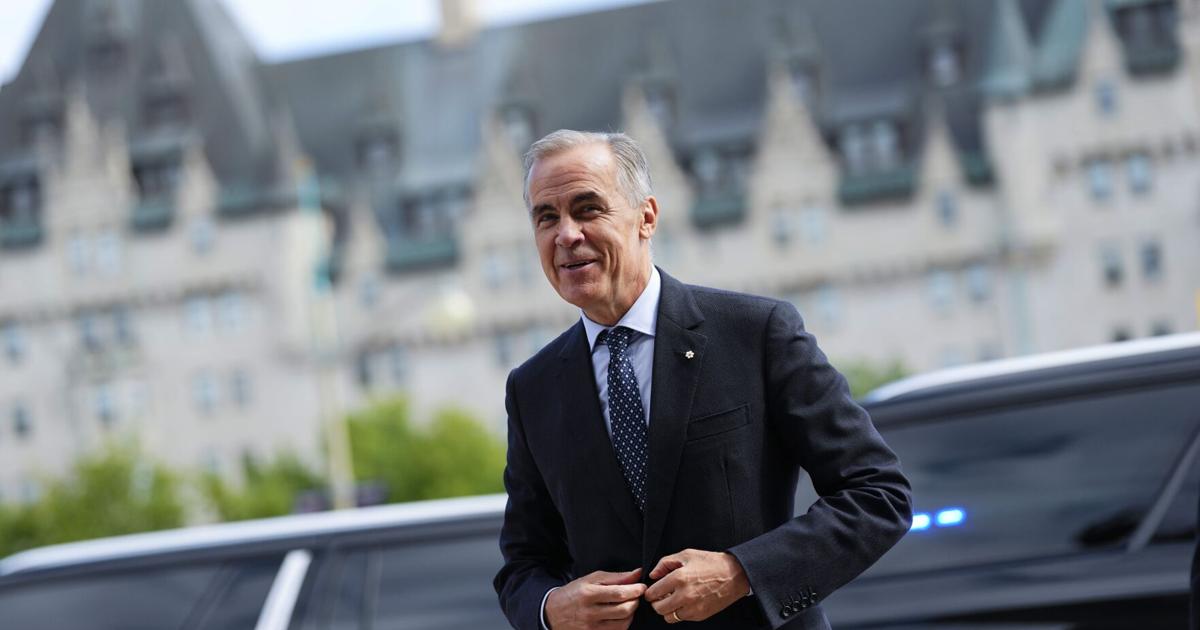
OTTAWA — Prime Minister Mark Carney says there is still a “positive opportunity” for a trade deal with the United States, but that the Trump administration must respect Canadian sovereignty and adopt a more serious tone before Canada returns to the negotiating table.
Speaking to reporters Tuesday morning outside his office on Parliament Hill, Carney said there were multiple issues that alone would have been enough for Canada to reject the deal that fell apart in August, including concerns about French-language protections and Canada’s freedom to pursue its own trade deals with other countries.
He also said U.S. officials need to stop taunting Canada online — a day after U.S. Defence Secretary Pete Hegseth posted an image on social media mocking Canadian military cadets — which Carney panned as “beneath their office.”
“When the Americans stop doing memes, stop throwing shade, stop trying to be tough and start being serious about having those discussions, we can have those discussions,” Carney said.
He added that before he told Canadian negotiators to abandon the talks, “there were elements of that mutually beneficial deal that we were moving towards, which is why we were still at the table, but we never viewed that we had that deal and it diverged towards the end.”
When the talks collapsed last month, the Trump administration slapped new 50 per cent tariffs on almost $28 billion worth of Canadian goods, adding to the suite of import duties that have hammered sectors like automaking, steel and aluminum manufacturing, and the forestry industry. The federal government intends to strike back on Sept. 8 with counter-tariffs.
Since then, U.S. Trade Representative Jamieson Greer has suggested the Trump administration will take further action if Canada follows through with those retaliatory tariffs. Trump had already threatened to hike import taxes on Canadian autos from 25 to 50 per cent, and Greer told the CBC last week that, “if there’s further retaliation from the Canadian side … we’re not going to just sit down and take that.”
Tensions have also escalated in recent days, with Premier Doug Ford lampooning U.S. President Donald Trump as a “dictator” and a “loser” who can “kiss my ass,” and Trump declaring that Lake Ontario will now be called “Lake America.”
At a G20 meeting in Asheville, N.C. on Tuesday, federal Finance Minister François-Philippe Champagne was scheduled to meet with U.S. Treasury Secretary Scott Bessent later in the day. Speaking before the meeting, Champagne told reporters he would be “firm” yet “constructive,” while looking to “reduce the friction” of recent days while Canada stays true to its position that it had to walk away from a bad trade deal.
Earlier this week, Bessent dismissed the idea of a “tit-for-tat” trade war between the U.S. and Canada, noting that the American economy is several times larger than Canada’s. He claimed Carney had turned the situation into a “political shouting match” that is only in the interest of his governing Liberal party.
“We’re not at war with Canada. How are we going to be at war with Canada? … Are they going to take their two submarines from the Edmonton mall and sic them on us?” Bessent told CNBC this week, referring to the now-defunct submarine attraction at the West Edmonton Mall.
Meanwhile, Carney welcomed the result of three byelections on Monday, where voters in North Vancouver—Capilano, Toronto’s Beaches—East York and Quebec’s Chicoutimi—Le Fjord elected Liberal MPs. Calling the result a “vote of confidence” in his government, Carney noted that more than 50 per cent of ballots were cast for victorious Liberal candidates.
He credited the win in Chicoutimi—Le Fjord, a seat held by the Conservatives since 2018, to the local candidate and the government’s plan to grow the economy and guard French language and dairy protections.
“The attitude of the United States in these discussions and subsequently has been one that the core Canadian industries either would be subsidiaries effectively of the United States industries, or would put in place terms where those industries would be gradually wound down in Canada,” Carney said, repeating his view that Trump’s aim is to destroy certain sectors of the Canadian economy for the benefit of the U.S.
Carney said he remains focused on boosting the Canadian economy and doubling trade with countries other than the U.S. over the next decade, as he argues the “rupture” on trade and relations with Canada’s closest commercial partner south of the border is a sign of a fundamentally changing world.
Error! Sorry, there was an error processing your request.
There was a problem with the recaptcha. Please try again.
You may unsubscribe at any time. By signing up, you agree to our terms of use and privacy policy. This site is protected by reCAPTCHA and the Google privacy policy and terms of service apply.
Want more of the latest from us? Sign up for more at our newsletter page.