

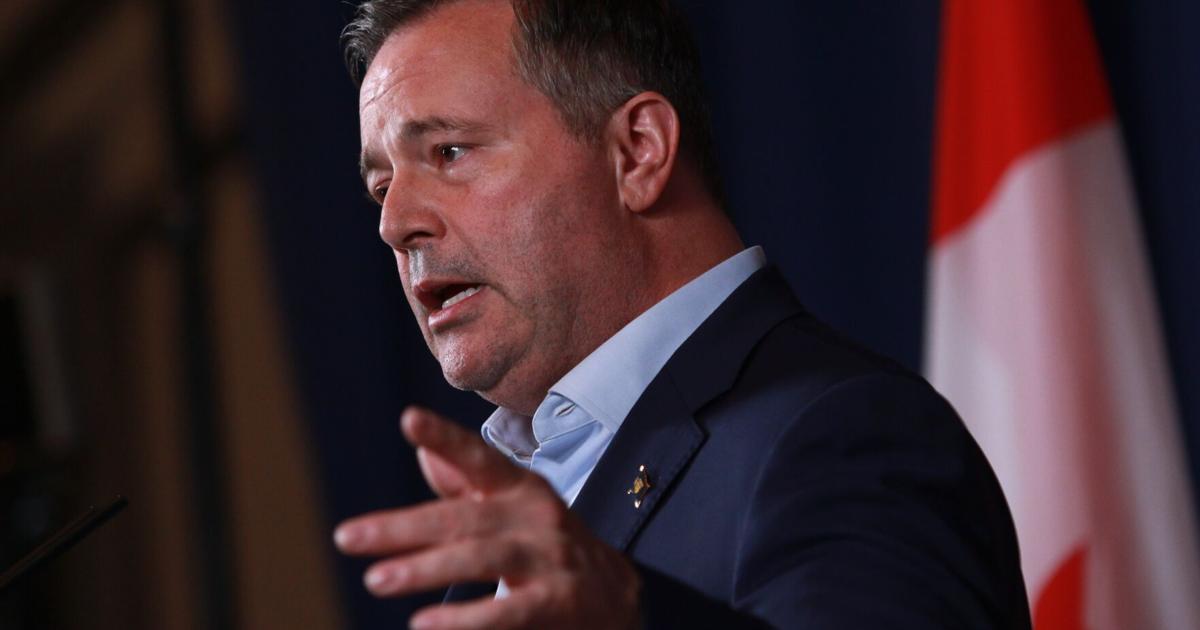
Former Alberta premier Jason Kenney is calling on police and the province’s election regulator to investigate the finances of a separatist political party.
Kenney’s comments follow a Star investigation into a mysterious surge in donations into the coffers of the Republican Party of Alberta (RPA), a provincial group that advocates for the province to separate from Canada.
The Star’s analysis found the party received a sudden influx of $190,000 in 2025 despite having reported no donations the year before. The cash came from fewer than 50 people, with more than half of them giving $5,000, the maximum amount allowed under Alberta rules.
The RPA’s donations soon dried up after that initial flood: the party reported just $6,000 in donations in the second half of 2025, and $1,000 in the first quarter of this year.
In an interview with the Star, Kenney said it’s highly unusual for that percentage of donors to give the max amount — especially to a young, populist party, which would typically be fuelled by larger numbers of ordinary people giving smaller amounts of money. Very few people can afford to give thousands of dollars to a political party, he said.
“It just doesn’t add up,” said Kenney, whose call for an investigation was first posted to the social media site X last week. “At the very best, something highly unusual is going on here.”
The RPA and its leader, Cameron Davies, did not answer questions from the Star for this story.
Ties to out-of-province donors
In a statement, Elections Alberta said it cannot publicly comment on what it may or may not be investigating. The agency also pointed to a 2025 change to its governing legislation, which Elections Alberta says raised its threshold for launching a probe. Now, it can only do so if it has “reasonable grounds to believe an offence has occurred.”
“This is a very high threshold, much higher than the threshold imposed on other administrative regulators,” Elections Alberta said. “This is the threshold required by police to arrest someone following an investigation.”
Alberta RCMP spokesperson Fraser Logan said the law enforcement agency can’t comment on whether it has received a complaint or started an investigation. “Further to that, the Alberta RCMP are unable to take these complaints either online or via email,” Logan said. “We encourage anyone with concerns regarding this matter to reach out to their nearest RCMP detachment or their local police.”
The Star also found $18,000 of the donations appear to have been made by four interconnected people based in British Columbia, a violation of Alberta election rules that require donors to legally reside in the province at the time they contribute.
One of the four was Apollo Chung, a longtime political operative who has worked for three political parties in B.C., and in 2025 served as executive director of the Alberta Republican Party.
Public records viewed by the Star connected Chung to a Vancouver address. He has not answered questions from the Star, but this week he told the online media outlet PressProgress that he recently lived in Alberta. He did not specify exactly when or how long he lived there.
Most recently, Chung had been director of operations for the B.C. Conservative party, but leader Kerry-Lynne Findlay announced last week that he had been fired. Findlay did not give a reason for the move, but Chung’s departure came after audio recordings were posted online of an unidentified Findlay staffer talking about monetizing their work in politics.
The Star cannot independently verify the authenticity of the audio. Chung told PressProgress that he was speaking in the audio, but that it was “doctored,” presented without context and part of an exaggerated conversation about fundraising. Findlay’s office has not responded to questions from the Star.
In his post, Kenney expressed concern about one of the alleged recordings, pointing out that Chung had also recently held a top role at the RPA. The combination of the alleged audio recording and the unusual fundraising patterns at the RPA raises questions, Kenney said.
“I just, connecting the dots, think that there’s a lot of smoke,” Kenney told the Star. “It all looks to me like something that demands an investigation.”
The RPA’s Davies has previously said that to his knowledge, the party did not accept out-of-province donations.
Kenney has been a critic — and target — of separatists
Kenney was Alberta’s premier from 2019 until he resigned in 2022, under siege from far-right and populist forces within the United Conservative Party he helped create. Over the last year, he has been an outspoken critic of Alberta separatism, which remains a minority opinion on the province as it heads to a referendum on the issue this fall.
That stance has, at times, appeared to make him a target. Earlier this year, his home address was allegedly revealed to a group of separatist volunteers as part of a massive voter data breach that is now under investigation by Elections Alberta, the RCMP and the province’s privacy commissioner.
The voter data involved in the breach was publicly posted by a separatist group called the Centurion Project, but Elections Alberta said it had originated with the RPA. Neither Davies nor the RPA responded to questions from the Star about the breach.
Kenney, who has repeatedly alleged there are “dodgy” characters in the separatist movement, has history with some of those involved, especially Davies, a longtime conservative political operative in Alberta.
Davies was previously fined by Elections Alberta after the watchdog investigated purported irregularities in the 2017 leadership race that made Kenney the leader of the provincial United Conservative Party. Among them were allegations that senior members of Kenney’s campaign had co-ordinated with another candidate to sling mud at a key rival.
Davies worked on that alleged ‘kamikaze’ campaign, and Elections Alberta later concluded he helped fuel it with illegal donations. The watchdog never accused Kenney of any wrongdoing in the scandal, and Kenney has said he did not know how the ‘kamikaze’ campaign was funded.
Speaking to the Star for this story, Kenney said he attended a meeting with the political operative in 2017 “against my better judgment.”
“I’ve never trusted the guy,” Kenney said.
— with files from Alex Boyd

