On June 19, 1948, at the R.R. Foster Sand Pit on the east bank of the Rideau River in old Gloucester Township, excavator operator J.B. Rolland was scooping shovelfuls of sand for a local building project when he saw something unusual spill out from the hillside.
Work was stopped as Rolland and fellow Foster employee Grant Harris examined what had been dug up. They were bones from some unknown animal, its remains buried about six metres from the river’s edge and at least that deep in the sandy terrain rising sharply up towards River Road (today’s Riverside Drive), a stone’s throw from Uplands Airport (now Ottawa International Airport) and a chip shot from the Ottawa Hunt and Golf Club course.
“Horse bones?” a crewman wondered, according to one account of the discovery. “Those didn’t come from any horse,” Rolland is said to have replied. “And how would they be buried at the bottom of this pit? Must be something prehistoric, I’ll bet.”
It would prove to be a smart wager.
Harris made a phone call to the National Museum on McLeod Street in downtown Ottawa, today’s Canadian Museum of Nature . Paleontologist Charles M. Sternberg, son of the legendary American dinosaur hunter Charles H. Sternberg and a fossil-finding superstar in his own right — discoverer, among other things, of Canada’s first Tyrannosaurus rex in 1946 — drove the nine-kilometre route to Foster’s pit. Sternberg examined the exposed bones, then asked workers to dig around some more. They turned up additional remains, and Sternberg hauled the load back to his lab at the museum “for intensive study.”
We know all this thanks to a front-page Ottawa Citizen story published three days after the historic find. Sternberg didn’t take long to determine that Rolland had unearthed the skeleton of a white whale or Delphinapterus leucas — better known to most Canadians, thanks in part to a beloved 1979 children’s song by the Canadian musician Raffi as a beluga.
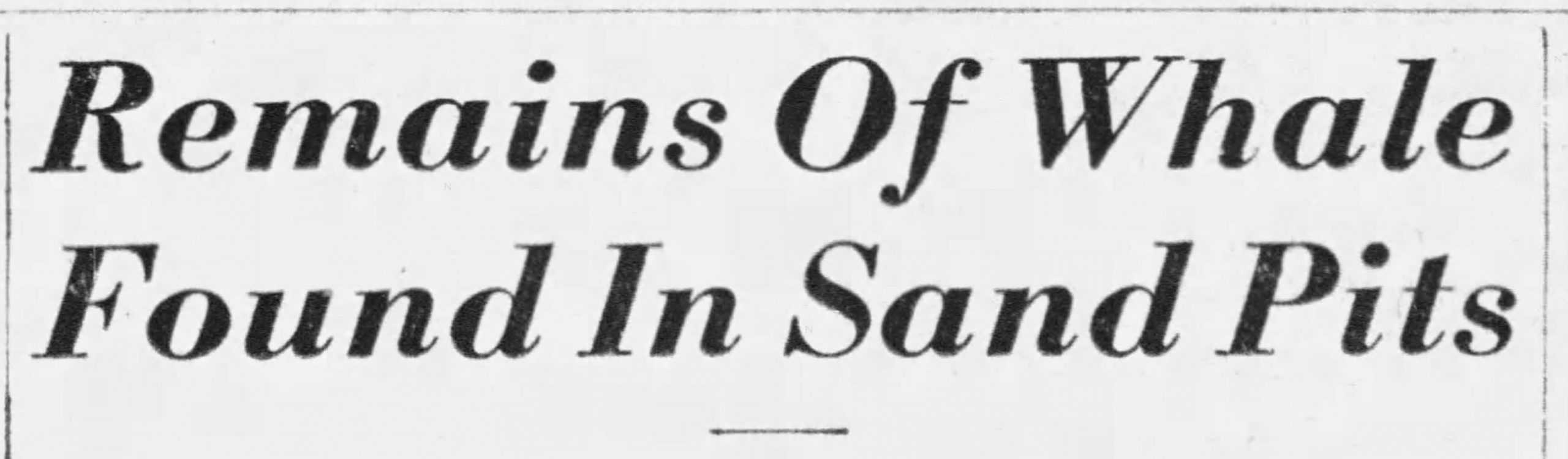
“Remains of whale found in Sand Pits,” the headline declared above author James Roe’s inevitable line about “a whale of a story” unfolding at the “popular resort of Capital picknickers close to the busy Uplands Airport.”

The commercial sand pit doubled in the 1940s as a summertime beach for local swimmers and as a rallying point for members of the Ottawa Light Car Club; in the 1950s and ’60s it was a party hot spot for teenagers.
The discovery of the bones “may be an important scientific event,” the Citizen story accurately stated. “To the scientist and the interested amateur, these obscure remnants voice a message to 1948 citizens from a very different era, when the Ottawa and Rideau valleys were covered by the brackish waters of the ancient ‘Champlain Sea’ stretching far to the south.”
And the beluga bones — traces, you might say, of one the oldest known vertebrate residents of the future Ottawa — still speak to us today. (More on Ottawa’s plentiful supply of 450-million-year-old invertebrates momentarily.)

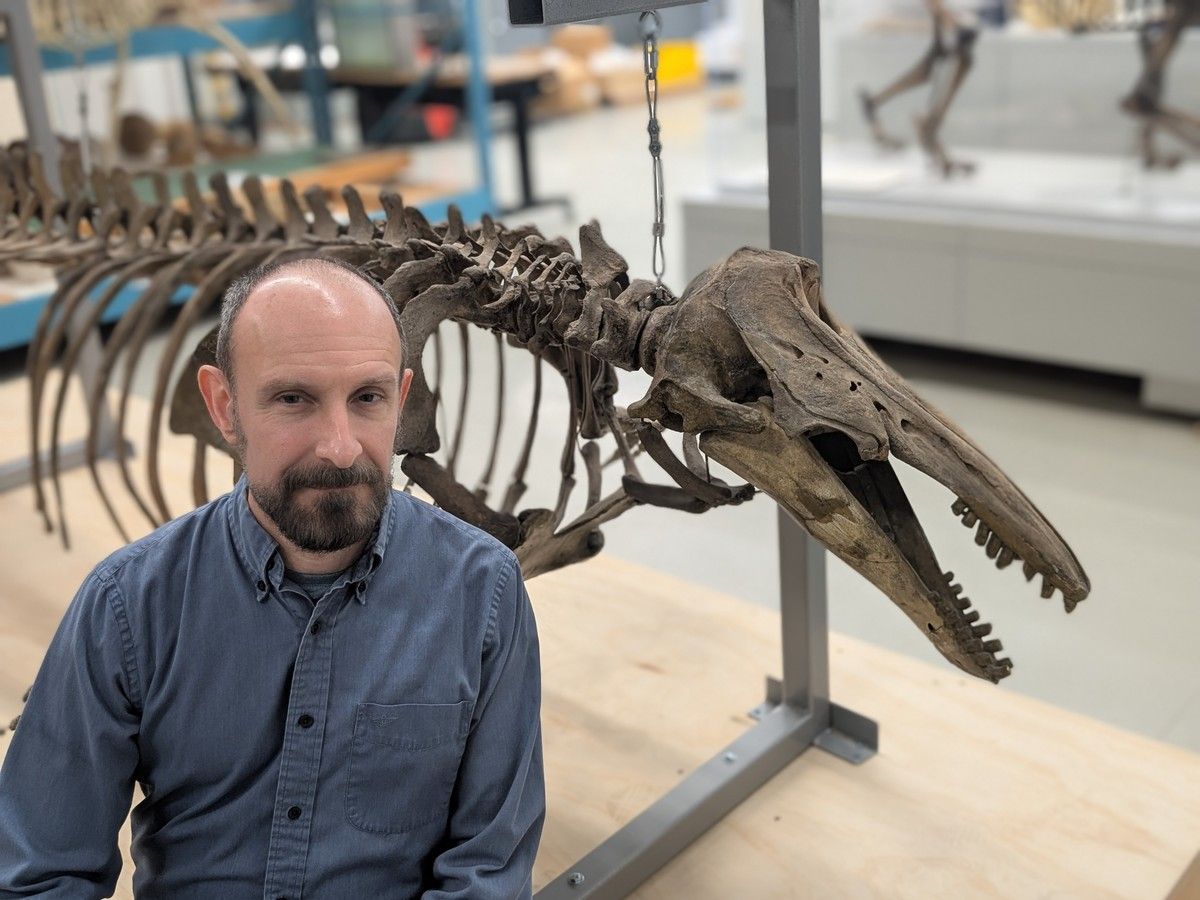
On a recent visit to view and discuss the beluga specimen, Dr. Scott Rufolo — curator of paleobiology at the Canadian Museum of Nature — sat beside the skeleton as it dangled from light chains attached to a long metal bar on a wheeled wooden platform. That’s how it’s safely moved around and displayed.
Rufolo explained that the museum’s whale represents a time in Ottawa history when the land we now inhabit as Canada’s capital was indeed far beneath the Champlain Sea, an erstwhile inlet of the North Atlantic Ocean mixed with meltwater from receding glaciers at the end of the last ice age about 10,000 years ago.
The beluga, at some unknown point before then, had died and drifted down to what was likely a shallow stretch of seabed, its flesh a source of nourishment for fish and other marine creatures, before being enveloped by ever-accumulating layers of sand.
The animal’s bones today are brownish gray, about the colour of weathered wood. About five metres in length from beak to fluke, the remarkably intact skull is the fossil’s most impressive feature; four rows of peg-like teeth and an opening for its blowhole atop the braincase are telltale signs of a capital city cetacean — found nearly eight decades ago in a place where no ocean has existed for 100 centuries.
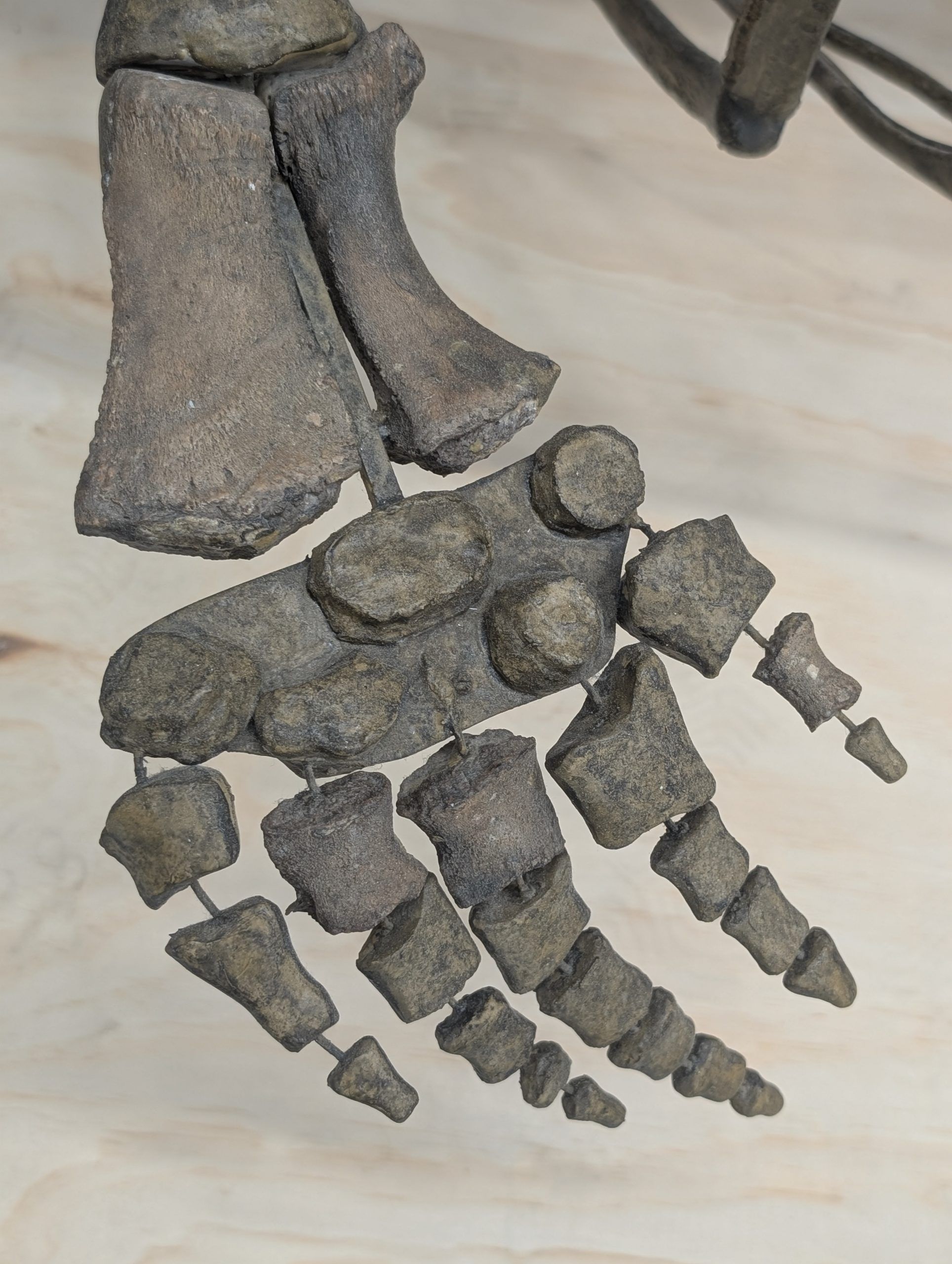
The skeletal flippers, each with five phalanges that are recognizably like human fingers, speak best to our common mammalian ancestry somewhere in the primeval depths of time. Narwhals are belugas’ closest relatives today, but we are distant cousins.
The specimen displayed here would have weighed 1,000 kilograms, more or less. Its closest modern descendants — genetically the same species as the sand pit beluga, Rufolo pointed out — inhabit the St. Lawrence Estuary, a population of perhaps 1,800 animals that munch cod, capelin, shrimp and other prey while moving seasonally no farther east than the Gulf of the St. Lawrence. This isolated group of belugas, the southernmost members of their species in the world, was declared endangered in 2014 — at high risk from pollution, noise, ship traffic and other human harms in an Anthropocene proving hazardous to most wildlife around the world.
Rufolo noted that the bones of the ancestor beluga found at Foster’s pit were mounted as part of a virtually complete composite skeleton using three separate white whale fossils from Eastern Ontario. The skull and other parts of the display specimen come from the dramatic find at Uplands in June 1948, along with the lower jaw of a second, smaller member of the species also discovered that spring at the sand pit.
Additional parts of the composite are from a third Champlain Sea beluga excavated from a bed of clay near Cornwall in 1870. That fossil was collected and documented at the time by Canada’s first official paleontologist, Elkanah Billings , in a pioneering Canadian scientific journal that began its life — would you believe it? — in the pages of the Ottawa Citizen in the 1850s.
“The length of the animal was probably about 15 feet,” Billings — a one-time editor at the Citizen — wrote in The Canadian Naturalist after securing the fossil for what eventually became a national treasure of paleontology held by the Canadian Museum of Nature. “The lower jaws are nearly perfect. The skull and upper jaws are much damaged and some of the parts lost. Thirty-five of the vertebrae, the two shoulder blades, most of the ribs, and a number of small bones were collected.”
Many of those bones were eventually added to what Sternberg, in a 1951 scientific paper, called the “splendidly preserved skull” and sundry remains of the two Uplands belugas. Generations of Ottawa museum-goers have learned about the city’s pre-human past by examining this exquisite, triply-sourced Champlain Sea whale skeleton.
***
Why think about the beluga now, as Ottawa commemorates the 200th anniversary of its birth as Bytown in 1826?
In part, to underscore the point that the history of Canada’s capital didn’t begin that year — not by a long shot. The bicentennial of Bytown’s beginnings, which coincide with the start of construction on the Rideau Canal, came at least 8,000 years after First Nations people began living — hunting, fishing, trading, toolmaking, storytelling — along the shores of the Ottawa, Rideau and Gatineau rivers. These were the major streams left behind when the land, once weighted down by mile-high glaciers, gradually rebounded and the Champlain Sea drained away.
Remember, too, that in the decades before Lt.-Col. John By came to the future national capital — a place that has remained the traditional, unceded territory of the Algonquin Anishinaabe to this day — handfuls of earlier settlers had already staked out properties in what would become Bytown and later Ottawa.
Richmond, originally a post-War of 1812 military settlement on the Jock River and now a bedroom village in the city’s rural southwest, took root in 1818. Philemon Wright had founded the future Hull and Gatineau much earlier, in 1800. It was located directly across the Ottawa River from where By would establish his town more than a quarter-century later, and numbered about 800 residents by 1826.
Coincidentally, Billings himself — the lawyer and journalist destined to become Canada’s No. 1 fossil hunter of the 19th century — was among that earlier sprinkling of non-Indigenous residents of proto-Ottawa who lived here before By came and Bytown began. Billings’ parents — Braddish and Lamira — were pioneers who settled in Gloucester Township in 1812 on the south side of the Rideau River in the aptly named, present-day neighbourhood of Billings Bridge. Elkanah was born there in 1820.
The beluga, found just a few miles upstream from where the Billings once lived, represents the incomprehensibly long stretch of time before the peopling of this place. That includes the eons of Earth history that had passed even before the Champlain Sea formed and vanished, a relatively brief and recent occurrence in geological terms.
When thinking about the history of a locale, reaching back to a time before humans were there establishes a baseline state of mind in which nature — land, water, plants, animals — commands centre stage in the storytelling, at least fleetingly.
There is a deep-time Ottawa to consider.
***
Imagine mountains as high and jagged as the Himalayas soaring above the bedrock that lies beneath parts of present-day Ottawa. See a smoking volcano to the west, just beyond where the Canadian Tire Centre is situated today. Dial the clock back a few billion years, geologists tell us, and the place that became Canada’s capital was an epic landscape of granite and marble — driven majestically skyward by a collision of Precambrian continents — that would put the Rockies to shame.
But time takes its toll, and eons of weathering would deeply erode and soften our Everests and Logans into heights no greater than the Gatineau Hills. As the raft of rock that became Ottawa-Gatineau drifted somewhere near the equator 500 million years ago, a balmy ocean covered the land but eventually left beaches that would harden into near-surface deposits of our famous Nepean sandstone — the cream-coloured platform underlying wide swaths of the region, and which was quarried in the 19th and early 20th centuries to fashion the city’s signature architectural creation: the Parliament Buildings.
Elsewhere in that Paleozoic time, sea bottom sediments of sand and silt solidified into broad strands of shale. Meanwhile, marine snails and other tiny, shelled sea creatures died by the quadrillions, drifted to the seafloor and deposited their protective armour and skeletal remains in layer upon layer of calcium carbonate. These solidified into the stratified, fossil-rich limestone deposits found widely across the region, including such outcrops as the dramatic bluff that became Parliament Hill.
Then — how time flies in a geological précis — the glaciers came in a series of freeze-thaw cycles that began some 1.5 million years ago and ended with a final super-chill that lasted from about 20,000 to 12,000 years ago. Forming layers of ice and snow miles high, the national capital region’s original skateway squashed the land down hundreds of metres and created a lifeless, frozen-in-time Icebox Ottawa for long stretches of time. The final glacier would leave a lasting imprint on the land — and it isn’t even over yet. North America is still, in fact, rebounding at the rate of a few millimetres per year since the retreat and melting of that last ice layer relieved the land of its unfathomably massive weight.
The deglaciation left gouges in rock, great ridges of gravel and massive boulders — so-called “erratics” that seem to appear out of nowhere — across the surface of the land. It was then that the Atlantic Ocean mixed with the melting ice and swamped much of present-day Quebec and Eastern Ontario for 20 centuries or so as the depressed land was filled by the Champlain Sea.
This temporary habitat for marine fish, whales and seals only disappeared gradually as the land rose year by year, leaving behind sandpits like the one at Uplands and beds of clay in former beaches and seabed shallows. Plus the skeleton of the odd beluga.
In Gatineau Park’s Pink Lake, there’s even a uniquely adapted three-spined stickleback that somehow managed to evolve from saltwater to freshwater fish as its aquatic environment was slowly, steadily transformed by time.
The vanishing of the inland sea eventually revealed the remnant river valleys of the Ottawa, Rideau and Gatineau — the primary waterways of the region. Their confluence at this place, perhaps as early as 8,000 years ago, drew the first Indigenous people to the future Ottawa-Gatineau, which became a pristine pine forest inhabited by wolves and woodland caribou. A natural travel corridor, trade hub and resource-rich meeting place, this patch of Earth — underpinned by epoch after epoch of geological upheaval, its surface sculpted by a grinding glacier and the motions of a meltwater sea — was a dynamic centre of action long before it became Canada’s capital city and a cockpit of national politics.
***
We have Elkanah Billings, more than anyone, to thank for our knowledge of Ottawa’s primordial past. Deposits of limestone and shale up to 20 metres thick form much of the underlying rock around the confluence of the Ottawa and Rideau rivers, including an eastern expanse of the city’s geology named the Billings Formation after you-know-who.
That rock is rich in fossils far, far, far older than the Foster’s pit beluga. Signature groups of extinct animals from those Ordovician and Silurian layers of limestone and shale — all at least 400 million years old — include ancient crinoids (primitive starfish, sea lilies and sea urchins) and the iconic oval trilobites, skittering marine creatures with no backbone but plenty of staying power for long periods of evolutionary history.
Fossils of these animals abound in Ottawa, and Billings was among the first to document hundreds of such long-vanished species from a time when the future North American landmass was part of a supercontinent called Laurentia and was situated near the equator. The tectonic process known as continental drift, played out gradually over millions of years, eventually repositioned the layers that became Ottawa’s bedrock basement to just north of the 45th parallel, about half-way between the equator and the North Pole.
Two of Billings’ prize finds — a species of trilobite called Eobronteus lunatus and a sea lily named Reteocrinus stellaris, which attached itself to the ocean bottom and used feathery limbs to pull plankton into its mouth — are kept in cupboards not far from the beluga bones in the nature museum’s world-class fossil hoard, most of it stored at the CMN’s preservation facility in Gatineau.
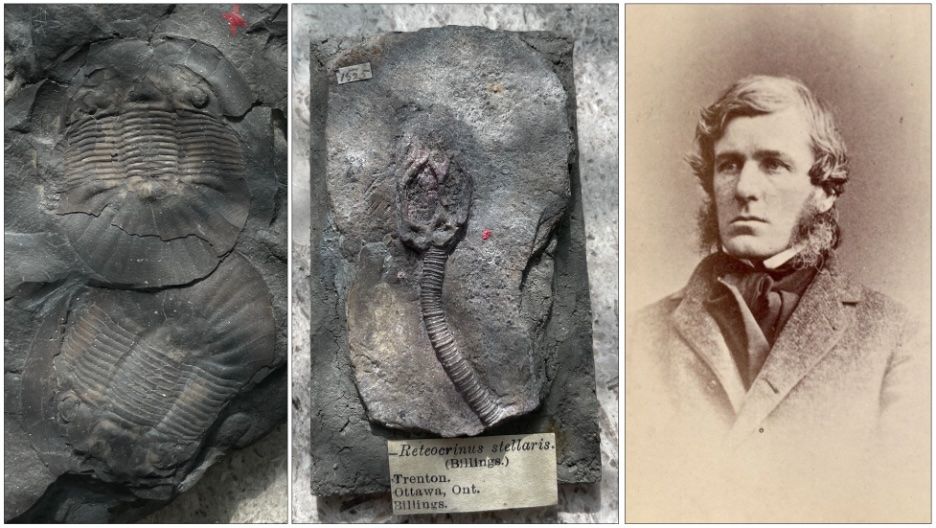
It’s hard to relate to spineless seafloor critters from tropical climes in Earth’s primordial past, even if we citizens of contemporary Ottawa share a tenuous connection with them through the rocks beneath our feet. On the other hand, the beluga shares our tetrapod biology — backbones, biggish brains, five-fingered forelimbs — and inhabited pretty much the same place at the same latitude that we do today, wet as it once was.
The retreating ice age glaciers and the rise and fall of the Champlain Sea left behind much more than a scientifically invaluable white whale specimen in its sand pit time capsule. They also left a profound imprint on the land that became Canada’s capital region.
More than two-thirds of Ottawa’s surficial geology — what we see at or near ground-level — has been shaped by the grinding, gouging, bulldozing actions of the glacial retreat, as well as the great deposits of sand and clay when the land rebounded and the post-glacial sea began drying up about 10 millennia ago.
From Foster’s pit and the Pinhey Sand Dunes in old Nepean — just three kilometres west of the beluga find — to the Mer Bleue Bog to the east, to the river valleys and the unstable beds of Leda clay underlying great swaths of the capital, the region owes much to the epic forces of ice, water and wind from our current, Quaternary period of geological history, reaching back “just” hundreds of thousands of years.
The other, smaller portion of what lies immediately underfoot in Ottawa are those fossil-rich layers of limestone and shale so well known to Billings — along with bedrock stretches of sandstone and dolomite — from hundreds of millions of years ago.
The original Parliament Buildings — made mainly of quarried blocks of local sandstone, held together by mortar mixed from riverside sand deposits, rising on the city’s signature limestone bluff — were also a legacy of the land and its richly layered backstory. Much of the sand for that project, including the West Block building where Canada’s House of Commons is currently located, came from a shoreline site directly across the Ottawa River from Parliament Hill. That place was also an ancient Indigenous burial ground as early as 5,000 years ago. It may be that tiny shards of bone from the graves of First Peoples who arrived here after the beluga was entombed — and long, long before Colonel By set foot in this place — are encased in the walls of our national legislature.
No, Ottawa’s history didn’t begin in 1826.
Randy Boswell is an Ottawa writer and journalism professor at Carleton University.
Related
Take control of your search results. Make the Ottawa Citizen a preferred source on Google and see verified local reporting first.