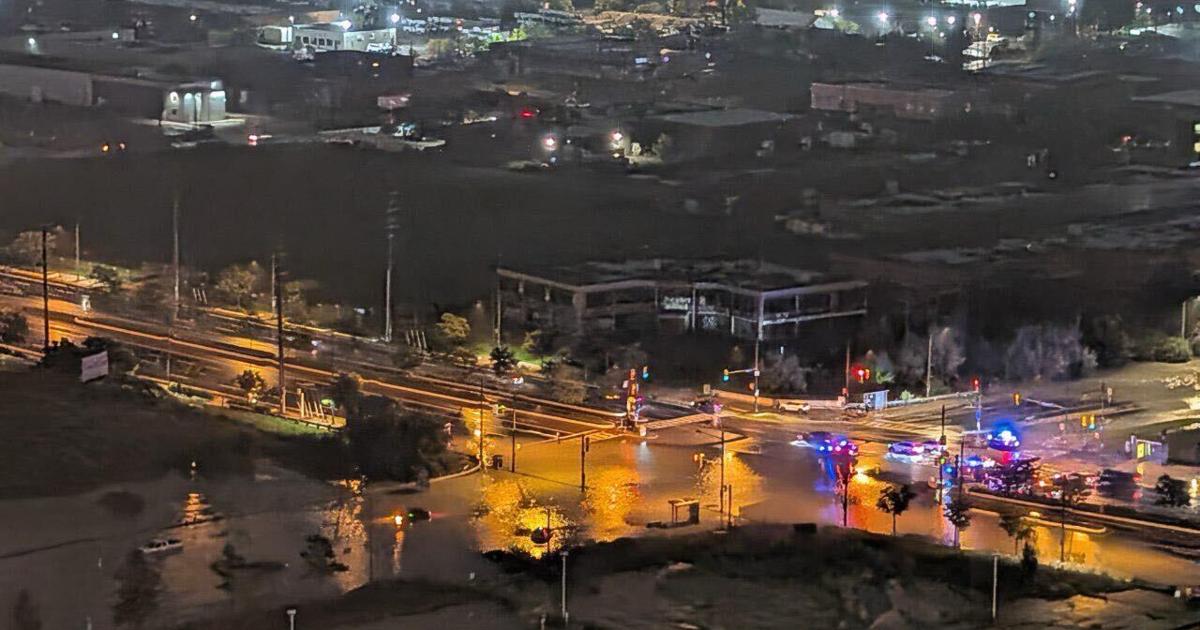
In the aftermath of Wednesday’s storm, dramatic photos and videos of submerged cars in floodwaters in and around Vaughan Metropolitan Centre circulated on social media.
Now that the waters have receded, those apocalyptic scenes at Vaughan’s new master-planned downtown near Jane Street and Highway 7, complete with condo towers and retail space, are raising questions about how prepared new housing developments are for severe storms as the climate crisis makes them worse.
It’s only in the last three to five years that builders have started to realize that climate change is happening and there’s no going back, said Blair Feltmate, head of the Intact Centre on Climate Adaptation at the University of Waterloo.
Extreme weather is only going to become “more dire, more challenging,” he added. “The state of preparedness is just in its embryonic stages.”
Wednesday’s storm was likely one of the worst to hit the region in 20 years, according to Environment Canada. Strong winds, rainfall of almost 140 mm in some areas and intense hail that led to damage across the Greater Toronto Area, flooding the Don Valley Parkway, uprooting trees and causing dramatic destruction at Rogers Stadium.
As residents pick up the pieces, some experts are pointing to the region’s increasing concrete developments as a culprit in worsening flooding problems.
Feltmate said Ontario is better off than other provinces because of its conservation authorities, bodies that keep track of floodplains. In general, he added, developers are prohibited from building in floodplains. If they do, they must “put measures in place to mitigate risk.”
Parts of the Vaughan Metropolitan Centre along Black Creek are located within the floodplain, according to an emailed statement from the Toronto and Region Conservation Authority (TRCA). After “significant flooding” in 2005, the TRCA has been helping the City of Vaughan with a flood plan.
In November 2025, the city broke ground on the $224-million Black Creek Renewal Project, with funding from the provincial and federal governments, to strengthen flood protection in the Vaughan Metropolitan Centre area, which includes adding green space to absorb water during storms and improving infrastructure.
Asked about the recent flooding and risk, an emailed statement from the City of Vaughan said they are investigating.
“As far as we can tell at this stage of analysis, this occurred because of a blockage of a private culvert,” the statement said.
Sarah McVie, an actress and organizer with the Black Creek Flood Coalition, said this project is part of an overall problem with developments around Black Creek.
She lives in Rockcliffe-Smythe, just south of Vaughan, and blames development in general for continued flooding. “My neighbourhood is a toilet,” said McVie, who is running for mayor of Toronto, in part because of these issues.
“It’s all because of the unmitigated development and lack of oversight with paving,” she said. “There’s no drainage. There’s no permeable land.”
Even if floodplains are taken into account, Feltmate said most of the floodplain maps are decades out of date.
Ryan Ness, the director of adaptation at the Canadian Climate Institute, agrees.
“We know we can’t rely on the past to predict the future anymore, and so these flood maps, these policies have to be updated to reflect the fact that the risk is increasing with climate change,” he said.
There are things that developers can do from the start, said Feltmate, like putting in permeable surfaces. Permeable pavement, for example, allows stormwater to soak through.
He praises Vaughan as being “progressive” when it comes to flood risk, compared to other cities in Canada. But he said it’s still not enough.
Toronto too has done a lot of work on this, but it isn’t keeping pace with severe storms.
Nidhi Subramanyam, an assistant professor in the department of Geography and Planning at the University of Toronto, said one reason why there’s not enough attention being paid to the issue is because it’s so hard to find affordable housing in Toronto.
Every year she asks students in her environmental planning class if they’d be willing to live in a floodplain and several say yes.
“I guess the short answer is people are willing to trade off risk for affordability,” she said.
Against the backdrop of the housing crisis and the focus on building in the province, it’s worth looking at “bandaids” to blunt the impacts of flooding.
“We shouldn’t pave over every inch of the earth with concrete because water just tends to run off faster on concrete,” she said. “We need to have more places where water can be absorbed into the ground.”
Redeveloping an area can provide an opportunity to upgrade storm sewers, for example, to make sure they can take water away, said Ness.
But “in some cases, like Black Creek, which has a huge area upstream of it that is mostly paved,” he added, “short of transforming that whole upstream area from pavement to vegetation, there isn’t a whole lot that can be done.”
And the problem is only going to get worse.
As the climate continues to warm, “it gives the atmosphere more ability to hold water and more energy to create extreme storms,” Ness explained.
Being a northern country, Canada is also warming faster than other parts of the world.
“The biggest limitation on all of this and moving forward is an overall lack of appreciation of the need to act with urgency to prepare for extreme weather,” said Feltmate.
“We’re too lackadaisical,” he added.
“People don’t realize that climate change is here to stay, period.”
Error! Sorry, there was an error processing your request.
There was a problem with the recaptcha. Please try again.
You may unsubscribe at any time. By signing up, you agree to our terms of use and privacy policy. This site is protected by reCAPTCHA and the Google privacy policy and terms of service apply.
Want more of the latest from us? Sign up for more at our newsletter page.