

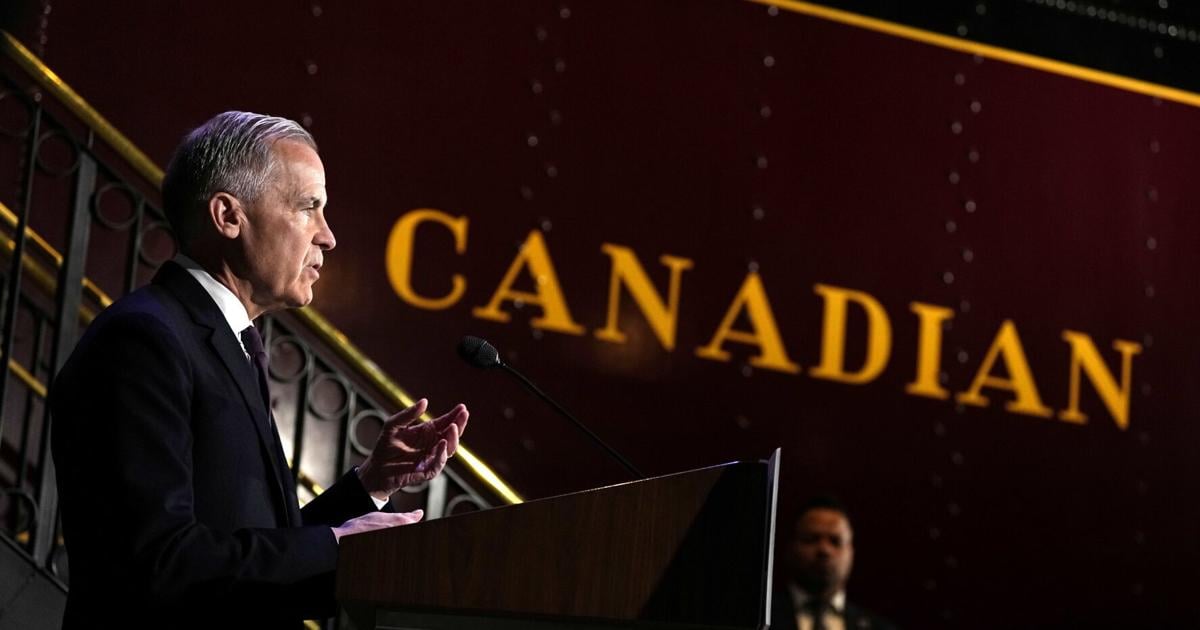
Seldom in history have so many high-powered financiers met at the same time and place as this month’s gathering in Toronto hosted by Prime Minister Mark Carney.
The inaugural Canada Investment Summit, to be held Sept. 14 and 15, is a flagship event in Carney’s project to increase investment in Canada by $500 billion over the next five years.
Carney has personally invited as many as 250 executives from 28 countries expected to attend, and who collectively manage almost $120 trillion.
We will probably never have more than a rough idea of the summit’s impact. It is a meet-and-greet affair, or more crudely a networking event. It is not a deal-making venue for the elite attendees, who head some of the world’s largest banks, asset management firms and sovereign wealth funds.
Their decisions to commit billions of dollars to Canadian energy, transportation and infrastructure projects will be made months or years from now.
Yet we know already that Canada has become more attractive to investors, not long after alarmist reports of money fleeing the country, and that Canada was at risk of becoming a capital desert.
In the 12 months ended May 31, foreign investors channelled $256 billion into Canada’s stocks and bonds. Foreign investment reached that level only once before since records were kept beginning in 1990.
Offshore companies spent $44 billion (U.S.) in the second quarter of 2026 buying Canadian assets, the highest level since 2007.
And there’s more investment to come, according to a recent report by TD Economics.
TD is forecasting a Canadian investment “supercycle” over the next decade or so.
To start, there already is about $1 trillion of estimated investment in more than 300 publicly announced Canadian energy, resources, defence and transportation projects planned for the next decade or later.
There is a welcome diversity to the projects, some underway and some approved or awaiting regulatory approval.
They include AI data centres; overhauls to ports, highways, rail, bridges and other transportation infrastructure to get Canadian goods to international markets more quickly; and no fewer than 86 mining projects at varied stages of development.
“The Canada-U.S. trade dispute is a compelling reason for Canada to pull the levers that are fully within its control,” TD says. “This means prioritizing the creation of a competitive ecosystem across the nation, including trade diversification through infrastructure expansion.”
TD calls the unusually high level of investment a “supercycle” because it is expected to be sustained for at least a decade.
“Given the long time frames of these types of infrastructure projects, investment could be sustained as far as the eye can see, with a quarter of the spending estimated to be more than 10 years away,” say Beata Caranci and Derek Burleton, co-authors of the report and chief economist and deputy chief economist at TD, respectively.
The two economists forecast even greater capital investment if the federal and provincial governments make more haste in enacting overdue reforms in tax policy, a more streamlined regulatory approval process, and a better alignment between labour market needs and available workers.
In that “pro-investment” scenario, TD says long-term investment could reach $1.7 trillion in the next decade or so.
And the bolder the reforms to create a stronger competitive agenda the more success Canada will have in “deploying private funds with fewer commitments from government coffers.”
The financiers gathered at the summit prioritize financial return on investment. But “the big prize for Canadians from a prolonged period of higher investment would be a jump in living standards after a decade of stagnation,” say the report co-authors.
“This equates to an extra $12,000 in real (inflation-adjusted) output per capita in a high investment scenario, double the growth in our baseline view (in the absence of bold reforms).
And that’s in addition to whatever payoff comes from the Canada Investment Summit.
The mere presence of the summiteers on Canadian soil when the economy is in a slump, Canada is fighting off an existential assault on its sovereignty, and two large provinces are flirting with separatism, is a powerful statement of global investor confidence in Canada.
Canada is emerging from more than a decade of negative international regard as being “uninvestable” with so many planned projects blocked by government or cancelled after interminable delays in obtaining regulatory approvals.
On that score, there is still work to be done. Progress has been made in removing some interprovincial barriers to trade and labour mobility, but many of these self-defeating obstacles remain.
But for the summiteers, especially those visiting from abroad, Canada’s relative economic and political stability is a pleasing contrast with geopolitical upheaval in much of the world.

