Donald Trump’s ban on Canadian booze could cost some people their jobs — but industry analysts say many of those losses could actually come in the U.S.
Tuesday night, the U.S. president signed a series of executive orders as he ramped up his trade war against Canada. One of them was a ban on the vast majority of spirits imported from Canada, including whisky, vodka and gin.
Roughly half of the $2 billion worth of spirits produced in Canada each year go to the U.S., according to industry estimates. That alone means that jobs will be lost depending on how long the ban lasts, said author and consultant Stephen Beaumont.
“It would be foolish to suggest if this goes on much longer than a month or two that there won’t be layoffs. There will be layoffs,” said Beaumont, co-author of “Canadian Spirits.”
Still, added Beaumont, many of the resulting job losses ”will likely be south of the border, despite Trump’s claim in his presidential proclamation that he was acting in the U.S.‘s best interest.
“There aren’t actually that many jobs on the production side of distilling. Where the people are going to be laid off is in sales and marketing. And a lot of those people are going to be in the U.S.,” said Beaumont. “He clearly hasn’t thought this out. It’s going to impact distributorships, marketing and sales people.”
Smaller, independent Canadian distilleries, said Beaumont, are far less likely to take a hit from the import ban, because most weren’t exporting to the U.S. anyway.
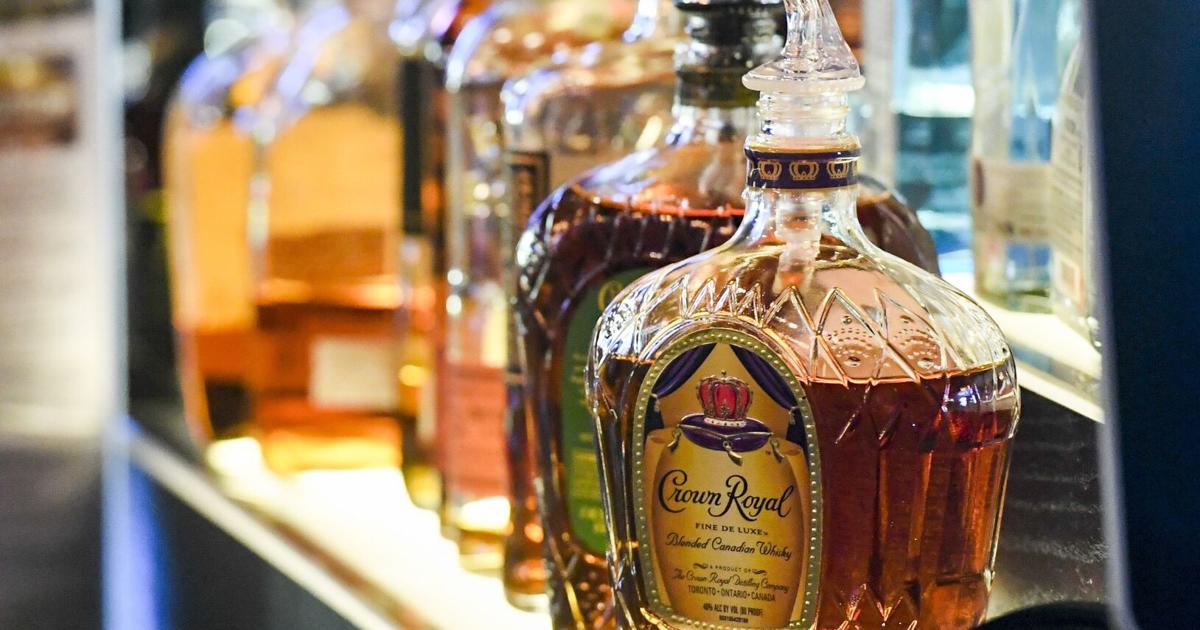
Most well-known Canadian whisky brands, said Beaumont, are owned by international booze conglomerates: Crown Royal is owned by U.K.-based Diageo, Canadian Club is owned by French giant Pernod Ricard, and Seagram’s VO is owned by Kentucky-based Sazerac Co.
“This isn’t harming Canadian companies as much as it is harming the Canadian divisions of major international corporations,” Beaumont argued.
In the presidential proclamation, Trump cited what he called a Canadian import ban on American products as justification for his move. The proclamation was titled “Excluding certain Canadian products from importation into the United States in response to continued discrimination against the commerce of the United States with respect to alcoholic beverages.”
“In my judgment, the action in this proclamation is consistent with the public interests and the interests of the United States,” Trump said in the full text of the proclamation.
In trade talks, U.S. officials have repeatedly brought up an ongoing 18-month boycott of U.S. beverages by most provincial liquor monopolies in Canada, including the LCBO.
The latest move will also, said Canadian whisky author Blair Phillips, hurt some U.S. companies which now own or distribute Canadian whisky brands.
“I think there’s a potential for a big trickle-down effect. There are millions of cases of Canadian whisky sold in the U.S. every year,” said Phillips.
He pointed to popular brands like Black Velvet or Seagram’s VO, both produced in Canada, but owned or distributed south of the border by American spirits companies.
“Look at Black Velvet, that’s owned by Heaven Hill now. And Sazerac distributes Seagram’s VO,” said Phillips.
The U.S. spirits industry has already taken a hit, partly because of the boycott from provincial monopolies, and partly because of changing alcohol consumption patterns in younger consumers.
Last year, Jim Beam announced it was halting production at its flagship distillery in Clermont, Ky. for all of 2026. Brown-Forman, which makes several U.S. whiskeys including Jack Daniel’s, permanently closed its barrel-making facility in Louisville, Ky. last year. And next week, a major barrel-making facility in Alabama, which was previously owned by Brown-Forman, is closing permanently.
The head of the association representing Canadian distillers decried the import ban.
“Obviously this is very concerning for the Canadian spirits industry,” said Cal Bricker, CEO of Spirits Canada. “We urge both sides to return to the table as soon as possible to resolve the dispute so we can return to free trade in spirits in North America.”
In the meantime, however, there will still be plenty of American drinkers longing for a sip of their favourite Canadian whisky, said Beaumont, who noted that in some parts of the U.S., it has surpassed even well-known American favourites like bourbon or Tennessee whiskey.
“In Texas, Crown Royal is the top-selling whisky. It sells more than any bourbon. It even outsells Jack Daniels in Texas,” said Beaumont. “There are going to be a lot of upset drinkers in Texas.”