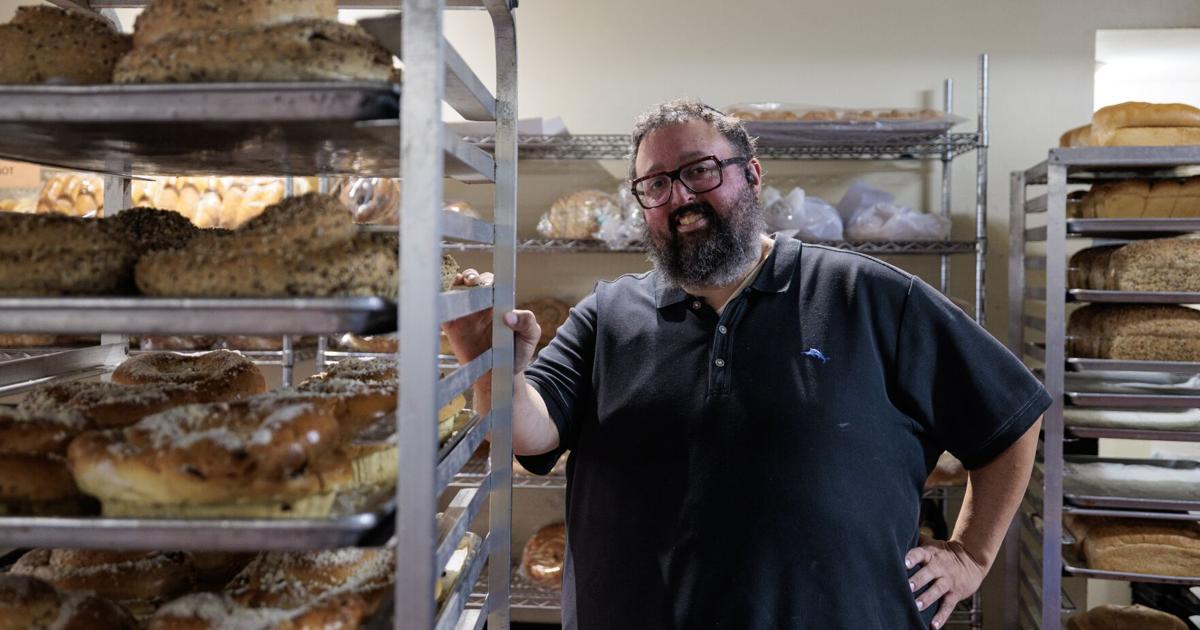
Jacob Aboudi can practically set his calendar by the long list of things going wrong at his bakery.
There’s the broken elevator, the frozen-over coils in the evaporators, the crapped-out lights in the storage room and the glitchy credit card processor. But he knew it was coming.
As Aboudi explained, every person has a built-up reservoir of things that didn’t go quite right in the previous year. In the weeks leading up to Rosh Hashanah, which begins at sundown Friday, that reservoir is emptied to enter the Jewish New Year “clean,” Aboudi said.
“It happens to me every year,” he said. “Anything that can go wrong happens in the month before.”
But the show must go on at Grodzinski Bakery, just north of Bathurst Street and Lawrence Avenue, where challah, cake and cookies are in high demand. Bakers work around the clock — and Aboudi himself barely sleeps — to keep goods on the shelves and orders going out to grocery stores, synagogues and schools nearby.
Grodzinski’s opened in Toronto in the mid-1990s and was bought by Aboudi and his wife two and a half years ago. Aboudi is not a baker by trade; his background is in banking and finance. He ran a hydroponics farm during the cannabis craze after legalization nearly eight years ago, then worked for a small Jewish soup kitchen.
His wife, an interior decorator, started selling cookies and desserts out of their home. Eventually, they bought Grodzinski’s.
Aboudi gets four hours of sleep a night. He wakes up at 2 a.m., studies Judaism for two hours, then stops by the bakery for the shift change at 4 a.m. He’s in and out throughout the day, helping his wife with their six kids as well as teaching Jewish ethics to high school students in the community. He is also opening a restaurant in the neighbourhood in a few weeks’ time.
He doesn’t nap. His secret, he said, pointing to the sky, is “the guy upstairs.”
There’s a Jewish teaching, he explained, that sleep renews the soul, not the body. How much sleep a person needs is determined by how productive they are. That’s why productive people tend to sleep less, he said.
But there are only so many hours in a day. Especially during holidays like Rosh Hashanah, which begins a 10-day period of repentance culminating with Yom Kippur at sundown on Sept. 20.
“Sometimes I don’t sleep,” he said. “Like, period.”
On a recent visit, “Life Is a Highway” by Tom Cochrane blared on the radio as customers streamed in and out. Shivan Sharma cleaned flour and excess dough off his work table as he wrapped up a nine-hour shift. He prepared more than 800 danishes; he has an order for another 1,600 waiting for him the next day.
Twenty-kilogram bags of flour are stacked in the corner, alongside sugar and 16-litre canisters of canola oil. A fan blows hot air out an open doorway.
A big mixing machine, which Aboudi said is worth $100,000, sits nearby. The dough-making process begins there before, depending on the product, it moves to the sheeter, which flattens out the dough to make croissants and other pastries.
Use of each machine is scheduled carefully to keep the process humming. The danishes Sharma has prepared go into the fridge, where they are stacked on racks upon racks, before eventually being taken out by a crew of night bakers, who move them to the proofer, then the oven.
They’ll be packaged and ready to go when the bakery opens at 6 a.m.
The pressure during Rosh Hashanah is mostly on the bread team at Grodzinski’s, with challah — shaped round or like a crown, symbolizing the full circle of the new year — being the most popular.
Bambi Katz, who lives on St. Clair Avenue, comes this way to do her shopping. She stopped in at Grodzinski’s to get her challah — round on this trip, she pointed out — and had a busy weekend ahead of her.
Her family is over Friday, then she’ll attend service the next morning. She’s also been invited to lunch and dinner the same day. “And then I’m done,” she said. “How’s that?”
Linda Belyea, busy stamping best-before dates on bread clips, has worked at bakeries in the neighbourhood for some 30 years. “I’m a veteran,” she said. She grew up in this neighbourhood, has lived here “since I was knee high to a grasshopper,” and has seen generations of customers come and go.
This time of year, she said, is “absolutely insane.” She packs bread, answers customer questions and picks out the products they want.
Despite the insanity, it’s good business for Aboudi. Just don’t ask how good.
“I believe in what our rabbis teach us,” he explained. “There is no blessing except in that which is hidden from the eye. So we don’t discuss how much we sell.”