

Donald Trump can’t tolerate being trumped.
What’s left of his influence — with voters, other countries, increasingly restive Republicans — depends on a cultivated image of dominance.
No matter what you think of his policies, don’t get in his way, or you will face retribution.
There’s no other way to understand Trump’s desperate and unhinged response to Canada’s decision to end fruitless trade talks. If a band of polite Canadians can stand up to his extortion, what resistance might be inspired among others harmed by his policies?
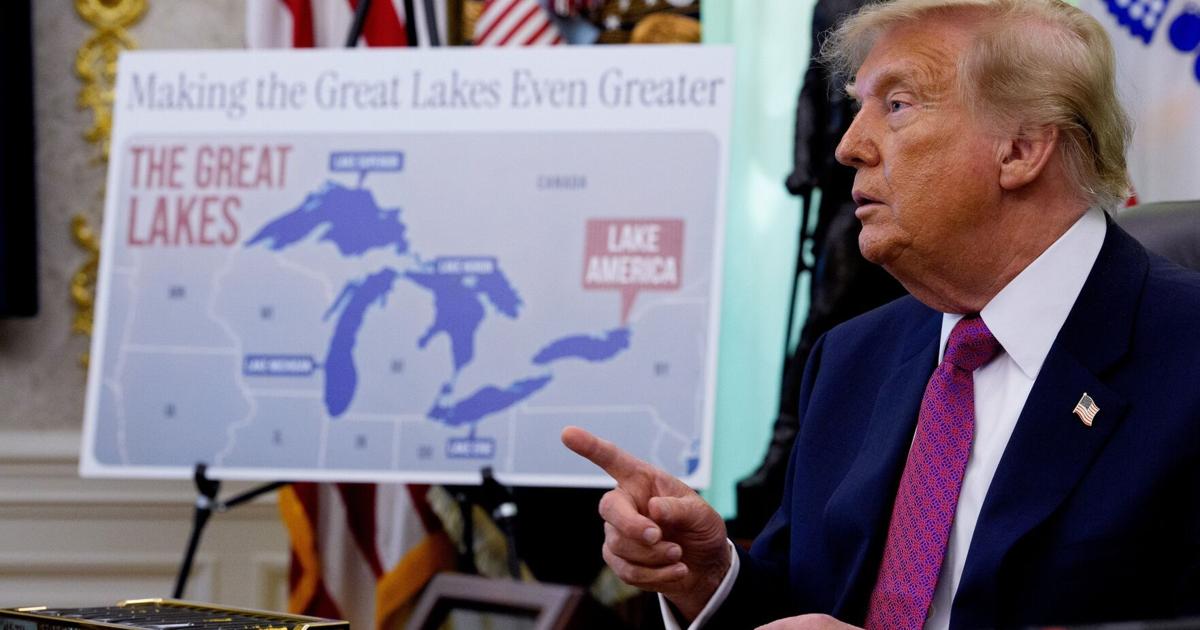
So Trump has unleashed a northward torrent of abuse, ranging from the economic (tariffs and more tariffs), to the ridiculous (renaming Lake Ontario), to the disturbing (an AI video showing him beating a supine Mark Carney with a hockey stick).
Comedian Jon Stewart summed up Trump’s strategy as trying to “troll (Canada) into submission.”
Amid the nonsense, Trump and his lieutenants are rolling out new justifications for targeting Canada. Like his initial trade war excuses last year (fentanyl smuggling, military underspending, Canadian content rules), they’re all unfounded.
Here’s a handy guide for debunking his latest doozies:
The trade deficit with Canada is $90 billion
Trump’s numerical claims about the Canada-U.S. trade imbalance have always been imaginary. Last year he threw out several invented numbers, ranging from as high as $200 billion to this week’s $90 billion.
The true deficit for 2025, based on official U.S. government data, was $27 billion. That consisted of a $55 billion deficit on merchandise, partly offset by a $28 billion U.S. surplus on services. (Yes, Donald, services count.)
That’s just three per cent of the massive two-way $900 billion bilateral flow. America’s trade with Canada is far more balanced than with the rest of the world — adding to the mystery of why Canada is suddenly Public Enemy Number One.
The deficit constitutes a subsidy to Canada
Whatever its size, Trump claims a trade deficit is equivalent to a subsidy. In reality, a trade deficit simply means one country buys more from another country, than it sells to that country.
When you spend $200 at the grocery store, it’s not a “subsidy.” You’ve bought things you need. America needs what it buys from Canada; our exports are better or cheaper than from other sources.
Any actual subsidy goes the other way. Other countries (including Canada) supply the U.S. with trillions of dollars of capital each year. That’s what allows the U.S. to run a perpetual trade deficit, every year for the last fifty.
The U.S. would save money by cutting off trade with Canada
Canada is the largest market for U.S. exports — $426 billion worth in 2025 alone. Ending that would cause a massive recession in the U.S., not just Canada.
Cutting off your nose to spite your face doesn’t make you feel better. It doesn’t save money, either.
Canada cheats at trade with its dollar
One of Trump’s most bizarre recent posts claimed that Canada’s dollar (presently worth about 72 cents U.S.) is used to rip off America. He pledged to stop this, without specifying how.
Yes, our currency has the same name. But that hardly means it should be worth the same. Some 25 other countries also have “dollars.” Are they cheating, too?
Exchange rates are determined by capital flows, investor expectations, comparative inflation, and many other factors. By boosting inflation and destabilizing investor confidence with his enormous deficits, Trump’s policies might indeed drive down America’s dollar. Then he can stop blaming Canada.
Canada can’t survive without the U.S.
This is Trump’s biggest, and most dangerous, lie, and getting us to believe it is central to his intimidation strategy.
Despite reduced U.S.-bound exports, Canada’s economy has continued growing. Two-thirds of those lost merchandise exports have been offset by new exports to other countries. And almost 80 per cent of our GDP is produced and consumed right here, by Canadians, for Canadians. Trump can’t touch that.
Yes, it will be a bumpy ride to disentangle our economy from overreliance on what is now a failed democracy next door. But as the 10th largest economy in the world, with a wealth of natural and human resources, and a stronger capacity to solve problems together, we will most definitely survive without Trump’s America.

