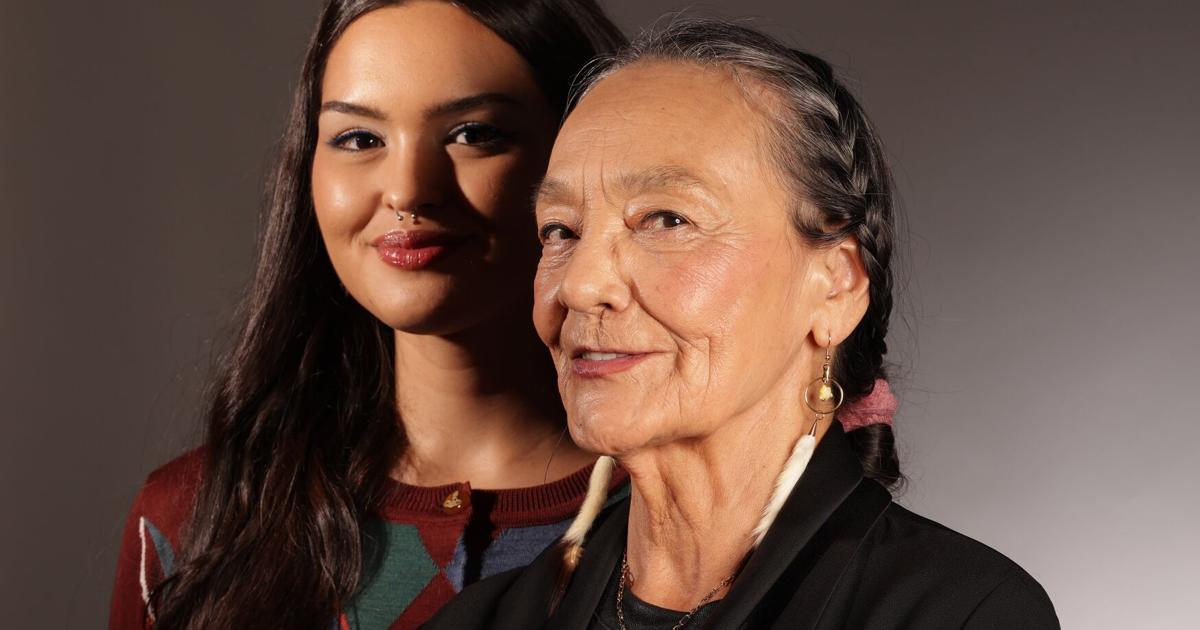
Tantoo Cardinal and Anna Lambe together quiet a room.
This isn’t the pair’s first meeting at TIFF. A 15-year-old Lambe made her acting debut alongside Cardinal in “The Grizzlies,” a critic’s favourite at the 2018 festival. This year, Lambe — the 25-year-old award-winning star of “North of North” — lights up in the screen in Nyla Innuksuk’s “In the Heart of the South,” a psychological drama topping TIFF ‘26 must-watch lists.
Cardinal’s career reaches back into the ‘70s, when roles for Indigenous actors were still being willed into existence. Lambe’s success points to how far that fight has come. “I’ve known it was coming,” says Cardinal, 76, whose roles have included “Dances with Wolves,” “North of 60” and “Killers of the Flower Moon.” “That’s the only thing that kept me going.”
A shooting star: ‘The place I started is so different from what’s in front of you’
Tantoo Cardinal: Anna, they call it a rising star … but (you) are a shooting star. It’s so exciting! When I was young, I wanted to have this amazing place where I could tell stories of what’s really going on … who we really are. We were still illegal, basically, when I started. Our own people would laugh at me for trying to use Cree in places, here or there. There were a lot of people who were ashamed of being Indigenous … or we were “Indians” in those days and “half-breeds” and “Eskimos.” The place that I started out is so different from what’s in front of you.
Anna Lambe: I’ve been doing a lot of press about the projects that I’ve been working on, especially “North of North,” where people ask questions like, “Why can everybody relate to this?” I think throughout history, our humanness has been denied so often. To be seen as people — even though it sounds so simple — is still radical. I feel so proud and grateful that there were people like you in the industry, who have fought through decades of misrepresentation and inauthenticity, finding every way that you can to put your voice into things because it’s made it possible for us to be recognized like this now.
T.C.: It’s bit by bit. I used to have this analogy that you can’t eat the whole bannock all at once. You take a bite at a time, you know? … We’re all going through this process of working our way through the murk of genocide and colonialism and all of that stuff. What are some of the potholes that you have to manoeuvre now?
Privilege and representation: ‘I’m not a representative of my entire community’
A.L.: I’m in a very privileged position now where I get to pick and choose the projects that I work on, and who I work with, like Nyla Innuksuk. There’s something about working on projects written and created by people from your community where you don’t have to take on the role of cultural consultant for free. That’s taken care of. There’s already a safety net. Often, I now get to go on a project just as an actor. Of course there are potholes, but more and more often it feels like potholes that every actor has to face. The unique one that always comes up is the pressure people try to project on you as a representative of your entire community. I’m not a representative of my entire community. You can’t be.
T.C.: No, you can’t be! But you’re doing an amazing job of where you are. You carry that space with such light. I was wondering, were you involved in the creation of the story for “In the Heart of the South?”
A.L.: No. A friend of mine who was working with Nyla told me that Nyla wanted to chat. I love working with women. I love working with Indigenous women. And I really, really love working with Inuit women. When I read the script, I was like, “Oh my God. It’s so good!”
T.C.: The dynamic between you and (actor) Zorga (Qaunaq) — it was hard to see what actually was going on and then it started to cook and I was like, “Ohhhh.”
Storytelling responsibility: ‘That’s a grey area that we need to talk about’
A.L.: We talk a lot about the importance of outsiders representing our communities accurately, and who has the right to tell what story, who has access and who doesn’t. But we haven’t talked very much about how, within our own communities, sometimes we exploit our own stories. We exploit each other’s stories. That’s a grey area that we need to talk about. It’s special that we get to do that with this film.
T.C.: That goes back to how much of our culture has been disintegrated and destroyed. I was raised by my grandmother, and when her friends would come over, our relatives would come from the bush and from that old, old place and visit. Whenever they told a story, they always told whose story it was. Whose life experience that was. It was a sacred thing. Nowadays, it’s just like, “Well, yeah, I heard it, so that’s good enough.” We’re bringing (stories) forward in a pig’s trough and people are just slurping it up without knowing what respect is. We don’t have any control over that. It’s like a gun — a gun is useful in some hands and not in others.
A.L.: People need to consider that just because you’re telling a story about your community and you’re from that community, and you feel like you’re doing the work because it’s representation — sometimes people hide behind that. You can exploit your own people’s stories. Then you’re performing for an outsider’s gaze.
T.C.: I think we’re both in a position where we can appreciate taking our time (with selecting acting roles).
A.L.: I’m very lucky, now, to be selective. There was a time where it was like, “I gotta pay rent.”
T.C.: Well, I had to because if I didn’t do it, they’re gonna paint up a white girl. I had to be available in stories and pictures, places that were terrible. Now I feel like OK, “I’m done with that world.” But there is a lot that got settled into my system of unfinished stories, unfinished characters, misused life force, you know? Because it was a war.
The power of grace: ‘There’s still room for mistakes’
A.L.: When we talk about all of these things — and what we can be doing better — there’s still room for mistakes. I like this idea of grace. We need to extend that to one another while having really difficult conversations.
T.C.: “In Heart of the South” does that well. I really appreciated it.
A.L.: I’m so excited because we have “In the Heart of the South,” then (Métis writer) Marie Clements has her film premiering at TIFF and (Cree filmmaker) Cody Lightning has his film premiere. Our stories for so long were not represented and not funded. It’s not lost on me: How many people, how much incredible talent we should have here now, because there have been so many visionaries for so long.
T.C.: Here it is, and you’re right in the middle of it, and there’s so much talent that’s in your generations and moving forward. Don’t forget us, old folks, eh?
A.L.: Never — you’re an icon.