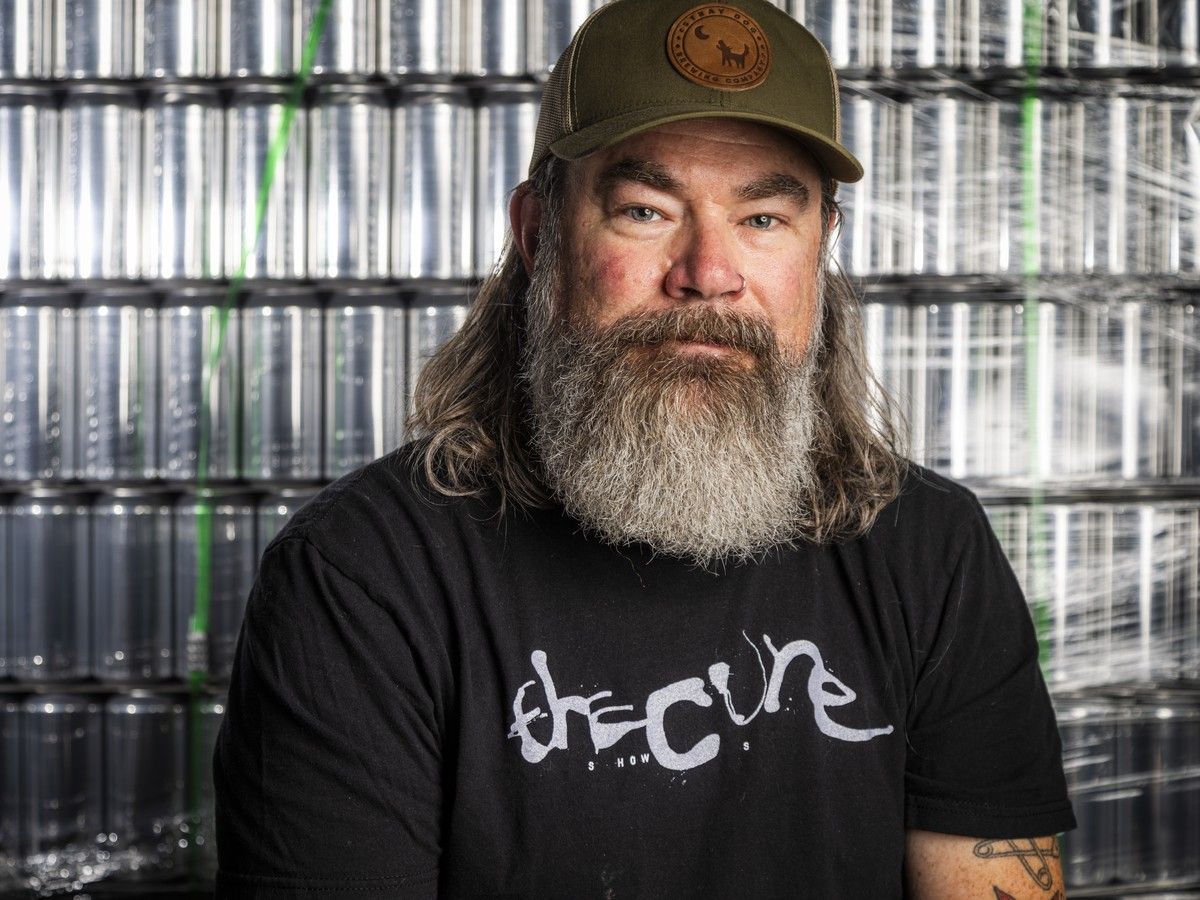
Twenty-eight days from grain to glass. It’s a common phrase in the homebrewing circles Marc Plante and his now business partner, Justin MacNeill, used to frequent.
“That’s what we call it,” Marc Plante, co-owner of Stray Dog Brewing Company , says. Now, as the owners of the local Orléans microbrewery, the 28-day timeline is also used to determine how frequently the owners need to purchase aluminum cans to package and send out their homemade beers.
Before tariffs, an empty aluminum can would cost 19 cents. Now, Plante and MacNeill pay 23.6 cents, with the cost of lids rising from four cents to six.
“It doesn’t sound like much,” Plante said Saturday, Sept. 12, as the brewery prepared to celebrate its ninth anniversary. “But when you multiply that by the thousands, they start to add up.”
Stray Dog goes through 3,000 to 4,000 cans every two to three weeks.
The brewery, which opened as Orléans’ first microbrewery nine years ago, is now navigating rising costs as other local breweries disappear. Orléans Brewing Co. (OBC) closed its doors in August, citing rising costs, increased rent and mounting pressures. It was the second Ottawa brewery to close this year after Kichesippi Beer Co . shut down in March.
“It really kind of gives you pause when you see a larger, more established microbrewery like Kichesippi Beer closing,” he said. “Like, OK, well, what did they do? And what are we doing differently, and how can we avoid that situation?”

Watching OBC close was “another gut punch.”
Plante says that the brewing company, which used to go through different suppliers to get its cans and lids, now exclusively goes through a Canadian company called Elk Packaging.
Stray Dog isn’t a big enough company to order in bulk and store a trailer full of empty cans in a storage unit. That’s why the brewery buys directly from companies like Elk Packaging, which gets its overall prices reduced by purchasing in bulk.
According to uOttawa constitutional and international law professor Errol Mendes, the latest retaliatory tariffs from the U.S., which came into effect Tuesday, Sept. 8, and were in response to Canada’s own retaliatory tariffs, are likely to impact smaller to medium-sized businesses. Though not immediately, Mendes said.
“The way in which the U.S. has retaliated for the retaliation focuses, to some extent, on where there would be pain for that small to medium business community,” Mendes said.
The science of pricing
uOttawa political science professor Charles-Étienne Beaudry says the federal government’s Innovation, Science, Economic Development Canada department should step in by developing a hotline where businesses can call a federal worker to consult on business decisions.
Beaudry, author of new book The Return of the Enlightenment, says the federal government has an opportunity to help businesses determine new pricing for their goods, and find new suppliers within the country and across the world, as Canada continues to aim for a more diverse economy, one less reliant on the U.S.
“It’s important for businesses to carefully study what would be the right new price in order to lower their profit margin by a small amount, while also not losing their customer base,” Beaudry said.

But not all businesses are knee-deep in debt just days after the latest tariffs came into effect. Beaudry says businesses who have inventories in their warehouses will survive without changing the supply chain of their organization immediately.
“There will be an economic shock for Canadian businesses in the coming weeks because of the trade war with the U.S.,” he warns. “But there’s light at the end of the tunnel.”
That light, he says, is a new Canadian economy, one less shackled and at the mercy of our southern neighbours.
“This is an opportunity for us to better diversify our partners (globally),” Beaudry said. “We’ll get to that light as fast as we work on it.”
Tariffs: another layer to layers of problems
Plante exuded a sense of acceptance towards the very realities that seem to be threatening his livelihood. He says his outlook on the future of his business is more neutral than grim or optimistic.
“We’ve been through this before,” he said of the tariffs. “It’s really just about riding the ebbs and flows. It’s just another thing that impacts the craft beer industry. And these tariffs are just one of many.”
The added costs from tariffs are “another layer on top of another layer of things” that affect the business, Plante said. “We know that (tariffs) are not going to be here forever … the situation down south, that’s not going to be like that forever.”
For Plante, it’s all about riding the waves out and focusing on supporting other local businesses along the way, by sourcing more Canadian products from local small businesses.
Mendes, who echoed the same sentiments, said businesses in cities like Ottawa should be thinking about how to help smaller businesses who are feeling the pain of retaliatory U.S. tariffs.
“How can we, as Canadians, try and help out? Well, the first thing is, I think there is a collective responsibility on a part of Canadians to see how we can help,” Mendes said.
‘Rising tide floats all boats’
About a decade ago, Orléans had no microbrewery. But Plante says the numbers suggested there was an appetite for one. The community had one of the highest craft beer sales rates in Ottawa, and with a population of about 124,000 about a decade ago, Plante says the opportunity was there.
“So we said to ourselves, ‘Why can’t we be the first ones?’” Plante said.
But now, fast forward a decade, microbreweries can’t just be about beer anymore, he says. “To me, everybody can make really great beer.”
“I think for us, it’s really about, how we care about the community and how we interact with people. And it’s how we think people feel welcome here,” Plante says.
Today, Stray Dog is one of just two microbreweries in Orléans, alongside Broadhead Brewery Company, which moved into the community during the pandemic.
Since then, competition has grown, but Plante said it has remained largely friendly.
“We always want to support each other,” Plante said. “Because rising tide floats all boats.”
Take control of your search results. Make the Ottawa Citizen a preferred source on Google and see verified local reporting first.