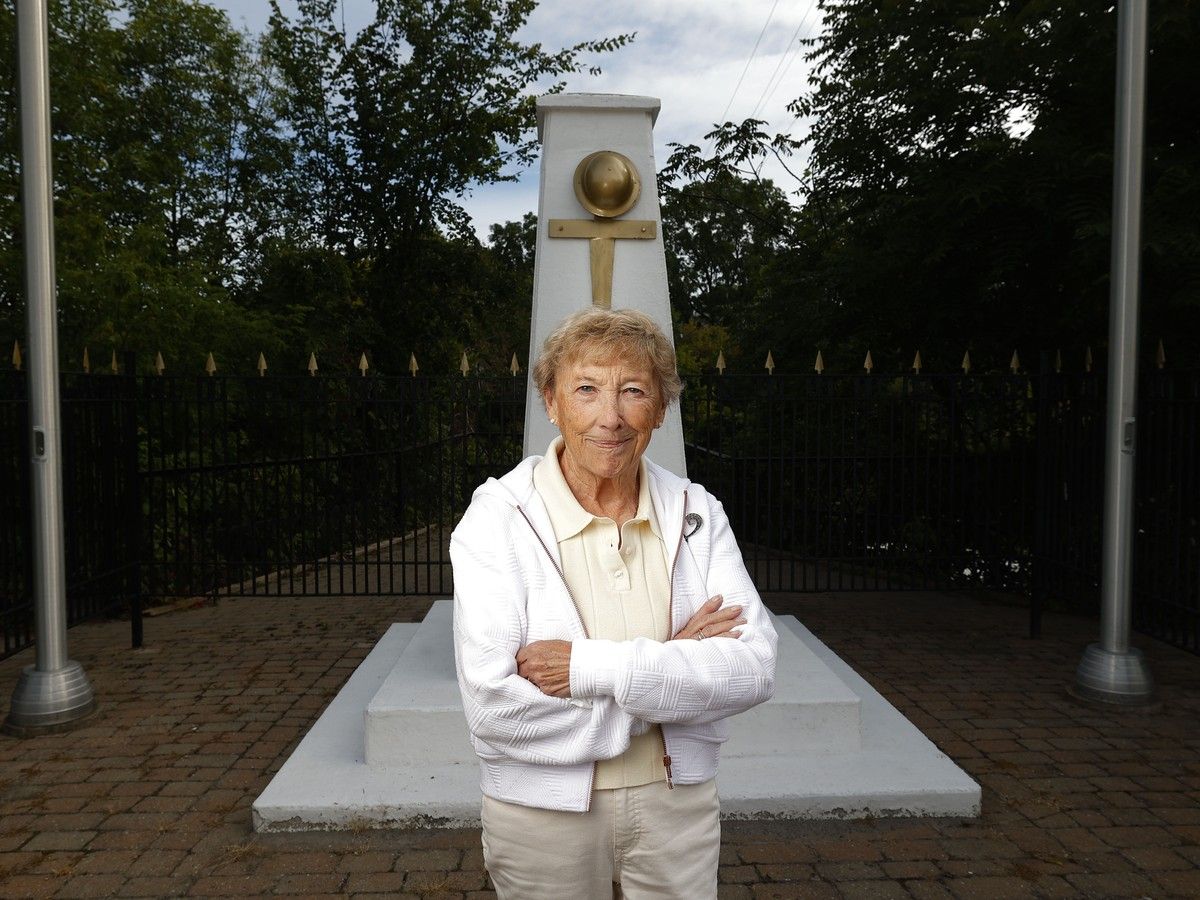
Longtime Manotick resident Barbara Usher always thought it would be wonderful to see fallen soldiers like her father commemorated during the annual Remembrance Day ceremonies at the village cenotaph.
“I often thought of him in November when I was down there,” the spry 84-year-old said in an interview. “I always wished there was something to honour him.”
Her father, Sgt. Edward “Eddie” Menzie, was a mechanic in the Canadian 1st Anti-Tank Regiment who died in Italy in 1944. His only child, the little girl who became known as Barbie, was two years old.
Barbie, now Mrs. Usher, will get her wish fulfilled thanks to a team of volunteers headed by Canadian Armed Forces veteran Terry Hunter, who’s a key member of the Ottawa Military History Club and the archives and historical officer for the Royal Canadian Legion Branch 314 in Manotick.
Hunter, who’s 65 and has lived in Manotick for about six years, didn’t realize the community’s cenotaph did not list the names of fallen soldiers until he watched a documentary on the monument produced by Ottawa military historian Norm Christie.
“When a cenotaph does not have the names, the stories of the war dead are not being told,” Hunter said.
(Some Ottawa-area cenotaphs, including the National War Memorial , do not list soldiers’ names, but others do. For example, the Eastview cenotaph in Vanier lists the names of 33 soldiers lost, while the Westboro memorial has a time capsule buried in front containing the names of 396 soldiers killed in conflict.)

Three years ago, with Christie’s blessing, Hunter decided that Manotick’s gap in information needed to be filled. Research was a challenge, he said, because the area was little more than a farming village in wartime, lacking amenities such as a city hall or central registry office.
But, with the help of four skilled genealogical researchers, the team was able to identify 22 men lost during the two world wars who had been either born in Manotick or lived there. The first 17, each with a short biography, were compiled in a matter of months.
They have not found any female names, nor any soldiers killed in combat after the Second World War.
A recent breakthrough came earlier in September, when three additional names were discovered. Another was stumbled upon by this reporter and confirmed by the team on Sept. 15: Gunner Philip Ryan, who was killed in a motorcycle accident in 1940, was born in Manotick.
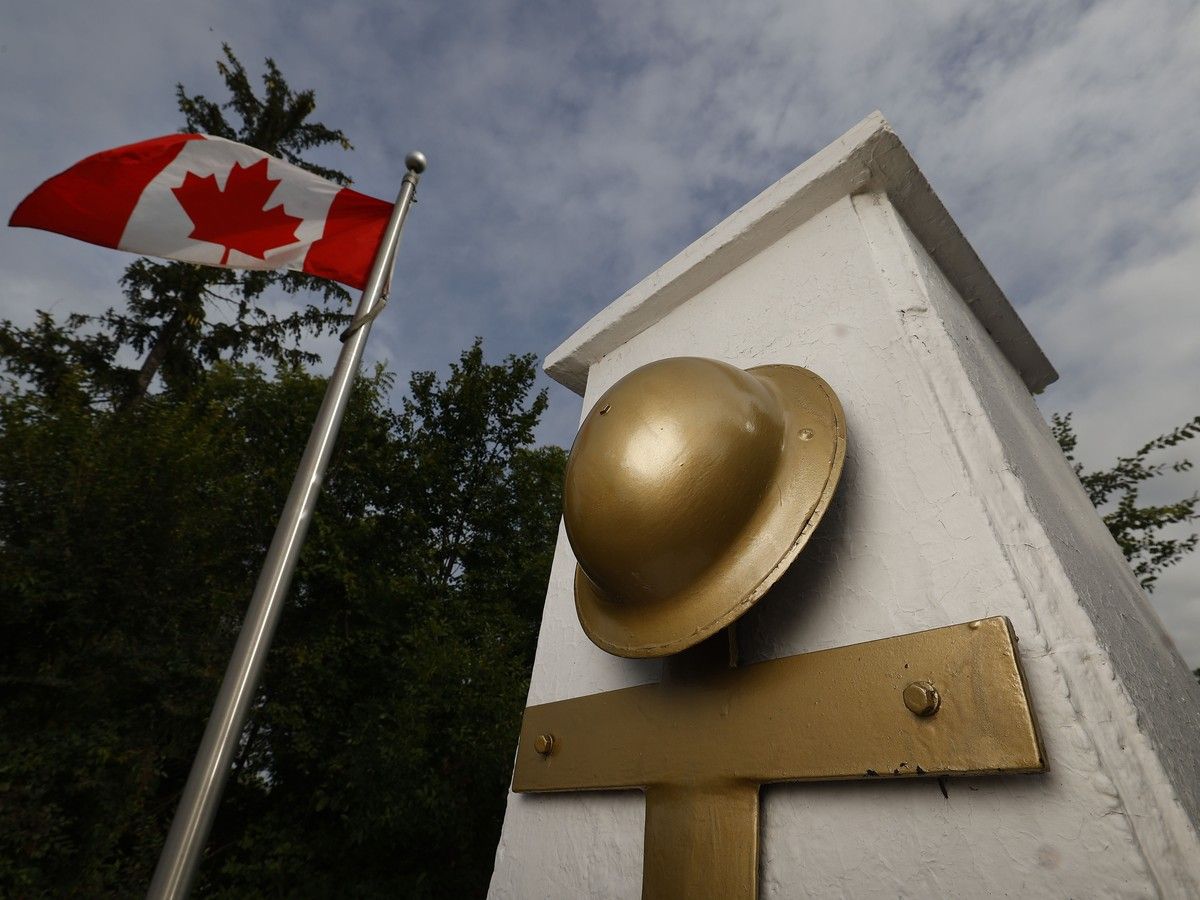
Menzie’s name was put forward by Neil Usher, Barbara’s husband of 62 years. It might have been hard to find otherwise.
“Unfortunately, Sgt. Menzie’s service file is not digitized, so I had to cobble the info for his biography from newspapers and online resources,” Hunter said, pointing to old clippings from two newspapers. The Ottawa Citizen and Montreal Daily Star covered Barbara’s solo arrival in North America as a four-year-old pre-schooler.

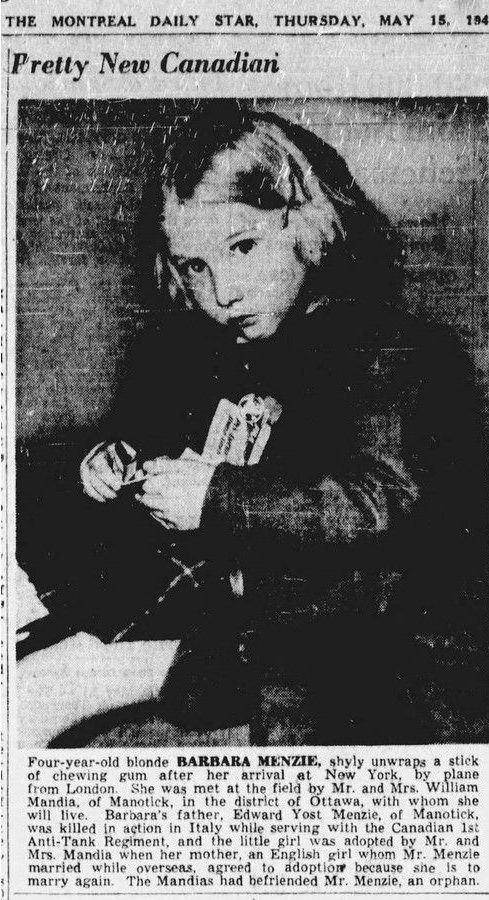
The Montreal paper carried the headline: Pretty New Canadian, along with a photo of the girl and a short article about how her mother sent her to live with friends in Canada because she wanted to remarry.
Barbara wasn’t sure if that was entirely true; her mother didn’t remarry for several years.
At the time, however, it was not uncommon for British war brides to leave their children in Canada, or for British parents to send their kids away from England for a better education, perhaps, a safer environment, or to grow up on a farm.
Whatever the reason, young Barbie was an unaccompanied minor when she flew from England to New York City aboard a Pan American Airways’ Clipper aircraft to join the family friends who wanted to adopt her. She remembers being the only child on the plane.
Mr. and Mrs. William Mandias travelled from Manotick to LaGuardia Field to pick up the girl.

Growing up with her new family in Manotick, Usher said neighbours would share details about her father, who had also grown up in the village. “I learned things from them,” she said of the father she never knew. “They went to school with him or they worked with him, and he seemed like a really good guy.”
Although her mother stayed behind in England, Usher said she was never formally adopted in Manotick because her mother didn’t want to fully let go. Her mother kept in touch, and, after remarrying, would visit Eastern Ontario with her husband.
Stories like that of Barbara’s family compel Hunter.
“It’s very much a passion project for me,” he said, noting he grew up in a military family and became fascinated by the war-time stories he heard from his parents and their friends.
“It started becoming a passion for me to learn more about what they had done and also investigate the history of our Canadian military overseas,” he added.
Now Hunter wants to hear more from the descendants of Manotick’s fallen soldiers, not only to find out more about them, but also to illustrate how war affected the families, friends and communities of those who served.
A virtual war memorial and a book are in the works to preserve the information.
The team also wants to invite the descendants to Manotick on Sept. 26 to be guests of honour at a parade and ceremony marking the 100th anniversary of the Canadian Legion , along with the dedication of the cenotaph. Ottawa’s Sons of Scotland Pipe Band will lead the procession with a mass lineup of more than 200 bagpipers and drummers.

If you know relatives of these soldiers or can suggest a name to add to the list, Hunter can be reached at [email protected].
These are the fallen soldiers of Manotick:
First World War 1914-1919
Private Alfred Wheeler Armstrong : 2nd Battalion (Eastern Ontario), Canadian Expeditionary Force (CEF), killed in action Sept. 27, 1918.
Lance Corporal Clayton Adam Bradley : Princess Patricias Canadian Light Infantry (PPCLI), killed in action June 2, 1916.
Private Robert Lorne Falls : 2nd Battalion (Eastern Ontario), Canadian Expeditionary Force (CEF), died of wounds April 9, 1918.
Gunner Charles Frederick Gorman : Canadian Field Artillery (CFA), 1st Brigade, 1st Canadian Division Canadian Expeditionary Force (CEF), died of wounds May 18, 1917.
Private Samuel Grayson : 7th Battalion (British Columbia) Canadian Expeditionary Force (CEF), died of wounds Nov. 13, 1917.
Private Samuel Helem : 146th Battalion (Kingston) Canadian Expeditionary Force (CEF), died of exhaustion May 19, 1917, after contracting pulmonary tuberculosis.
Private Allan Peter Hicks (Brother of Cpl Frederick Gorman Hicks : 27th (City of Winnipeg) Battalion CEF, died of wounds received during the Great War on Dec. 6, 1919.
Corporal Frederick Gorman Hicks (Brother of Pte Allan Peter Hicks) : Canadian Army Service Corps (CASC), died from pneumonia Jan. 21, 1921, after contracting pulmonary tuberculosis during the Great War.
Private John Robison Padget : 2nd Canadian Mounted Rifles (British Columbia Regiment) CEF, killed in action May 22, 1917.
Private Claude Potter : Canadian Army Medical Corps (CAMC), died of illnesses Feb. 26, 1921, related to contracting pleurisy and phthisis (pulmonary tuberculosis) during the Great War.
Gunner Matthew Herbert Scott : Canadian Field Artillery-17th Battery, 5th Brigade, Canadian Expeditionary Force (CEF), died of wounds Aug. 29, 1918.
Sapper Hubert Stamp : Canadian Engineers posted to Canadian Corps Headquarters Signal Coy, killed in action Aug. 18, 1917.
Private Percy Edward Vaughan : 5th Battalion (Saskatchewan), Canadian Expeditionary Force (CEF), killed in action, Feb. 22, 1918.
Second World War 1939-1945
Flight Sergeant George Ernest Percy Birtch : Royal Canadian Air Force (RCAF), killed in action Sept. 1, 1943.
Sub Lieutenant (Acting) Arthur Gordon Byshe : Royal Navy Fleet Air Arm-HMS Saker, killed during training, Nov. 16, 1944.
Pilot Officer Leonard Cornelius Driscoll : Royal Canadian Air Force (British Commonwealth Air Training Plan), killed during training Oct. 28, 1943.
Private Eugene Foubert : Hastings and Prince Edward Regiment, died of injuries Aug. 11, 1944.
Lance Corporal Ray Stuart Graham : Hastings and Prince Edward Regiment, killed in action Feb. 4, 1944.
Private Eldred Leonard Johnston : Royal Hamilton Light Infantry, died of wounds May 8, 1945.
Sergeant Edward John Yost Menzie : 51st Battery, 1st Anti-Tank Regiment, Royal Canadian Artillery, killed in action Dec. 13, 1944.
Gunner Philip Ryan : 51st Battery RCA, 1st Anti-Tank Regiment RCA, killed in motorcycle accident Sept. 13, 1940.
Pilot Officer Thomas Albert Kidd Watterson : Royal Canadian Air Force (RCAF), killed in air crash during a navigational training and military transport flight Feb. 14, 1943.
Take control of your search results. Make the Ottawa Citizen a preferred source on Google and see verified local reporting first.