

STRASBOURG—The European Union should welcome Canada as an associate member of the European Union, EU President Ursula von der Leyen told a packed legislative assembly here Wednesday.
“We want to bring the relationship to the highest level possible,” said von der Leyen in a state of the union address to the European Parliament, saying Canada is a valued partner on the war in Ukraine, key to diversifying its energy sources and upholds democracy and the international rule of law.
“I would like to work with you to opening the door for Canada to be the first associate member of the European Union,” said von der Leyen, prompting a loud wave of applause in the massive circular chamber.
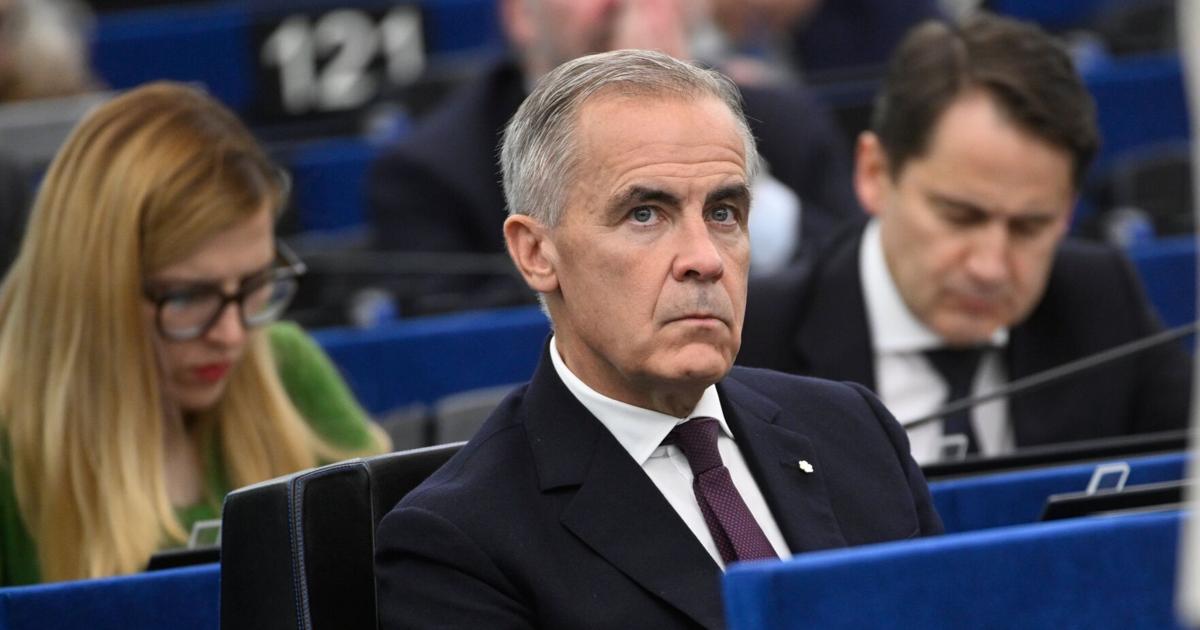
At that, Prime Minister Mark Carney, seated as an invited guest at the front row off to her left, smiled broadly and shook hands with an Irish minister of state, and walked over to shake von der Leyen’s hand and kiss her on each cheek. Some European parliamentarians offered a standing ovation, but it was not a uniform response across the chamber.
Carney is not scheduled to take questions from Canadian media here today but will address the same chamber on Thursday.
In a written statement issued after von der Leyen spoke, he said, “We welcome President von der Leyen’s proposal that Canada and the European Union move beyond the CETA to an Alliance for the Future. This is a unique, positive approach that we will define together, building on our common strengths and based on our shared values.”
Usually, there are many steps to membership in the EU. Today’s proposal came from von der Leyen, but it’s not a formal invitation to join the bloc immediately.
The idea that Canada would bid for “associate membership” in the EU was first reported by the Wall Street Journal Sunday. Canadian officials spent the past few days denying Canada was seeking outright membership, and was not the one to propose the term “associate member.” A senior Canadian official told the Star Tuesday that the Carney team did not in fact view it as a helpful term.
“We don’t particularly like it because it implies some form of membership,” the official told the Star. “What we’re trying to do is something new and different.”
The prime minister himself discounted outright membership on Sunday.
“We’re not looking to become a member of the European Union,” Carney said. “What we are looking — and will begin discussions for — [is] a unique alliance with the European Union. We share the same values, we have the same priorities and we have very complementary strengths.”
But he was less categoric about associate membership — a term that is yet to be set out in any European regulations or official document setting out rules for accession.
For her part, von der Leyen, as EU president, leaned into the special relationship that Canada has with Europe as she delivered a state of the union speech and proposed the new official status for Canada.
“In this new world we must reimagine our partnerships,” von der Leyen said, as she outlined new free trade deals Europe had signed in the past year with India and others, or deals it is still pursuing.
She said Europe and Canada share deep cultural, historical and personal links, noted because of the Canada-EU trade agreement (CETA) trade in goods has grown by 75 per cent in the past decade.
And von der Leyen emphasized “We see the world with the same eyes: from AI to climate change, from the Arctic to geopolitics. And we have stood together: on Ukraine, on defence, on raw materials and on supply chains.”
“But above all, dear Mark, Europe and Canada believe in democracy. We believe that power does not belong to the strongest, the richest and loudest – but to all of us, that democracies have the freedom to choose with whom to work.”
She said Europe and Canada will advance from the current trade deal to something she called an “alliance for the future” that she said would create “a common prosperity and economic security space.”
She said the alliance will work on “intelligent manufacturing,” “a tech alliance that will integrate defence industrial bases,” the Arctic, energy, critical minerals, batteries, AI, quantum, cyber and economic security.
Von der Leyen also moved to preempt criticism that Canada and Europe are turning away from the United States.
“This is a partnership not against anyone else, but for our common strength.”
The notion that Canada would formalize an association with the EU while other aspiring countries struggle to accede to the EU with its onerous rules, is a novel and somewhat controversial one.
The Financial Times, quoting European diplomats from member state capitals, reported several believed the idea was unwelcome, with one saying it is “not really thought through,” and another expressing concerns that it could anger Trump.
But Von der Leyen’s speech, which spanned more than an hour, canvassed major threats facing the continental member states including war in Ukraine, disinformation, the trading bloc’s daily trade deficit with China of 1 billion Euros, and its reliance on imported fossil fuels for energy needs, which last year cost 90 billion Euros, she said.
She announced several new policies, in particular one certain to anger many U.S.-based big tech companies and platforms.
The European Commission, the executive body, will propose on Thursday an “EU Kids Act” to combat the addictive features of smartphones, social media, and the criminal exploitation of private content, von der Leyen said.
“We will take a gradual and differentiated approach. Each age has its own sensitivities. And therefore, each will have its own tailored protection level. In sum, no social media under the age of 13. No personal account under the age of 15. That means, from 13 until a child turns 15, only mini accounts set up and supervised by parents, with limited features and time restriction. And between 15 and 18, safe design will be an obligation for the platforms.”
“Europe has the power to act. It is we who decide our rules, not big tech.”
Yet there were also distinct differences in some priorities. In contrast to Carney’s plan to increase production of and exports of fossil fuels, von der Leyen doubled down on Europe’s obligation to address climate change.
She said the EU “can must and will meet its climate action targets,” portraying the threat of climate change is real and unrelenting, and calling for Europe to accelerate development of its clean energy technologies. After a summer where wildfires devastated vast swaths of Spain and France, she proposed a European firefighting service.
Carney arrived early in Strasbourg after hosting a global investment summit where he promoted his trade diversification agenda. At the European Parliament buildings, he was greeted and walked a red carpet accompanied by von der Leyen, and European Parliament President Roberta Metsola, who had extended the invitation to the Canadian leader to make a speech of his own Thursday.
As Carney was flying to Europe, Conservative leader Pierre Poilievre raised many objections to any notion of Canada setting out a new European relationship, when there already exists a free trade agreement, as well as a defensive alliance with NATO.
“So, what more is Mr. Carney proposing,” he asked, “because what Conservatives do not support is forcing waitresses who are struggling to pay their rent, or welders who are worried about losing their homes, to pay higher taxes to a government in Europe, or to follow laws made by European bureaucrats that don’t even know where the Lower Mainland of B.C. is, or to have European immigration policies that will further overwhelm our housing, healthcare, and job market.”
Error! Sorry, there was an error processing your request.
There was a problem with the recaptcha. Please try again.
You may unsubscribe at any time. By signing up, you agree to our terms of use and privacy policy. This site is protected by reCAPTCHA and the Google privacy policy and terms of service apply.
Want more of the latest from us? Sign up for more at our newsletter page.

