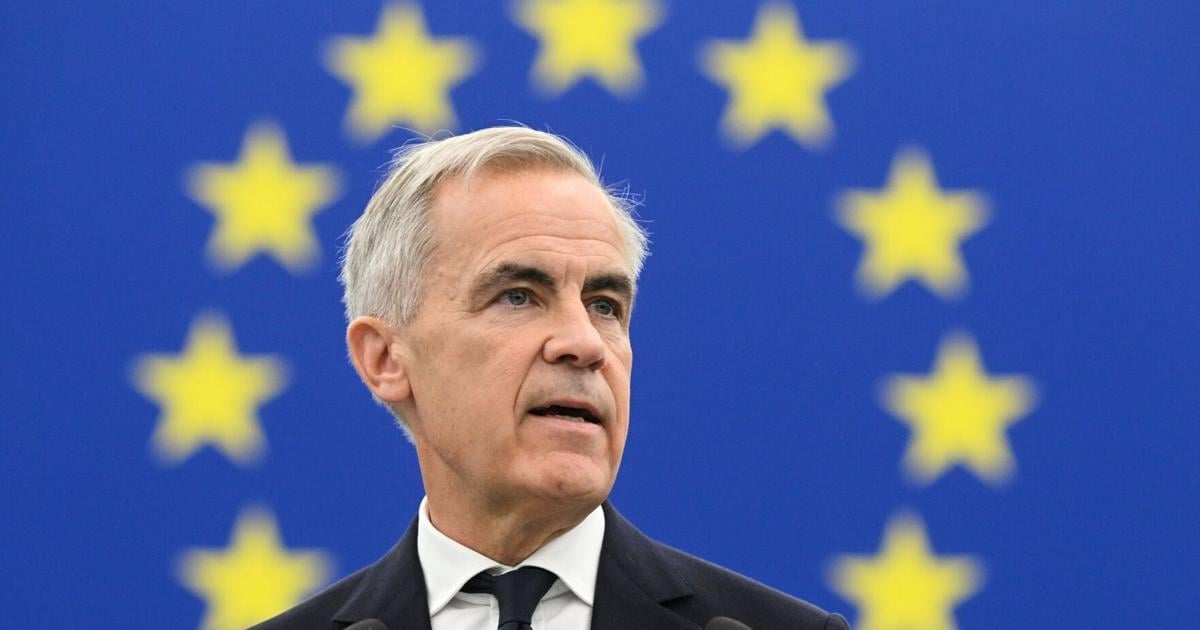
STRASBOURG, France— Canada is ready to enter a more formal partnership, including associate membership, with the European Union to strengthen sovereignty and resist global pressures, Prime Minister Mark Carney said Thursday as the U.S. president threatened to punish such a move.
Speaking to a half-full European Parliament chamber, Carney brushed aside Donald Trump’s late-night warning that any move by the EU to accept Canada as its first associate member would be a “hostile act” that could warrant steep tariffs on Europe, if not outright trade bans.
Instead, Carney took up the call by EU Commission President Ursula von der Leyen a day earlier and said he is open to her invitation to move beyond the Canada-Europe Trade Agreement on free trade to establishing what both called an “alliance for the future.”
Von der Leyen, in her state of the union address to Parliament on Wednesday, urged Canada to work toward becoming an associate member of the EU despite the fact that associate membership is not set out in the 27-country bloc’s framework.
“We welcome this ambition,” Carney said in his Thursday speech after being greeted for the second day on the parliament’s red carpet. As if to pre-empt political critics at home, including Conservative leader Pierre Poilievre who condemned it as a loss of sovereignty, Carney said polling shows “an overwhelming majority of Canadians support much closer ties.”
And in answer to Trump’s condemnation, Carney said, “I am not proposing a third bloc in order to become a great-power rival – only with better manners.”
“We do not seek power to dominate others. On the contrary, we are pursuing resilience so that no one can control our open markets, impair our sovereignty, threaten our territorial integrity, or undermine our freedoms, our democracies, our rule of law. Those motivations, combined with our latent hard power, mean we can help to create the next just, stable, and prosperous world order.”
Trump’s global tariffs, his war of choice in Iran, and his courting of China, Russia and other authoritarian leaders, along with his musings about annexing Canada as a 51st state or the Danish territory of Greenland as American territory, have fueled widespread anxiety among other U.S. trading partners and allies.
Like his Davos speech nine months ago, Carney’s address was peppered with literary and metaphorical references, this time to German writer-philosopher and statesman Johann Wolfgang Goethe, Canada’s blood ties to Europe born of wartime sacrifices, and an extended forest analogy for how countries can learn to survive killer storms.
Where the Davos speech in January at the World Economic Forum called on middle powers to band together to form coalitions to resist superpowers like the U.S., Russia and China which spurn rules and are upending the international order, the Strasbourg speech suggested such a coalition already exists between Canada and Europe, and should be deepened.
“A Canada-EU alliance would create a beacon for other democracies,” the prime minister said. “An alliance not defined by what we oppose, but about what we are for: freedom, solidarity, prosperity, sustainability. An alliance that builds resilience for what it allows us to do for our citizens, and our citizens to do for themselves. An alliance strong enough so that no one can dictate our choices. Open enough that others can join. Principled enough that our strength reinforces international law rather than replaces it.”
Carney said his objective for “a deeper partnership” with Europe is “collective resilience.”
The prime minister said there is “mutual advantage” in combining strategic capabilities in key sectors to address vulnerabilities and sustain economic and national security in the face of geopolitical uncertainty.
“Canada and Europe should secure our strategic autonomy through deep cooperation in the full range of strategic capabilities, including critical minerals, defence industrial capacity, AI and compute, energy security, space, and payments,” Carney’s prepared text said.
He spelled out how those sectors could be leveraged.
“Europe brings market power. Research depth. Advanced manufacturing. The ability to set standards that the world frequently adopts,” he said, pointing to the “re-arm Europe project” that is rapidly building up a stronger defence industrial base. Canada’s participation in that program, called SAFE, was agreed to last year, the first non-European country to join.
On the other hand, Carney said Canada offers “energy at huge scale and in every form the transition requires. One of the world’s largest endowments of critical minerals. Deep capabilities in space, AI and quantum. Amongst the strongest banking systems in the world, and the most expert pension capital. Unique Arctic geography, and privileged access to both Atlantic and Pacific networks.”
Time, Carney suggested, was of the essence. “We should build on each other’s strengths – deliberately, systematically, and rapidly.”
He said the Canada-Europe free trade agreement, and a defence and strategic partnership launched last year are “not yet equal to the ferocity of the changing climate, nor is it moving fast enough to match the speed of the upheaval.”
He said they should move toward “seamless, digital trade in non-agricultural goods and a wide range of services,” ease the ability of young people to “live, work and study where they want on either side of the Atlantic Ocean” and advance other initiatives.
Prior to the speech, incoming Canadian ambassador to the EU, Jonathan Wilkinson said many of the details are still to be worked out, despite Canadian and European officials working intensely behind the scenes for months to set the stage for the twin von der Leyen and Carney addresses.
More details are expected to be announced at the Canada-EU summit in late October in Montreal.
-this is a developing story.