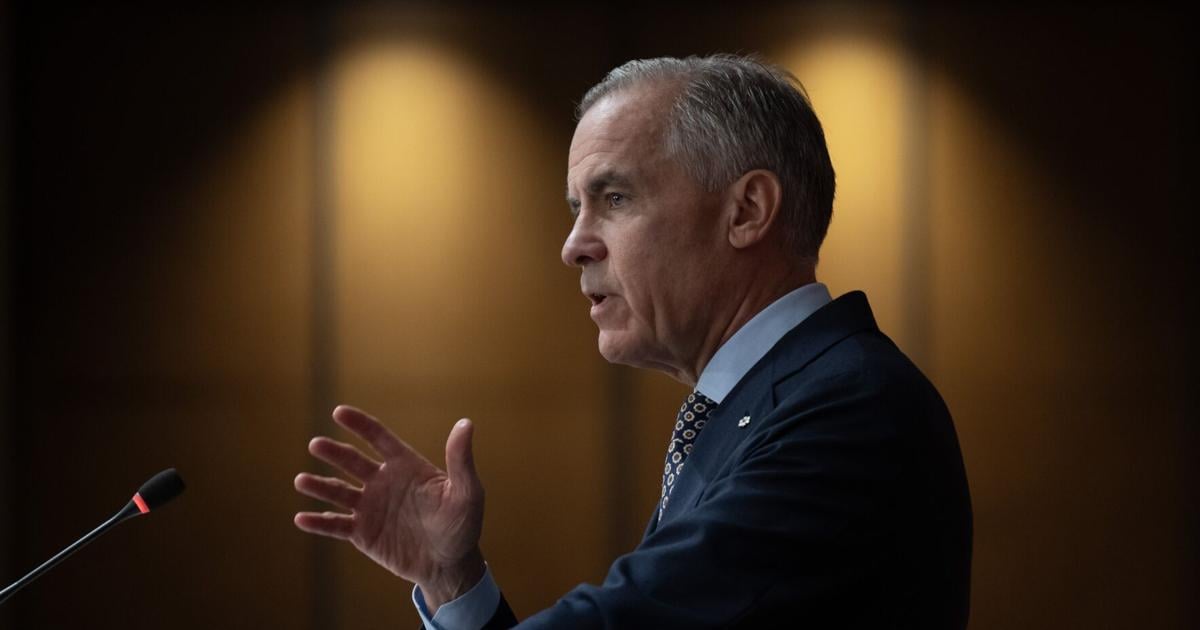
OTTAWA — Mark Carney’s trajectory is clear. And he’d like the rest of us to keep up, please.
The prime minister has moved past denial, anger or bargaining when it comes to dealing with the unpredictable President Donald Trump, his royal court of enabling cabinet ministers, and trepidatious corporate America.
He’s moved past acceptance, too.
In the face of what he calls the rupture in the international rules-based order, Carney has — literally at a whirlwind pace — moved on to other places, government leaders, and investors, and wishes that Canadian political figures, business developers and the public would too.
You can see it every other day now.
After halting trade talks last month over what he called unacceptable American demands that would have eroded Canadian sovereignty, Carney incurred more Trump tariffs and wrath. The White House ordered Lake Ontario’s name changed to Lake America, among other jibes, prompting the prime minister to urge Trump to stop “throwing shade” and posting memes to taunt Canada.
But now it’s Carney who is taking pokes and cracking jokes of his own.
In Toronto, he told global investors on Tuesday that Trump had given him the gift of a key to the White House. “You just bring it, they’ll let you in,” Carney recalled, imitating Trump’s voice. Or, Trump said, “Maybe they’ll shoot you,” the prime minister said with a chuckle, delighting his audience. “And that sort of sums up the relationship that we have.”
In Strasbourg, France on Thursday, Carney said the goal of a deeper alliance with Europe isn’t “to become a great-power rival — only with better manners” — drawing laughter at the European Parliament.
In Ottawa on Friday to jazz up his caucus ahead of the return to Parliament, Carney mimicked Trump’s fascination with bigness as he touted a federal-provincial deal to develop hydroelectric energy, wind and solar in Labrador, providing the “equivalent of 18 Hoover Dams.”
“Eighteen Hoover Dams,” he repeated. Carney then stretched his hands apart, wearing a knowing grin. Liberal MPs in the room recognized the Barack Obama gesture Obama used to mock Trump’s “weird obsession with crowd size” and roared.
They laughed again when Carney quipped about Trump’s massive budgetary package dubbed the One Big Beautiful Bill Act. Carney said his proposed business tax changes will make Canada’s effective tax rate on new investment “the lowest of any major economy in the world, less than half the rate of” — he waited for Liberals to join the chorus — “the United States. We didn’t need a big, beautiful bill. We needed a targeted initiative,” Carney said.
Beyond seeming looser and more willing to take public shots at Trump, the change in Carney’s outlook can be seen in his travels, speeches and, perhaps most tellingly, in policy gestures both large and small.
Turns out it wasn’t just about getting Canadians into the flamboyant Eurovision song contest.
Or about signing deals to export liquefied natural gas to Germany — via Asia. Or about striking agreements with France to better share intelligence information. Canada already has information channels via NATO where European allies who are outside the English-speaking “Five Eyes” network can share information. But the Five Eyes network of Britain, Canada, Australia, New Zealand and the U.S. remains dominated by Trump’s America, and Canada needs options.
From Carney’s first trip abroad after becoming prime minister in March 2025, when he flew to Paris, London and Iqaluit, to this week’s travel to Strasbourg in a quest to make his Eurovision ours — with important stops in the Gulf states, China, Davos and India along the way — it might look like it’s all of a piece, all part of his trade diversification agenda.
But look closer and it is clear Carney has changed as his time in office has progressed.
His own sense of urgency has increased. So has his impatience.
On that first trip in 2025, Carney seemed uber-confident he would nail a “comprehensive economic and security deal” with Trump. Nothing less would do. Self-assured that his bona fides as a central banker and crisis manager could persuade Trump and his fawning team that a deal with Canada was better than no deal, Carney undertook an intensive charm offensive with Trump.
He appealed personally to the president, cultivated a close texting relationship, downplayed 51st state threats, hosted him with G7 leaders in Alberta, met him at other international summits, travelled twice to Washington — last fall believing he was close to a deal — even flew to Egypt at the last minute to stand alongside other world leaders to hail Trump’s leadership in a peace deal to end hostilities in Gaza.
That was before Trump invaded Venezuela, threatened to take control of the Danish territory of Greenland and started a war with Iran.
Even so, Carney had seemed able and willing to navigate Trumpland.
He tempered Canada’s overtures to other countries with assurances to Trump that the prime minister still had his eye on securing a deal with the United States.
He minimized the significance of the deal with China, assuring the president it posed no threat and that only a small trickle of Chinese EVs would enter Canada.
In New York, he took up Trump’s own slogan to signal to the White House his intentions were aligned with theirs: “A Canada strong will help make America great again,” Carney said.
Over and over, Carney publicly deferred to the U.S. leader.
Whenever he met with Ukraine President Volodymyr Zelenskyy, including three times on Canadian soil, Carney publicly acknowledged the critical role of the U.S. when it comes to negotiating any lasting ceasefire, if that is even obtainable.
Notice what’s going on now. Carney signed “a 100-year partnership” with Zelenskyy with details to be negotiated over the coming months for a long-term framework covering co-operation in defence and security, trade and investment, reconstruction, energy, critical minerals and technology.
He told the world this week Canada seeks to formalize a new long-term and deeper alliance with Europe, no matter what it ends up getting labelled.
His officials have told the Star it is not just an anti-Trump strategy.
But if Carney was a man in a hurry before, this week and next clearly take that sense of urgency to a new level.
After he listened to European Commission President Ursula von der Leyen invite Canada to work toward becoming the EU’s first-ever “associate member,” Carney jetted from Strasbourg to Liverpool to bond with new British Prime Minister Andy Burnham. There, he made a bid to persuade the U.K. leader to join forces on a defence capital financing bank, and to advise him Canada wants to join the U.K.’s joint Expeditionary Force.
That is a coalition of 10 like-minded Northern European NATO nations — Denmark, Estonia, Finland, Iceland, Latvia, Lithuania, the Netherlands, Norway, Sweden, and the U.K. — “focused on mutual support and co-operation, and which share a commitment to democracy, human rights, and the rule of law.”
But it most assuredly is not a NATO-subset group. The U.K. is leading its formation.
That was all in the space of a few days before the next flurry of meetings for Carney in the coming days.
The prime minister will travel Sunday to meet with President Emmanuel Macron in St-Pierre-Miquelon, the French territory off Newfoundland’s south coast. Initially, Carney had no time to make it there, because on Sunday evening he is welcoming to Ottawa Jonas Gahr Støre, Prime Minister of Norway, a country that boasts the world’s largest sovereign wealth fund, with a value of over $3.5 trillion.
But now Carney is making a hasty trip to the French archipelago, even though Carney and Macron were already scheduled to meet at the United Nations meetings in New York on Monday.
In fact, Carney’s agenda at the UN is jammed. He co-hosts a roundtable on multilateralism with European Council President António Costa and the Kenyan president on Monday. He co-hosts with Macron and Burnham a leader-level event on the two-state solution for Palestine, one year after Canada, France and the U.K. recognized Palestine as a state. And Carney co-hosts a high-level pledging event for the Ocean Eye International Alliance, along with European Commission President von der Leyen.
In Strasbourg, Carney exhibited he is more than a touch impatient at questions — including from Canadian and international reporters — that continue to focus on the United States and where things are at with Trump.
At a news conference in Strasbourg, he was dismissive of a question about whether the new alliance with Europe will strain relations with the U.S. — after Trump threatened Europe with more tariffs or a trade ban as a result.
Carney said the presidents whose ideas, perspectives and leadership he is interested in right now are those in the European Union.
Carney might as well have said it out loud: Who cares?
Error! Sorry, there was an error processing your request.
There was a problem with the recaptcha. Please try again.
You may unsubscribe at any time. By signing up, you agree to our terms of use and privacy policy. This site is protected by reCAPTCHA and the Google privacy policy and terms of service apply.
Want more of the latest from us? Sign up for more at our newsletter page.