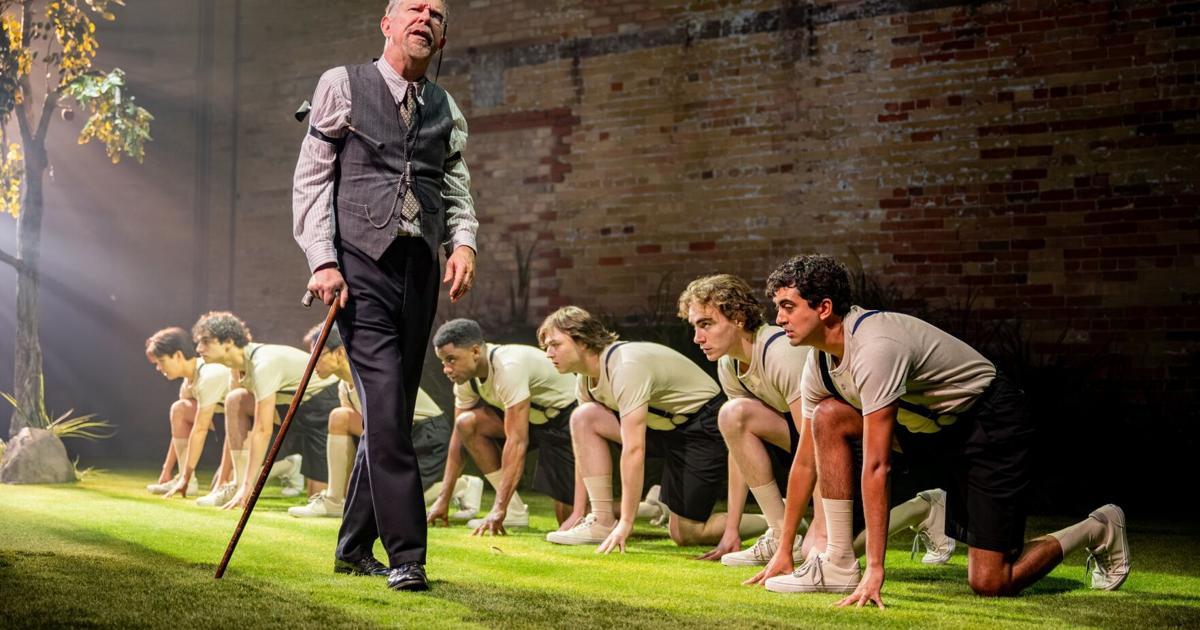
The Paolo Santalucia era at Soulpepper has begun.
And it’s off to an auspicious start with “Spring Awakening,” which opened Thursday at the Young Centre for the Performing Arts’ Baillie Theatre and marks the new artistic director’s debut production, kicking off the company’s 2026-27 season.
It’s a riveting adaptation and staging of the seminal German tragedy of the same name that not only makes a statement but also serves as a glistening showpiece for Santalucia and his company, offering a glimpse of what may be to come under his tenure.
It’s also a production that plays right into Santalucia’s strengths, both as a playwright and a director, demonstrating his skill at melding text and direction and his ability to conjure ravishing, almost filmic visual moments that fill the Baillie stage, all while never losing sight of the story’s most intimate moments.
His adaptation remains thematically faithful to Frank Wedekind’s original work — a searing chronicle of sexual angst and repression, as seen through the eyes of a group of teenagers living in 19th-century Germany. But the changes Santalucia makes are always bold, always unapologetic. In the end, he modernizes the classic text and makes it more accessible without sacrificing its integrity or rewriting the dialogue in a contemporary vernacular.
Gone are many of the thorny biblical and mythological references from the original story. (Santalucia and set designer Shannon Lea Doyle instead represent some of these religious ideas in the show’s production designs.) Gone, too, are several domestic scenes depicting the teenagers’ parents, who loom large over their children’s lives.
In their place, Santalucia pushes outward, expanding the world Wedekind first created. A new prologue, opening with schoolmates Moritz Stiefel (Jake Cohen) and Melchior Gabor (Jake Bunyan) in a Latin class overseen by the strict disciplinarian Professor Knochenbrüch (Diego Matamoros, channelling the terror of an army general), shows us that the society of Santalucia’s “Spring Awakening” is one of unforgiving rules.
This is a world where children are dealt with like caged animals. They’re fawned over in one moment, beaten in the next and then treated as aliens in their own bodies. It’s also a world where repression leads to rebellion, which eventually erupts into violence.
One of the strongest aspects of Santalucia’s production is the cast, made up of both stage veterans and many fresh faces, some of whom are members of this year’s Soulpepper Academy (a training program whose illustrious alumni include Santalucia).
As Melchior, whose rebellious nature and thirst for knowledge turns him into his town’s pariah, pushed to the fringes of his society, Bunyan accentuates not only his character’s angst, but also his tragic, aching loneliness. When he says, “I feel so far off from everyone. Like I’m watching the world through glass,” Bunyan makes the audience feel every bit of Melchior’s despair.
Similarly, Cohen’s performance as Moritz offers a sobering portrait of a boy struggling to understand his changing body, all culminating in a crushing, second-act soliloquy in which I found myself quivering, muscles twitching alongside Cohen’s Moritz, stuck vacillating between this world and another.
Arguably most tragic of all is Olivia Neary-Hatton’s 15-year-old Wendla Bergman, treated like a porcelain doll by her overprotective mother (Liisa Repo-Martell) and forced to walk through life in ignorance.
The supporting cast also offers some fine performances. Jasmine Case makes a mighty impression in just one scene as Martha Bessel, a friend of Wendla’s who reveals that she’s physically abused at home. Anaka Maharaj-Sandhu is equally compelling as Ilse, the most liberated of the teens in town, whose narrative arc is more satisfyingly developed and expanded by Santalucia.
But not all the textual changes work, with some dramaturgical faults coming across as especially glaring. It’s highly improbable, for instance, that Melchior and Moritz’s school in rural, conservative Germany would host school dances — which weren’t popularized until some four decades later, and in the U.S. no less.
There are also some pacing issues in the production’s first of three acts. On opening night, the actors spat out their dialogue so hurriedly that it offered the play little space to breathe. Maybe it was unintentional and could be chalked up to opening-night adrenaline from this young cast. Or maybe it was wholly intentional, meant to show the tragic inevitability of how these characters were hurtling toward their demise. Yet no matter what it was, that blistering pace at times compromised the production’s intelligibility.
Thankfully, on opening night, the production’s pacing settled by the time we arrived at the second and third acts of this tragic triptych. And it’s then that I began to feel the austere, melancholic beauty of Santalucia’s “Spring Awakening.”
His production is firmly set in its original historical period. Ming Wong’s plain costumes evoke the barrenness — and monotony — of these characters’ provincial life. So too does Doyle’s expansive set, depicting an open meadow with a lone juvenile tree.
I appreciate Santalucia’s restraint in not trying to forcefully draw the connections between our world and the one in “Spring Awakening.” Even then, it’s not difficult to see that the society in the play is not too distant from our own. We’re seeing controversies surrounding school book bans creeping up with increasing frequency. Down south, we’re also witnessing state governments trying to erase the long-fought separations between church and state.
I think it’s easy to watch “Spring Awakening” and walk away feeling hopeless about the way history doesn’t progress linearly but on an infinite loop and how we find ourselves in a moment much like that which spurred Wedekind to pen his societal treatise that is “Spring Awakening.”
But for as dispiriting as this play can be, I believe it also offers hope, particularly in its final moments. Because “Spring Awakening” is really a story as much about life as it is about death. And, ultimately, it demonstrates that, as cyclical as the chilling darkness of winter may be, spring will always come again, awakening us from our ignorant slumber.
Error! Sorry, there was an error processing your request.
There was a problem with the recaptcha. Please try again.
You may unsubscribe at any time. By signing up, you agree to our terms of use and privacy policy. This site is protected by reCAPTCHA and the Google privacy policy and terms of service apply.
Want more of the latest from us? Sign up for more at our newsletter page.