PARIS—Prime Minister Mark Carney is having a Celine Dion moment.
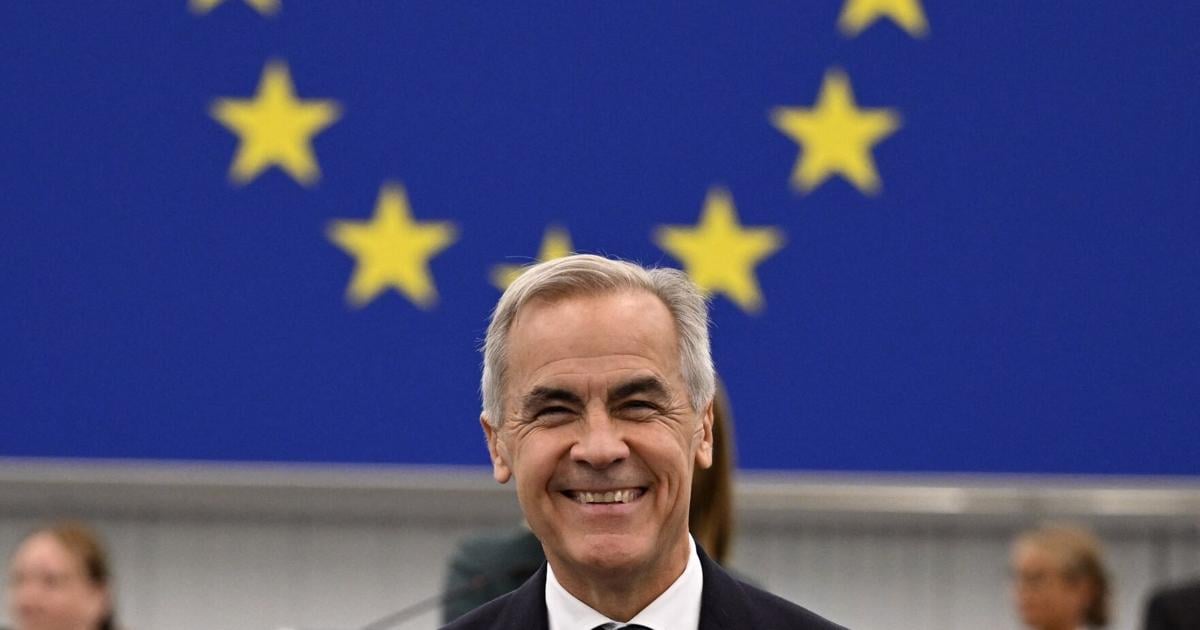
Like the ultra-famous Quebec singer, he landed in France to open arms (at least by geopolitical standards), prompting a standing ovation in the European Parliament by merely showing up.
Even as Carney was wowing Strasbourg with his pitch to build stronger ties between Europe and Canada, the warm and fuzzies spilled over to the five-star hotel in Paris where Dion has been staying to launch her against-all-odds comeback tour.
That Dion chose France for her comeback from a debilitating neurological disorder is natural. She loves France and they love her back.
A small crowd had been waiting for hours in the hopes of catching a glimpse of — or even a conversation with — one of Canada’s best-known cultural exports, and when they weren’t bursting into song, they spared a thought or two for her home country.
“Canadians have lots to give. That’s the image we have. Even if it’s cold there, they are warm,” said Laetitia Laisné, on vacation from Normandy and carving out some time for celebrity sighting. “I only hear good things.”
She, like the others lining the barricades, feels personally close to Dion because of her music, and that gives her a curiosity about the singer’s home country.
“We all know Celine Dion. She has done a lot for Canada because she is close to people. It’s done a lot for the image.”
Can Canada escape Trump’s shadow with the EU?
On the other side of the country, Carney, too, was in his happy place, that political arena where he knows everyone in the room, values align and trade barriers are the same as they’ve ever been.
In his plan to dilute our dependence on the U.S., diversify our trade and investment with other countries and enhance Canada’s security, it probably doesn’t feel any better than right now.
We now have a solid framework of intentions that has culminated over the course of the last few weeks: improved Employment Insurance benefits for those who get shafted by U.S. tariffs: many billions of dollars pledged by institutional investors to build up Canada’s infrastructure; two major tax measures designed to ease the way for big business; a loud signal that Canada and the European Union will deepen ties; and more legislation on its way to streamline business processes.
These are key pillars of a government-driven plan, but they now require substantial determination and resources to live up to their billing.
Trump is not the only force hurting jobs
Sewing a sturdier safety net, for one, will take more than enhanced EI. Since U.S. President Donald Trump aims to cripple some of Canada’s key industries, Canadian workers will also need retraining and access to new opportunities.
And Trump is not the only force buffeting our workforce. Artificial intelligence and aging are also driving structural changes that have yet to be appreciated. While expanding EI will help some parts of the workforce in the short run, the bigger issues loom.
Similarly, investment pledges have a long way to go before they can deliver dividends to the country’s economy. Will they materialize in a way that adds value, rather than simply shuffle assets into new hands? The announcements have been made, but they are headlines for now. The investors, alongside regulators, still need to write the story.
The tax measures will need assessment in real time.
Doubling down on advanced tax rulings for major new investments and business ventures may well give some certainty to those sitting on the fence. But since the most recent plan to prioritize big money comes on top of earlier plans to also prioritize big money, what will happen to the smaller money that is so often the lifeblood of innovation and plucky entrepreneurialism?
Immediate expensing rightfully hogged all the tax-policy attention last week since it is an important move that could cost the federal treasury billions of dollars. The announcement expands on previous, narrower and more temporary versions of accelerated capital cost allowance.
It’s designed to give a much lower tax rate to companies that invest in machinery and equipment — the very things that could bolster employment, productivity and Canada’s competitiveness. Those companies that simply recycle money or sit on the sidelines won’t benefit.
For it to work as intended, business needs to step up and that’s not guaranteed. Corporate tax cuts in the past have done little to improve Canada’s investment record or productivity over time. Maybe this time, under pressure, will be different.
As for the new arrangement with the EU, perhaps the Strasbourg love-in for Carney and Canada will infuse the trade and investment relationship with the kind of energy that has been missing since we signed the CETA free-trade agreement with them years ago.
While bilateral trade has slowly increased over the life of the agreement, it’s underwhelming. And 10 countries have yet to ratify it.
This time, it’s clear that Canada and the EU have a mutual and urgent economic interest in deepening ties in critical mineral production, artificial intelligence and defence. But they’ve already taken agriculture off the proverbial table.
Like in the case of the investment pledges and tax measures, we can hope that trade negotiators and businesses move aggressively into the space that the announcements have created, in a way that transforms the framework of intentions into material benefits on both sides of the ocean, defying Trump and driving prosperity in spite of him.
In the midst of that ugliness, it’s a relief for Canada to feel the love and see the stars of politics, investment and culture out front. But for these intentions to amount to the hoped-for profound change that brings widespread and reliable economic strength, it has to be more than infatuation.
Dion’s rebuild is confident, triumphant and deeply connected to her people. Can Canada do the same?