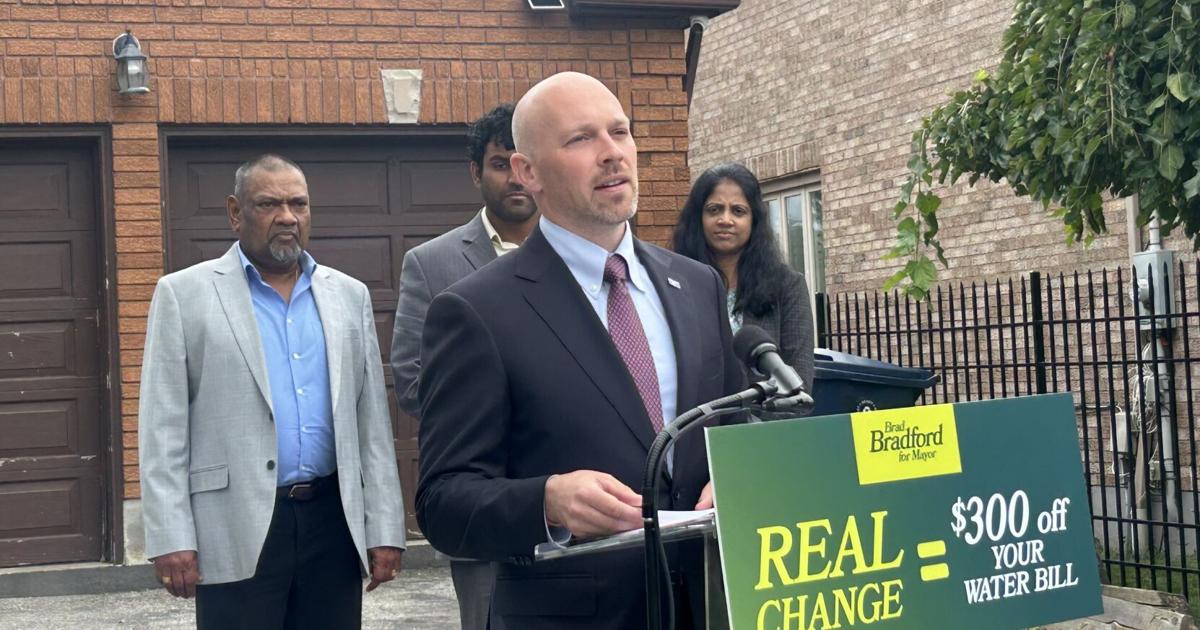
Mayoral candidate Brad Bradford says he wants to change the city’s water department into a public utility — like Toronto Hydro — with the aim of cutting water bills.
At a press conference in Scarborough on Monday, Bradford said the savings would come from money residents have been paying into the city’s accounts to fund capital infrastructure projects like flood protection. He proposed, instead, that the city would take on debt to fund those projects — a move his election rivals and some critics are calling risky.
“Toronto’s been collecting too much money from the wrong people in the wrong way and then just sitting on it,” Bradford said. “As mayor, I will cut your water bill by 25 per cent on the first $1,500 of your bill. For the average household, that’s about $300 a year in savings right back in your pocket.”
Bradford said two-thirds of the average water bill is “being warehoused for pipes and plants that won’t be built for years” and repeated that it’s “your money … we didn’t need to take from you in the first place.”
He also said an independent board would set water rates.
Money in those reserve accounts Bradford is referencing is already earmarked to fund various projects like sewage treatment plants, stormwater management and flood protection in the long term, but he argued that “a smarter, more sophisticated way” to finance these projects is to borrow money, similar to Toronto Hydro, if they are decades away from being completed.
Bradford compared his proposal to paying off a mortgage, but critics said it could have long-term consequences.
“This is the most reckless financial move I have seen since amalgamation,” said Gord Perks, a longtime councillor and ally of Mayor Olivia Chow who is retiring this year.
“Those loans have to be repaid, with interest,” Perks continued. “Essentially what he’s doing is taking out a mortgage to lower taxes in the short term, but it’s crazy because you have to pay it back and you have no tax revenue. So, the only way to do it is to cut services down the line.”
Bradford has also proposed freezing property taxes in his first year as mayor — effectively a budget cut, given the city’s costs go up each year — while proposing an independent audit of the city budget, a suggestion that raised the spectre of unpopular Rob Ford-era spending cuts.
According to the city’s budget documents for water, $18.9 billion is needed over the next decade for necessary infrastructure projects but, based on current annual water rates, the city’s reserve, which has over $2 billion right now, is on track to drop to just $365 million, or less than two per cent of what the capital plan needs, over the same period.
“This will provide Toronto Water with limited capacity to respond to fluctuations in market pricing or to address unplanned or emerging infrastructure needs,” the documents say.
Jason Thistlethwaite, an associate professor at the University of Waterloo’s school of environment, enterprise and development, said it may not be a bad way to prioritize and create sustainable budgeting, as other municipalities across Canada have done, given there is a “laundry list” of items Toronto needs to fund.
“The important question is whether borrowing can lower costs for households today without creating larger cost or infrastructure risks in the future,” he said, noting the devil will be in the details and execution. He added new laws also give the province “considerable authority” over public water utilities, including governance, rate plans, corporate structure and borrowing conditions.
According to provincial legislation passed in 2025, a water corporation has to submit a rate plan which the minister can refuse, approve or amend, and the province can also appoint board members.
“There does seem to be a risk that you could be providing a window for more provincial influence,” Thistlethwaite said. “You could get more controversial rates.”
Chris Alexander, polling third after Chow and Bradford in the mayoral race, slammed Bradford’s idea in a press release, arguing that borrowing more would make projects more expensive while kicking the costs down the road.
“Bradford, who claims to be a fiscal conservative, now wants to create a whole new bureaucratic system … modelled on Toronto Hydro,” Alexander said. “Does he know Toronto Hydro has $3.6 billion in debt against $7.7 billion in capital assets, and paid $124.6 million in interest alone last year?
“That is interest charged on every dollar, every year, and you pay for that in your hydro bill. Do the same to our water and the pipes don’t get cheaper to fix.”
In a press release, Chow’s campaign spokesperson Shirven Rezvany said, “By giving up control of Toronto water’s system, (Bradford) wouldn’t even be able to set the rate he claims he would.”
Chow told reporters later on Monday that Bradford’s idea could also open the door to privatizing drinking water.
“I would never,” she said. “Bradford changes his mind all the time … I will not sell our water to the highest bidder, though.”
Bradford said there is “zero chance, not now, not ever” that a public utility for water would be privatized because he would ban it in city bylaws.
But Perks argued that is “completely unrealistic” because such a move would put the utility under the province’s thumb, making city bylaws null if any premier decides to privatize the service one day.
Sarah Buchanan, campaigns director for the Toronto Environmental Alliance, said giving control of Toronto’s water system to Doug Ford’s provincial government is fraught.
“They have absolutely bobbled the climate resilience file and are paying almost no attention to it and ignoring experts who are trying to speak up on the need for more investment in climate adaptation,” Buchanan said.