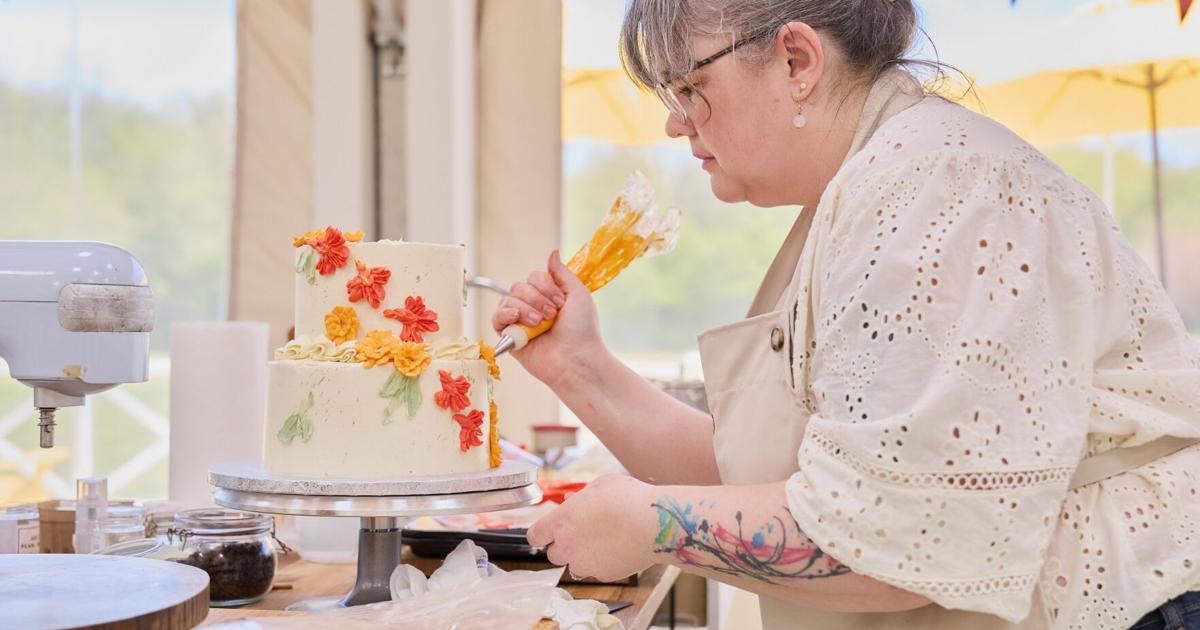
There’s a crisp fall chill in the air, and that can mean only one thing: it’s time to get baking.
From bubbling fruit crisps to fluffy cinnamon rolls slathered with cream cheese frosting, to prettily decorated cakes to serve a crowd for dessert, there’s nothing quite like cosying up with a freshly made baked good — and leaving the whole house scented with it — when the leaves begin to turn.
Baking is a year-round sport for the home bakers competing on the 10th season of “The Great Canadian Baking Show,” which airs on CBC Sundays at 8 p.m. But when cooler weather rolls around, they feel that familiar urge to turn on the oven just like we do. Their bakes are just a touch more sophisticated than your typical apple pie.
This fall, Andrew Arcello of Stittsville, Ont., who happens to be the show’s first plant-based baker, is steadily baking up a large patch’s worth of pumpkin-shaped sourdough loaves. They’re tied up with criss-crossed butcher’s twine before baking to get the curvy look.
Justine Reyes of Saskatoon is busy experimenting with freeze-dried corn powder in her bakes (which can be found at your local Bulk Barn), a subtle nod to the classic symbol of fall harvest. Its concentrated sweetness has been a hit in her Filipino-style leche flan and molten salted egg custard buns.
Jen Hudson, who hails from Mundleville, New Brunswick, is reinterpreting autumnal flavours such as spiced chai in new creations like her Dirty Blueberry Chai Cake. Chocolate espresso cake layers are filled with blueberry compote and frosted with chai buttercream and a chocolate ganache drip.
It’s this level of creativity that earned these talented amateurs their spots in the legendary baking tent, where they duke it out each week to earn the title of Canada’s best home baker. But despite the show’s competitive nature, there’s a strong sense of camaraderie and community.
“If someone did great, everyone’s congratulating them. If someone didn’t do so great, everyone’s very comforting and kind,” said Toronto competitor Sam Kim, adding the bakers still talk every day, long after filming ended. “Baking is usually a pretty solitary activity … When else do you get to parallel play with a whole bunch of other people who are just as passionate about it as you?”
The opportunity to be the show’s first plant-based baker was the highlight of Arcello’s experience. His goal in the tent was to never hear “the worst sentence possible, which is, ‘that was really good — for plant-based.’” Despite the judges’ well-documented love for butter, he aimed to create bakes that were equally delicious. “There’s no compromise in flavour or texture,” said Arcello, who thinks “viewers will be amazed to see the feedback” on his creations.
For home bakers looking to make plant-based treats, Arcello recommends experimenting with a few key ingredients. “Aquafaba, the liquid from a can of chickpeas, is liquid gold for a plant-based kitchen, or anybody who’s interested in replacing eggs in any type of recipe,” he said, adding that it makes great Swiss meringue buttercreams. For baking that requires more structure, like macarons or dacquoise, Arcello leans on powdered potato protein (he likes the brand Potatowhip), which whips up with water.
While it may be tempting to scroll online for your fall baking inspiration, these self-taught experts recommend a more analogue approach. “I started learning how to bake through social media and looking back, it was way too overwhelming and I came across a ton of questionable and unrealistic recipes,” said Montreal competitor Kami Elmekki.
Reyes echoes this, recommending cookbooks like her tried-and-true favourites “Breaking Bao: 88 Bakes and Snacks from Asia and Beyond” by Clarice Lam and “Momofuku Milk Bar: A Cookbook” by Christina Tosi. “They’re so much more reliable and detailed than random recipes online,” she said.
However, Reyes does refer to reels and short videos to break down tricky techniques, such as intricate cake decoration. “I love using them to learn the delicate movements and angles for glossy Korean buttercream florals. It’s so much easier to follow than still photos.”
If the bakers could offer one piece of home baking advice based on their time in the tent, it’s this: “Be kind to yourself and trust the process,” said Kim. “There comes a point in every cake where you’re like, ‘This is the ugliest cake I’ve ever made. I think I need to throw this in the garbage.’ But then it always comes together in the end,” she said. Remember: “we’re all our own worst critics.”
That’s especially true when it comes to feeding family and friends. “People are very forgiving of your baking,” said Arcello. “Especially if you’re giving it to them as a gift.”
Home baking tool kit
Canada’s top home bakers shared the essentials they reach for the most.
A French-style whisk
“A really nice quality whisk can be really helpful,” said Arcello, who’s fond of his long and narrow French-style whisk. “It just is so great for mixing, and it’s really sturdy, so it’s not breaking in your hand when you’re mixing a thick dough.”
Kuhn Rikon whisk, $16, amazon.ca
A bench scraper
“Bench scrapers are a multi-tasker I never knew I was missing until I bought one,” said Elmekki. “I use it to flip and portion sticky dough, transfer ingredients from my cutting board to a pan, clear my kitchen counter, and I’ve used it to smooth cakes in a pinch as well.”
Lee Valley bench scraper, $10, leevalley.com
A digital scale
“Once you start baking using weights instead of measurements, it’s hard to go back,” said Hudson. “It makes your results so much more consistent.”
Zwilling digital scale, $73, williams-sonoma. ca
A cake wheel
“Invest in a half-decent, nice, spinning metal cake wheel. It really makes a difference for your frosting,” said Kim, adding that it’s a vastly different experience from using a cheaper plastic option.
Celebrate It cake turntable, $60, canada.michaels.com
A digital thermometer
“I rely on my digital thermometer so much,” said Reyes, especially for making finicky frosting. “Buttercream changes with temperature, so knowing how it behaves helps you get the results you want. For smooth cakes with sharp edges, I use buttercream at about 24°C. For piping or filling, I aim for around 18°C for more structure.”
Master Chef digital thermometer, $20, canadiantire.com