

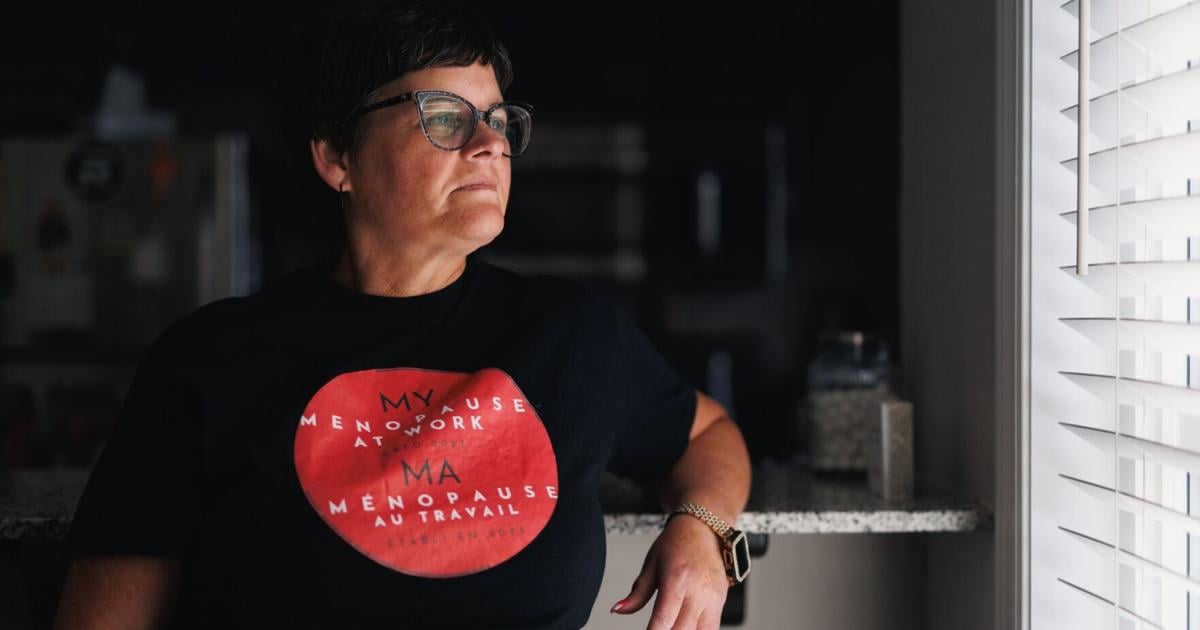
Three years ago, Darlene Mulcahey felt like her brain stopped working.
A senior program officer with nearly 20 years at the Canada Border Services Agency, she reads and writes for a living. But in 2023, a flurry of symptoms hit her without warning: insomnia; heart palpitations that drove her to the ER; and brain fog so debilitating words would not stick.
“It would take me, I swear to god, a good half-hour to read a couple of paragraphs and for it to sink in,” she said. “I’ve never felt anything like that in my life.”
When she tried to explain it to her manager, he told her, “I don’t know how to help you.” Her family doctor did: Four months on medical leave and a prescription for menopause hormone therapy.
It worked.
Mulcahey, now 57, returned to her job and launched a successful online support program for other working women.
But a long-term intermittent shortage of transdermal estrogen patches and Canada’s lack of a centralized early warning system for drug shortages is threatening the health of working women across the country.
Just a week ahead of World Menopause Day on Oct. 18, Manulife reports more than a tripling of hormone therapy insurance claims over the last five years. And a recent study by the Menopause Foundation of Canada found unmanaged symptoms is pushing one in 10 women out of the workforce, a $3.5-billion hit to the Canadian economy every year.
“It’s unacceptable,” Mulcahey says.
Veteran hedge fund manager Carol ‘Mitch’ Mitchell, who donated millions for a menopause chair at Mount Sinai Hospital, is blunt in her assessment.
“If we were dealing with a Viagra shortage, Canada would call in the army,” she said. “And you can quote me on that.”
Dr. Wendy Wolfman, director of Mount Sinai’s Menopause Clinic, says the estrogen patch shortage is a “worldwide problem,” driven by an explosion in use by women once reluctant to take hormones.
Her clinic sees more than 7,000 patients a year with a long wait-list. And drug company reps visit regularly, she said, with one exception.
“I have never had a Sandoz rep here. Never. And I don’t know why because we prescribe a lot of patches.”
A spokesperson for Sandoz, which makes Estradot and a generic version, said the “unprecedented” spike in demand for the patch “cannot be fully met at present.” The company said HRT patches “are highly complex to manufacture, and increasing capacity is therefore challenging.”
Bayer, the only other Big Pharma player in the estrogen patch field, said it discontinued its 100 mcg dose in 2018 as a “business decision” but still produces 25, 50 and 75 mcg patches. But good luck finding them.
“Due to an increased demand of the CLIMARA® 50 format,” the company said, there is currently a shortage in Canada,” adding they expect the problem to be resolved by December.
And for many women, an oral pill is not interchangeable with a patch, said Dr. Michelle Jacobson, chief of obstetrics and gynecology at William Osler Health System. Estrogen, she says, is absorbed through the skin and is a better choice for patients with obesity, liver problems, heart disease or a predisposition to blood clots.
Jacobson, who sees upwards of 500 patients a month, says the dance to find patches can get silly.
When a pharmacy runs out, it faxes her to say so, oftenwithout saying what it does have leading to multiple faxes back and forth.
“Dumbest thing ever,” she says. “You can quote me on that.”
Estradot’s 100 mcg dose has been out of stock since Aug. 3 while Sandoz’s generic version is available but not all pharmacies have stock.
Some patients amid higher dose shortages, Jacobson says, get ‘crafty’ — cutting patches or wearing several lower-dose ones at once. The patients she feels worst for are those who were doing well with their treatment.
“They’ve compromised enough already,” she said. “Now they’re compromising again because we can’t stock the product.”
Vanessa Rodrigues is one of them.
The 55-year-old Parks Canada manager from St. John’s, N.L., has been prescribed Estradot for three years to control night sweats and hot flashes, but often goes homewith a substitute — which can be a problem due to her reaction to the alternate’s adhesive.
Rodrigues has never gone without, but sometimes relies on the help of friends who share with each other during shortages or for extended work trips.
Mulcahey switched to an estrogen gel during a shortage, but got back on the patch as soon as they were available after she experienced a return of hot flashes.
Janet Ko knows firsthand how high the stakes are when unmanaged symptoms spill into the workplace.
At 48, she walked away from a job as a senior V-P at a large organization, burned out by brain fog, joint pain, insomnia and heart palpitations that also sent her to the ER.
Every doctor told her she was healthy. She had never heard the word ‘perimenopause,’ the transitional phase leading up to menopause when a woman’s ovaries begin to make less estrogen which can last 10 years.
Hormone therapy, when she finally got it, was a “game changer,” said Ko, who in 2022 co-founded the Menopause Foundation of Canada with Trish Barbato.
More than 10 million women in Canada over the age of 40 are in some stage of menopause, Ko’s foundation reports, and now represent a quarter of Canada’s population and workforce.
“This is an age group of women who are contributing to society, who have developed skills over many years,” Wolfman says. “If they can’t work, then that’s a loss for everybody.”
Where a woman lives and what she earns shapes how hard shortages hit.
In Newfoundland, Rodrigues’s pharmacist can hand her an equivalent product. In Ontario, pharmacists cannot make that switch without going back to the prescriber, which Ko calls a systemic barrier.
The Menopause Foundation of Canada this month released a policy report demanding action from Ottawa and Big Pharma.
High on the agenda: allowing pharmacists to prescribe hormone treatments for menopause.
Ontario’s public drug plan offers no comfort covering neither estrogen patches nor gel, Jacobson and Wolfman note, forcing women on social assistance to shell out $50 a month or go without no matter how many exemption forms their doctors file.
“Everyone in Canada is so happy because we’ve got a universal health care system,” Jacobson said. “No, we don’t.”
Jacobson’s fix is a provincial system that shows prescribers, in real time, which pharmacy has what.
“Why can’t you find out who’s got what in stock?” she said. “Why is this so hard?”
In Ottawa, the House of Commons committee on the Status of Women is studying menopause’s effect on the labour force and is accepting public submissions on the topic until Oct. 23.
Mulcahey has filed her brief on behalf of the group she built called My Menopause at Work, which has more than 3,100 members across Canada.
She does it off the side of her desk, unpaid, and plans to retire from Canada Border Services by the end of the year.
“I want to be the voice for other women who are afraid to speak up or just don’t feel well enough to speak up and advocate for themselves,” she said. “The only thing worse than menopause is going through it alone.”

