The new Cliff Energy Centre helps heat and cool more than 80 federal government buildings, but it also had to look pretty. That took procurement ingenuity.
Ottawa’s newest federal government building opened in June so quietly you’d think the ribbon-cutting ceremony was some kind of state secret.
That the feds might even be embarrassed by it.
Maybe they are: Public Services and Procurement Canada, which is responsible for the facility, is about as spotlight-averse as a federal government department can anatomically be.

The Cliff Energy Centre, meanwhile, is more than comfortable with the spotlight. You might even call it flashy.

The Evening Citizen
Linger in front of the building on the Ottawa River Pathway and passersby will stop to ask you what it is — because you can’t miss it.
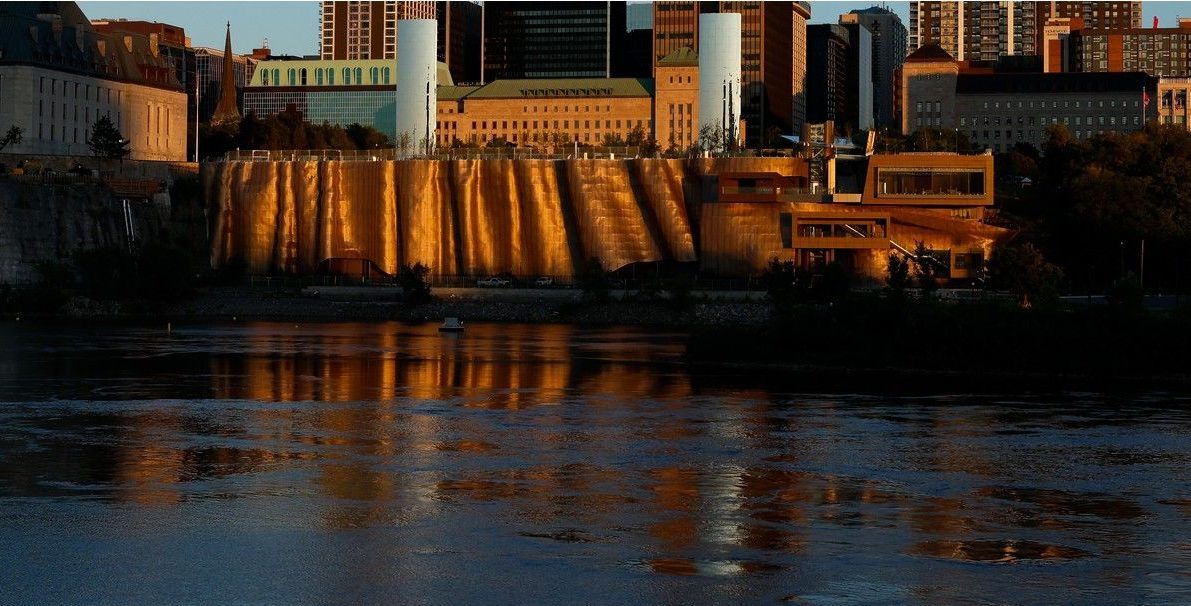
It is built directly into the cliff face below Wellington Street and is sheathed in a shimmering stainless steel curtain that follows the contours of the escarpment.
At dusk that curtain catches the sun, robing the whole place in gold against the black evening river. What look suspiciously like theatre boxes jut at jaunty odd angles from the building’s western end.
It’s an arresting sight, especially from Gatineau or when heading south on the Portage Bridge into Ottawa.
Some liken it to a classic James Bond villain’s lair — the kind that’s hidden in a volcano.
But rather than burrowed in the mouth of Vesuvius, the Cliff Energy Centre hides in plain view just west of Parliament — between the Supreme Court of Canada and Library and Archives Canada.
The setting is arguably one of Canada’s most iconic urban backdrops, a jewel of Ottawa tourism. The river, the cliffs, the green-and-sepia roofs of the Peace Tower and Library of Parliament.
This view was once the back of the Canadian dollar bill, opposite our Queen when she was still young.
Who’d shoehorn a factory into all that stately grandeur?
But that’s just what the Cliff Energy Centre is — an industrial plant that manufactures high and low temperatures, heating and cooling many of downtown Ottawa’s federal government buildings.
Part of the National Capital Region’s district energy system, that plant could have turned out a cement bunker. In fact, it once was — and almost was again. But things turned out differently.
“We didn’t want to build a concrete box,” said Tomasz Smetny-Sowa, gesturing from iconic building to iconic building outside the Cliff facility during a recent tour.
A mechanical engineer by training, Smetny-Sowa is senior director of the Energy Services Acquisition Program, or ESAP, a Public Services and Procurement Canada initiative to modernize the heating and cooling systems that serve more than 80 federal government buildings in Ottawa.
That includes all of the buildings on Parliament Hill, some of which are more than a century old. The previous heating and cooling systems were of similar vintage — and often steam-driven.
It was not always safe. In 2009, Peter Kennedy, a 51-year-old worker at the old Cliff plant, died when a steam boiler there exploded. That tragedy led the feds to plead guilty to a series of Canada Labour Code charges and to paying more than $300,000 in consequent fines.
It also led to more urgent recognition that the antiquated energy plants needed replacement.
Smetny-Sowa described that older Cliff plant as featuring an industrial smokestack and barbed wire — a forbidding scene that blocked the view of the Ottawa River below.
The new plant would have to last the next 100 years, be built to withstand any emergency and cut greenhouse-gas emissions.
But Smetny-Sowa was convinced that it would also need to be beautiful. And that costs money.
Six years ago, speaking at the International District Energy Association’s annual conference, when plans for the new facility were still in the works, Smetny-Sowa put the issue bluntly:
“We had to introduce some sort of aesthetic attribution to the plant,” he said.
“The federal government always goes for the lowest bid and we had a lot of problems to convince them that’s not the way,” Smetny-Sowa added. “That was probably the toughest sell.”
The $3.4-billion public-private project, aimed at replacing or retrofitting the Cliff plant and the system’s three sister energy plants, earmarked $1.3 billion for design and construction.
But Smetny-Sowa’s team also devised a procurement strategy that would reward ambitious design.
Specifically, bidders could earn credits for including features in their proposals that went beyond the project’s minimum requirements. Those credits would then be deducted from the proposed fee for evaluation purposes, making high-quality designs more competitive.
The available credits capped out at a hefty $60 million.
As Smetny-Sowa puts it, “to have a nice building like that, we need $60 million!”
Note that the credits did not change the proposal’s real price. Still, it was an unusual scheme.
“I’ve never seen that before,” said Derek Hardy, a senior project director at bbb architects Ottawa, the firm that eventually won the contract.
Founded by Ritchard Brisbin, bbb is known for its work on the Ottawa International Airport, on what is now Rogers Centre Ottawa and on the LRT stations servicing the Confederation Line.
The firm’s Cliff bid succeeded in part thanks to the idea of adding a public elevator to the project — one that will zip members of the public from the shore of the Ottawa River up to a grand new 3,500-square-metre park between the Supreme Court and the Library and Archives.
Tessa Kampman, another bbb architect on the project, noted how unique it is that so many of the firm’s initial concepts survived from the competition in 2018 to be realized now.
Those ideas started with the new park (which after a delay now set to open in spring 2027).
Just off Wellington, it is a granite-paved square dotted with raised garden beds. A good portion of it sprawls across a cantilevered roof overhanging the escarpment.
In essence, this new city space is the roof of the factory below.
“The idea is that the structure does not look like a power plant from the outside,” Mohamed Khalil, bbb’s architectural technologist, told one industry publication about the project.
“The majority of the mechanical equipment is contained within concrete buildings below grade — and then above grade is prioritized by gardens, walking paths and connections to the public realm.”
Gone is the smokestack out of Dickens that once stood here billowing pea soup. Two glowing mirrored chimneys loom above instead, reflecting Ottawa back upon itself and exhaling vapour.
“It’s not the dirty exhaust of old industry,” said Kampman, who added later of bbb’s design work: “Sometimes we felt like kids in a sandbox playing on Parliament Hill!”
At the Cliff’s edge a long, 100-metre-plus brass rail, as expressive as the arc of a calligrapher’s brush stroke, follows the curves of the escarpment, echoing the stainless-steel curtain underneath it. Glass panels follow along. This lookout may now be downtown Ottawa’s most dramatic river vista.
A stairwell, called the “Cliff Climb,” which jackknifes against the escarpment, gives access to the theatre boxes below (as does that elevator). The main level is an education centre designed by Moment Factory, the Montreal studio best known for its partnerships with Cirque du Soleil.
But that classroom’s immersive games, aimed at educating children about energy and sustainability, are no match for the view of the Ottawa River in the huge plate-glass window. This space — housed in one of the aforementioned theatre boxes — and its industrial kitchen in the back will soon host events.
An adjacent corridor featuring a bank of windows looks down into the Cliff Energy Centre’s machinery below.
It’s there, amid the boilers and hard hats, that this plant is linked, via 14 kilomeetres of pipes, with the two other energy centres, at Tunney’s Pasture and Gatineau, and to the buildings they heat and cool. “It’s like Wonka land down there,” said Hardy, who still marvels at the lab works.
The pipes cross over to Gatineau along the Macdonald-Cartier Bridge, and it is Quebec that provides much of the low-carbon electricity that powers this cleaner system.
ESAP also built these two other plants with bbb architects Ottawa; a fourth centre, independent of the downtown circuit and located at Confederation Heights in Ottawa’s south end, was retrofitted by the same team.
But it was the Cliff Energy Centre that had to abide by so many of the National Capital Commission’s design guidelines — including an emphasis on granite and different tints of copper.
After all, it had to jibe with Parliament.
Now, even outside a heating and cooling plant, with the pipes and water tanks and Wonka works all below grade and curtained, “there’s no doubt,” according to Hardy, “where you are in the world.”
The Citizen newsroom is proud to report important stories like this one. If you would like to support our work and help our team continue to tell longform, deeply-reported journalism, please consider purchasing a digital subscription. ottawacitizen.com/subscribe