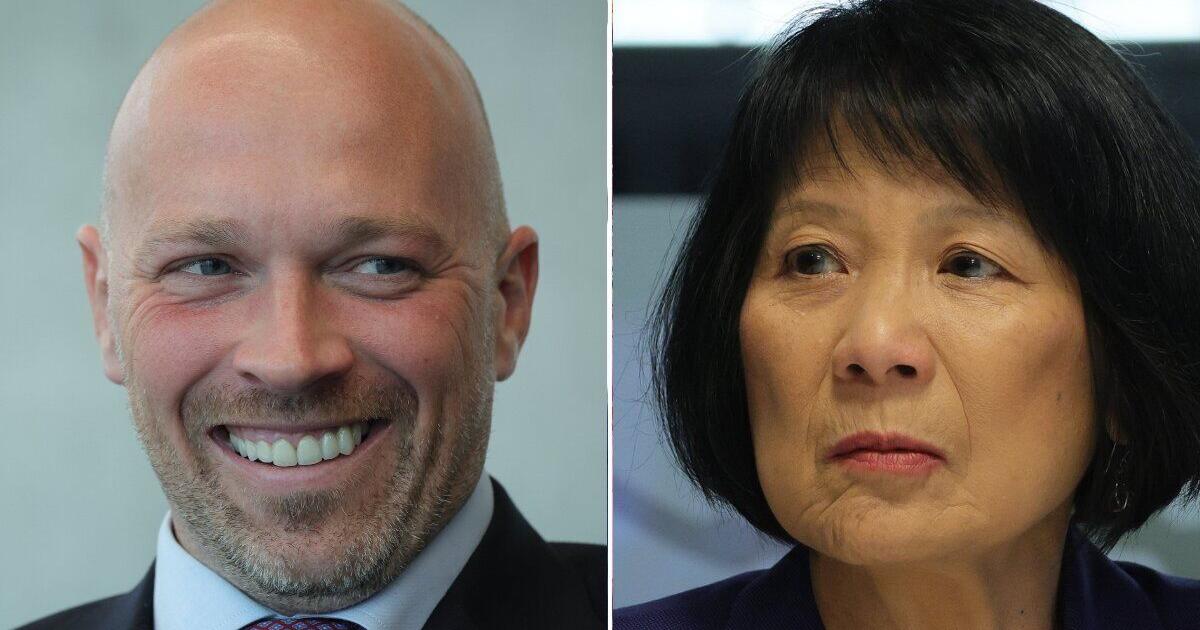
Brad Bradford and Olivia Chow are neck and neck in the race to become Toronto’s next mayor, according to a new poll, setting up a tight contest just days ahead of the Oct. 26 vote.
A new poll by Liaison Strategies released Wednesday suggests that the Beaches — East York councillor is two percentage points ahead of the incumbent mayor among decided and leaning voters.
According to the poll, 49 per cent of respondents said they would cast their vote for Bradford as mayor if the election were held today, while 47 per cent said they’d vote for Chow.
“This is a really big shift,” said David Valentin, principal at the polling firm, referring to the fact Bradford now appears to be in the lead after trailing Chow for months.
“What that really speaks to is the fact that his advertising and his team have been really aggressive in getting his message out there,” said Valentin. “And his message is really focused on affordability and safety.”
However, Valentin cautions that Bradford’s lead is within the poll’s margin of error.
“While Bradford leads by two, this is within the margin of error of 3.1 point,” said Valentin. “The race is a statistical dead heat.”
Bradford “has momentum in the final week of the campaign,” added Valentin, “but the momentum isn’t everything.”
Valentin pointed to the 14 per cent of respondents in the poll who are still undecided: “I think the undecideds are the wild cards here, but I also think turnout is the wild card.”
Not all undecided voters will come out, Valentin continued, but the higher the turnout and depending on where in the city that turnout is, “it could make for a very exciting election night.”
Liaison’s findings match a poll released by Mainstreet Research this week, but differs from some other polls like Nanos Research which, in collaboration with CP24 and CTV News, found Chow in the lead at 50 per cent over Bradford’s 47 among decided voters, with a margin of error of plus or minus 3.6 percentage points.
Valentin said it’s likely Chow and her camp are going to start using “some very harsh rhetoric” in the days to come about what a Bradford mayoralty would entail.
Chow’s team seems to already have started on that strategy. “This election is a simple choice,” Chow’s campaign said in a press release Tuesday. “Do we choose to keep moving forward together to protect renters and make life more affordable? Or do we go backwards with cuts to services under a mayor who ignored people in his own ward for years?”
Bradford, meanwhile, announced this week he’s going on a “25/7 Tour” to visit all 25 Toronto wards in seven days. “We’re on the cusp of change,” according to one of Bradford’s recent press releases. “Change is within our grasp. But to change the city, we need to change the mayor. Toronto’s comeback starts now.”
Both Bradford and Chow’s campaigns have similar priorities — affordability, safety and transportation — but have approached them in starkly different ways.
Bradford has made ambitious promises at times criticized for being unrealistic. Meanwhile, Chow has largely run on her record, which has also been criticized at times for not being bold enough.
Another development in the race may have helped pull Bradford forward. Chris Alexander dropped out of the mayoral race on Oct. 6, the first day of advanced polling. While not all of his supporters flocked to one candidate, it’s likely Bradford got more of the Alexander vote than Chow did, Valentin said.
The Liaison poll surveyed 1,000 Torontonians on Oct. 18 and 19 using an automated phone survey across landline and cellular networks. It has a margin of error of plus or minus 3.1 percentage points, 19 times out of 20.