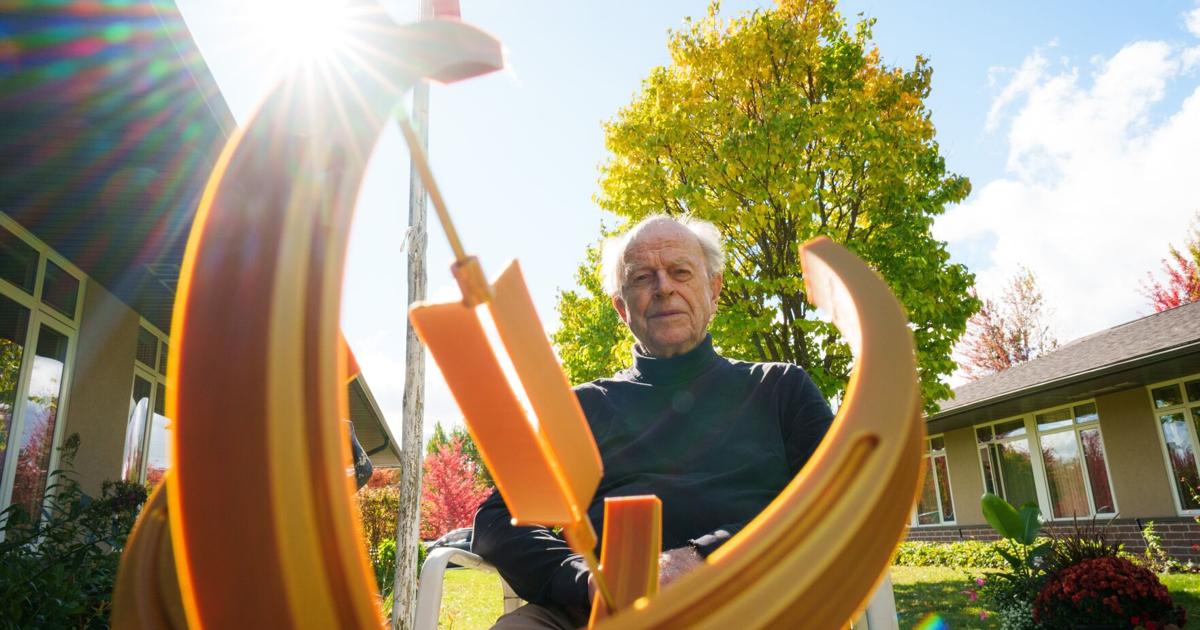
Robert Stairs can’t say exactly when he first saw York University’s sundial, sometime around 1967. But nearly six decades later, at 101, he remembers what struck him: it was beautiful.
He liked it enough to stop at an old shop on Yonge Street and buy a miniature sundial of his own. He kept it in his garden for more than 40 years before eventually donating it to York.
The original sundial, meanwhile, was gone.
By the 1980s, York’s wooden instrument had rotted beyond repair and been removed. Stairs was sorry to see it go. Decades later, he decided to help bring it back — with a $600,000 donation toward a new sundial for the university.
“The original, which I had admired, unfortunately disappeared,” Stairs said. “I thought it was a great shame that it had gone.”
The result is an eight-foot bronze sundial designed to help students and visitors understand the relationship between the sun, time adjusted to their precise location on Earth. It is York’s first publicly accessible sundial for teaching and observatory tours since the original disappeared.
Stairs, a retired chemistry professor who taught at Trent University from the mid-1960s to his retirement in the 1990s, and now lives in a Peterborough, Ont., retirement home, says he had been interested in sundials for a long time. But he can’t pinpoint exactly when that interest began.
He does know what he hopes will come of his gift: that other people will learn from it and enjoy it.
“I’m an old man, it’s a little awkward to get down there … I shan’t go very often,” he said with a laugh.
“But anyway, I hope other people will learn from it and have fun with it.”
The project took shape after Stairs visited York’s observatory in 2021 and discovered the missing sundial.
The work of bringing a new tool to campus fell largely to Robert Kellogg, an 80-year-old sundial designer and vice-president of the North American Sundial Society.
With Kellogg’s help, Sea West Observatories engineered the new instrument, which shares its donor’s surname. The sundial can indicate the time to within minutes when users adjust its wheel to align with the sun.
The design took about two years, and Stairs’s donation covered the entire construction cost.
Kellogg described completing the project as “awesome.”
“I was both impressed and very proud,” he said. “I think Stairs, likewise, was extremely proud of the sundial he sponsored.”
For Elaina Hyde, York’s observatory director and a professor of physics and astronomy, the sundial is a teaching tool that offers something increasingly uncommon: a direct connection between the movement of the sun and the measurement of time.
“It’s a clock that will never need a battery,” Hyde said.
Unlike a conventional clock, a sundial depends on the sun’s apparent position in the sky and the observer’s location. York’s new instrument is calibrated for its precise position on campus; moving it even a few inches would compromise its accuracy.
Hyde said the sundial also offers an opportunity to revisit ways of understanding time and place that were once much more familiar.
“That tie between your physical location and what you see in the sky is something that was previously very well-known by humans, and especially the Indigenous peoples of this area,” she said. “That’s something you don’t see a lot today. It’s an unusual thing to be able to bring back.”
She expects physics and astronomy classes to make use of the instrument. Its bronze construction, cast by Canadian company Artcast, should also make it considerably more durable than the wooden sundial that preceded it.
“I’m hoping that this sundial is still here in at least 100 years,” Hyde said.
The new sundial was unveiled at a ceremony on York’s campus in September, attended by Stairs, Kellogg and Hyde.
“I was very pleased … when it appeared,” Stairs said. “It’s a very handsome object.”