The Liberal government will table its second budget under Prime Minister Mark Carney today. Follow for live updates and analysis.
Updated 15 hrs ago
Éric Blais: Doug Ford aims to protect Ontario. Mark Carney says Canada can shape its own destiny

Éric Blais
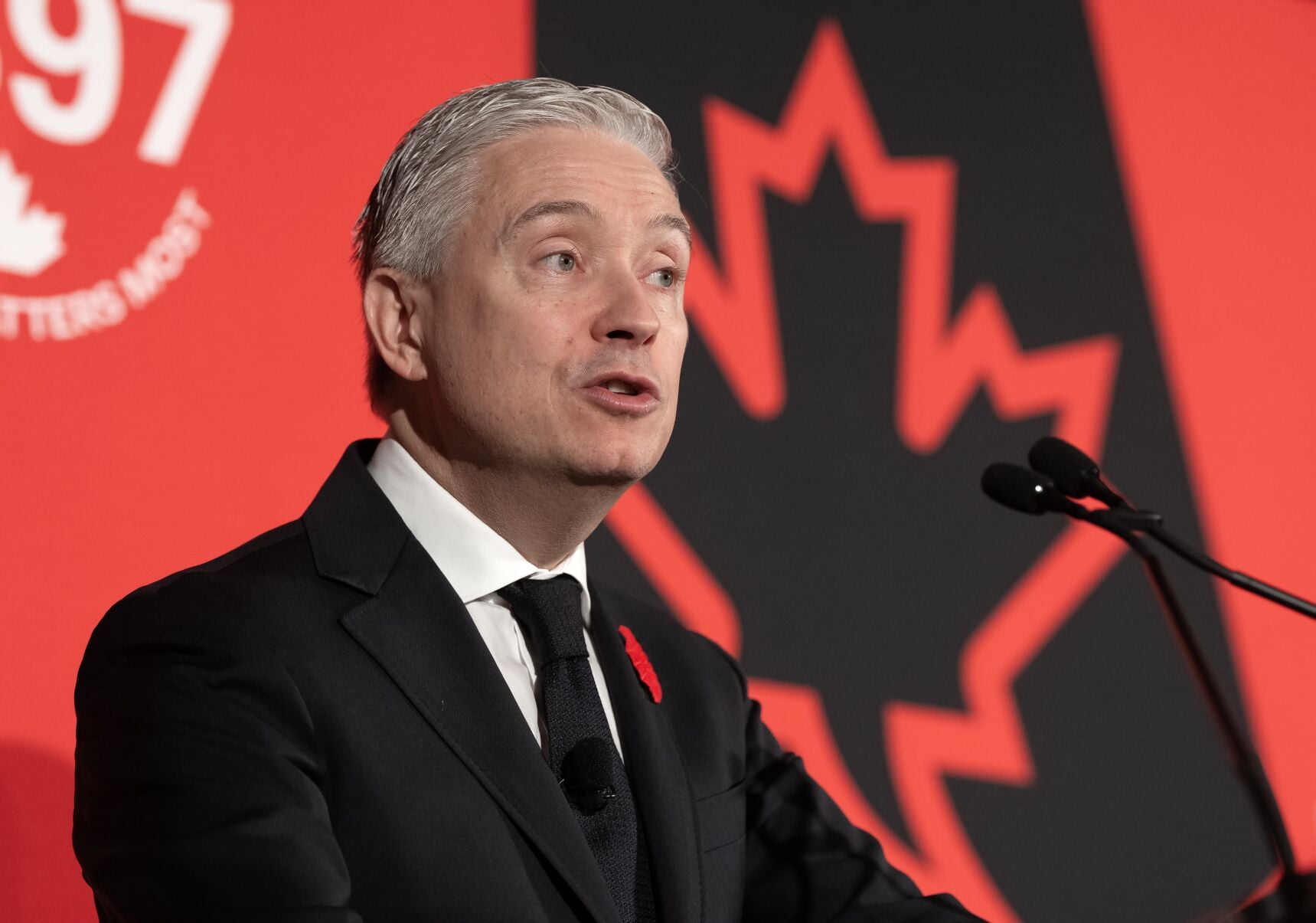
Federal Finance Minister François-Philippe Champagne speaks at a Canadian Club breakfast in Toronto on Monday, ahead of releasing the latest federal budget on Thursday, which is labelled “Masters of our destiny” in English.
Frank Gunn/The Canadian Press
Finance Minister François-Philippe Champagne’s budget, due Thursday, makes a bold promise on its cover: “Masters of our destiny.” It’s a confident line for a Canada determined to remain sovereign. It also echoes William Ernest Henley’s 1875 poem Invictus: “I am the master of my fate.”
Henley wrote it from a hospital bed after losing a leg. He wasn’t claiming control over what happened to him. All he could control was how he faced it. If you read the budget’s title the way Henley meant it, “masters of our destiny” is a promise about resolve more than outcomes. But a budget, unlike a poem, is measured on results.
Churchill borrowed the line in 1941, but he first warned that it was no time for boasts or glowing prophecies. That’s precisely what a budget offers, in numbers.
Protecting Ontario
Ontarians have been hearing a different word. Doug Ford asked them to let him protect Ontario and they returned him to office. And his government’s advertising has been reminding us ever since.
Last Thursday, Ontario Finance Minister Peter Bethlenfalvy showed what that protection looks like on paper. The deficit for this year is now projected at $16.9 billion, up from $13.8 billion in March. Balancing the books has been pushed back to 2029-30.
Bethlenfalvy blamed U.S. tariffs on steel, autos and manufacturing and the conflict in the Strait of Hormuz driving up energy prices. The result, he said, was a world “awash in a sea of instability.” Then came a line I suspect we’ll hear again: “While I’d like to balance today, I’m also a realist.”
Ford aims to protect us while Mark Carney claims to master our destiny. The difference is more than semantics.
In advertising, a slogan is a promise and a promise is a yardstick. Even more so on a budget cover.
“Protect” is a defensive promise that comes with an excuse included. When things go wrong, you point at the threat outside.
Controlling your future
“Master” offers no such excuse. Being master of your destiny means controlling your future rather than letting external forces dictate it. The tariffs are an external force. So is the Strait of Hormuz. No government in Canada has complete control right now.
Ottawa will say the title is an aspiration, not a guarantee, and that a government that sounds resigned in a trade war only invites more pressure. Carney also arrived with high expectations and still enjoys strong support, so he has room to manoeuvre.
But that is the trouble with a strong brand. Every time Carney raises the bar, the next jump gets harder. The man who arrived as the steady hand promised to steady the ship. Now he promises mastery of the seas. Popular leaders can afford big promises, but not to miss them.
The results won’t wait. A budget comes with targets for growth, jobs and deficits and Washington has threatened new tariffs as early as Jan. 1. The auto plants in Oshawa and Windsor and the steel mills in Hamilton are where “masters of our destiny” will be measured first and that test won’t be graded on effort.
Carney is setting a bar Ford has been careful not to set for himself. Ontario is where we’ll find out whether he can clear it.
A smaller promise in Quebec
In French, the budget isn’t called “Masters of our destiny.” It’s called “Maîtres chez nous,” Jean Lesage’s 1962 slogan for nationalizing Quebec’s power companies, which later became a rallying cry for the sovereignty movement. Carney has been using it in French speeches for a year. It’s a smaller promise.
Being “master of your own house” means controlling what’s yours. Being master of your destiny means controlling what happens next. In translation, Ottawa didn’t soften the claim for English Canada. It raised it.
The budget will be judged by what it delivers. In Quebec, it will also be judged by whose words it borrowed. That version sets a yardstick too. Just not the one Champagne has in mind.

Updated 17 hrs ago

Here’s what fiscal hawks are watching for in Budget 2026
By Craig Lord The Canadian Press

Finance and National Revenue Minister Francois-Philippe Champagne listens to a question during an armchair discussion at the Canadian Club of Ottawa, in Ottawa, Monday, Nov. 2, 2026. THE CANADIAN PRESS/Adrian Wyld
ajw
OTTAWA – The Liberal government is getting ready to reveal how a prolonged global energy shock and a series of spending commitments over the summer have affected the state of federal finances.
Budget 2026 — the second federal budget tabled under Prime Minister Mark Carney — is coming on Thursday.
Titled “Maître Chez Nous” — Masters of our Destiny — the budget is expected to continue pivoting the federal government away from day-to-day government program spending and toward an aggressive infrastructure agenda.
Analysts will be looking for signs the federal government is keeping federal debt on a sustainable track as it tries to stoke investment and find new markets for trade.
Parliamentary Budget Officer Annette Ryan said in a new economic and fiscal outlook last month that her office is skeptical that Ottawa will meet its fiscal anchors.
The federal government has pledged to decrease the size of the deficit as a share of the economy in future years, and to balance the operating side of the budget by 2027-28.
The PBO expects deficit-to-GDP to instead rise midway through Ottawa’s horizon. The fiscal watchdog also says the operating budget could be balanced a year late; the Liberals claim they’re a year ahead of schedule.
Randall Bartlett, deputy chief economist at Desjardins, said it’s particularly difficult to estimate Ottawa’s deficits now, in large part because this government is often less clear than its predecessors were about spending timelines and classifications.
Seemingly arbitrary definitions for operating expenses and capital spending have become sources of irritation for fiscal hawks like Bartlett and the PBO.
“I think whether governments are borrowing to spend on operating expenses or capital investments does make a big difference,” Bartlett said.
“However, the federal government’s definition of capital versus operating is unclear, erroneous and, quite frankly, self-interested.”
According to Desjardins’ account, the federal government has added roughly $50 billion in planned new spending over the coming decade since April’s spring economic update.
Ottawa’s biggest new fiscal commitments in recent months include the planned Pacific Link oil pipeline to the B.C. coast and a new expanded tax incentive called the “productivity mega-deduction.”
The government also has substantial defence spending commitments on the horizon to meet rising NATO targets.
But Ottawa’s bottom line is getting a lift from stronger than expected nominal GDP — a broad measure of Canada’s tax base. Counter-tariffs on U.S. imports are also feeding into federal coffers, while higher global oil prices from the war in the Middle East have been good for the government’s revenue stream.
Bartlett said he expects to see Ottawa’s deficits come in lower over the near term, thanks largely to the energy windfall. But he also warned that those revenues are not sustainable — and the federal government will have to show it can be prudent once the well dries up.
“As oil prices start to fade going forward, when that tide goes out, we’re going to see who’s not wearing their swimsuit,” he said.
The federal government projected a deficit of $65.3 billion for fiscal 2026-27 in its spring economic statement, declining to $53.2 billion by 2030-31.
The PBO’s latest outlook has this year’s deficit $2 billion lower than that, at $63.3 billion. But the office sees the deficit fluctuating in the years ahead and ending up at $67.8 billion by 2030-31.
The PBO says if the government had not made those spending commitments since the spring, deficits would have been $4.6 billion lower per year over the forecast horizon.
Finance Minister François-Philippe Champagne told reporters in Montreal on Wednesday that running deeper deficits to support workers in tariff-hit sectors is “the right thing to do.”
“If you want to be strong, you have to support people in industries and sectors and regions which have done nothing wrong,” he said.
“The fact that we have the strongest fiscal position in the G7 is exactly providing us the wherewithal to weather more difficult times, to support families, to support industry, and to build that bridge for the future.”
Champagne often compares Canada’s fiscal standing to that of other G7 partners to justify further borrowing and an aggressive infrastructure agenda.
Colin Busby, director of policy engagement at the C.D. Howe Institute, said while it’s true Canada is not in the same bleak fiscal situation as peer countries like the United Kingdom or France, he argued Ottawa ought not to take that for granted.
“The current trajectory that Canada is on, we have to be cautious that in five or ten years’ time, we could become like them if we don’t correct course,” he said.
The Liberals have downgraded the government’s previous fiscal anchor of a declining debt-to-GDP ratio, but many fiscal watchers — including the PBO and the International Monetary Fund — continue to see that ratio as an important marker of sustainable borrowing.
Desjardins sees this metric rising as the oil windfall fades starting in fiscal 2027-28, but predicts it will decline over the longer term.
Canada isn’t putting its sovereign credit rating at risk yet, Bartlett said, but additional spending could put Ottawa on a more precarious fiscal footing.
The federal government has used up much of its fiscal leeway with recent spending commitments, limiting its ability to respond to future shocks, he argued.
“There’s a real challenge for the federal government at this point, because it has painted itself into a bit of a fiscal corner as to what it can announce further going forward.”
Busby said he’s looking for a commitment from Ottawa to redouble its efforts to find savings in the budget.
The Liberals announced in last year’s budget that they were planning on $60 billion in savings from government spending over five years, a target Busby dismissed as “timid.”
“As we’re looking to pay for some of the bigger-ticket items … are we going about ensuring that we’re getting the best value for money out of the programs that we have currently on offer?” he said.
This report by The Canadian Press was first published Nov. 4, 2026.
— with files from Marieke Glorieux-Stryckman in Montreal
Read more on the federal budget at thestar.com
Updated Nov. 3, 2026 at 7:56 p.m.
Ottawa’s focus groups report low awareness of federal deficit, budget updates
By Craig Lord The Canadian Press

Prime Minister Mark Carney, right, and Minister of Finance and National Revenue Francois-Philippe Champagne shake hands during a photo op before the tabling of the spring economic update, on Parliament Hill in Ottawa on Tuesday, April 28, 2026. THE CANADIAN PRESS/Justin Tang
JDT SDV
OTTAWA – The Liberal government is getting ready to table its 2026 budget on Thursday — but Ottawa’s own focus groups suggest Canadians aren’t watching the state of the federal purse too closely.
Finance Canada commissioned market research firm Environics to host a series of roundtables with Canadians roughly a week after Ottawa tabled its spring economic update on April 28.
Mid-year fiscal updates offer Canadians a glimpse of federal finances between budgets and sometimes include announcements of new items or spending priorities.
Over the course of a week, Environics conducted 10 online focus groups across the country involving 73 people, divided between younger and older Canadians.
A final report from the focus groups was delivered by Environics on June 4, a month before the federal government embarked on pre-budget consultations for the summer. The report was only recently published online.
The report suggests Canadians tend to tune out fiscal updates.
“Top of mind awareness of the spring economic update was very low, even after participants had been prompted about it having taken place,” the report found.
Since the 2025 federal election, the Liberals have broadly deepened deficits with new spending to pivot Canada’s economy away from reliance on the United States. The April fiscal update showed a general improvement in near-term deficits, thanks mostly to stronger-than-expected economic results at the end of last year.
Regardless of the state of the borrowing track, the report noted focus group participants expressed “little concern about the deficit.” Most participants felt there was no point in trying to balance the budget quickly, given disruptions from U.S. tariffs and the war in the Middle East.
“For most, the deficit is just a number and they had little sense of what that really meant or how it affected their personal lives or standard of living,” the report stated.
Among other consequences, prolonged deep government deficits require more federal money to service interest costs. A tighter fiscal situation can eventually restrict a government’s ability to respond to economic shocks.
Many participants did tell Environics they understood on some level that running deep deficits can harm the economy and there should be a plan to bring borrowing under control.
Conservative Leader Pierre Poilievre regularly rails against the Liberals over deficits and is urging the government to cut wasteful spending ahead of Thursday’s budget.
The Liberal government claims its fiscal guardrails — shrinking the deficit as a share of the economy and borrowing only for capital investment starting next year — are keeping it on a sustainable track.
Some roundtable participants did say they were aware of a few specific items highlighted in the update. But awareness was low even when it came to the Liberals’ landmark affordability measures, Environics found.
Few participants reported knowing about the Liberals’ grocery and essentials payment, which replaced and expanded the previous GST benefit for lower-income households.
A pause on the federal fuel excise tax was viewed positively, Environics reported, but some confused it with the Liberals’ move to kill the consumer carbon price a year earlier.
The spring economic update also included a plan to spend nearly $6 billion to foster more careers for young Canadians in the skilled trades.
“Most participants had not heard anything” about such a plan, the report said, adding most reacted favourably when informed about it.
Finance Canada uses regular roundtables to get a sense of how the public is responding to its efforts to guide the economy. Environics noted these focus groups offer a range of opinions but the firm does not weigh those findings as a traditional poll might.
“The use of qualitative research allows the department to get a clear and current sense of the evolution of the public mood towards the state of the economy, the sense of personal economic well-being and government actions in the economic sphere,” the report states.
This week’s budget will show whether a tailwind from higher global oil prices has offset the surge in federal spending commitments since the spring economic statement.
When Prime Minister Mark Carney took office in 2025, he reversed the federal government’s fiscal schedule — the budget is now tabled in the fall, and mid-year updates in the spring.
Only two or three older participants who labelled themselves as “news junkies” reported being aware of a spring economic update, the Environics report noted.
There was stronger awareness of Carney’s travels overseas to find new trading partners for Canada, and a broader recognition of American news stories over Canadian ones.
That was particularly true among younger participants, who reported getting more of their news from TikTok and Instagram, where Environics noted U.S. news is more prevalent.
Despite the low awareness of the spring economic update, Environics said that after they were told about the contents of the plan, participants’ “opinions were mixed but generally neutral to positive.”
“Many participants noted that they did not have high expectations from the federal government in the first place,” the report said.
This report by The Canadian Press was first published Nov. 3, 2026.
Read more on the federal budget at thestar.com
Updated 20 hrs ago
Immigration levels update to be included in Nov. 5 budget
By David Baxter The Canadian Press

Immigration, Refugees and Citizenship Minister Lena Metlege Diab rises during question period on Parliament Hill in Ottawa on Tuesday, Oct. 27, 2026. THE CANADIAN PRESS/Adrian Wyld
ajw
OTTAWA – The annual immigration levels update will be included in the federal budget being released Thursday, a government source with knowledge of the plan has confirmed.
This will be the second year the annual update is included in the budget document.
Prime Minister Mark Carney has said immigration is back under control and he told the New York Times in September the question is now about when Canada should begin a “controlled increase” in population.
Finance Minister Francois-Philippe Champagne said Monday Canada previously was bringing in more people than public services could handle or communities could absorb.
“I always felt that you need to welcome people to Canada, but on a level that allows you to provide the basic services or the infrastructure that can support the people coming into our shore,” Champagne said during a pre-budget appearance at the Canadian Club of Ottawa.
“And therefore, that’s what we did. We’ve been able to bring the immigration level to a more sustainable level for now, but also for the future.”
During a Monday speech to the Canadian Club of Toronto, Champagne said Canada has relied too much on an expanding population for growth, instead of focusing on worker and business productivity.
Cedric Marin, an Ottawa-based immigration lawyer and a former member of the Immigration and Refugee Board of Canada, said he expects to see the government increase the number of permanent residents.
He also predicts those new permanent residents will mostly be people who are already here — particularly those who fled wars to come here on work or study visa programs.
“The government’s policy over the last years has admitted literally hundreds of thousands of people through temporary public policies, whether it’s the Ukrainian policy, whether it was the Afghan policy,” he said.
“What’s the solution? Well, solution one is they leave Canada, right, to go back to Ukraine, which is not an option, to go to Haiti, which not an option. Number two would be to provide for a pathway for them to legally settle inside Canada through permanent residency.”
Marin said if the government opens a permanent residency path for these people, it could save government resources currently being expended on visa renewals while keeping the size of the temporary population in check.
Batia Stein, managing partner for EY Law’s immigration practice, said she’s not expecting a major immigration increase in the levels plan. She said the business community is looking for predictability as sectors like health services, skilled trades and technology look to bring more talent to Canada.
“We talked about reducing student numbers in the last year or so. There’s also been a big reduction then in the postgraduate work permits sort of moving on to permanent residence. And that had a fairly big impact on employers in Canada,” Stein said.
“We had a whole bunch of people who were in Canada, already working, who now could not become permanent residents of Canada. And so there was a reliance on that population that suddenly changed for our Canadian employers.”
The government’s current plan is to admit 380,000 permanent residents annually between 2026 and 2028. Ottawa also has two one-time programs aimed at giving permanent status to 140,000 temporary residents through 2026 and 2027 that aren’t included in the broader target.
Jason Kenney, former Alberta premier and federal immigration minister, told The Canadian Press in October immigration levels were still too high and should be lowered further.
“We need a period of lower levels so that we can absorb the overhang of admissions under the Trudeau-era and focus on successful integration,” Kenney said.
“A country is not just a balance sheet. Sure, if your only goal is to juice GDP numbers, you bring in infinite immigrants because then you get infinite demand. But you also get a crash in per capita GDP and living standards and all of the associated problems.”
Kenney cautioned that if Canada is unsuccessful in integrating new arrivals, it could lead to the kind of pushback on immigration that has contributed to the rise of far-right nationalist parties in countries like the U.K., France and Germany.
Stein, who immigrated to Canada from South Africa, said she’s seen more pushback against immigration policy lately than at any other time in her 30 year career. She said more needs to be done to tell the story of immigrants’ contributions to Canada.
Stein said Canada is getting to a place where there’s an opportunity to look at “some controlled and sustained” growth after recent reductions.
The previous Liberal government had planned to add 500,000 permanent residents annually. Justin Trudeau’s government began to reverse course and reduce the number of newcomer admissions in 2024, a trend the Carney government has since continued.
Statistics Canada data shows Canada’s estimated population grew from about 38 million people on July 1, 2020 to just over 41 million on the same date in 2024. Population growth has slowed over the last two years; the July 1, 2026 population estimate is just shy of 41.8 million people.
The government has set a goal of reducing the number of temporary residents in Canada to five per cent of the total population by the end of 2027. Statistics Canada estimates the non-permanent resident population at 6.7 per cent of the total population as of July 1.
The annual update will be published after its legally mandated Nov. 1 deadline, even though the Immigration and Refugees Protection Act says the report must be tabled in Parliament on or before that day if the House is sitting.
Nov. 1 fell on a Saturday last year and the government used that fact to publish the levels report after the deadline. The deadline fell on a Sunday this year. The House was sitting during the week leading up to the deadline in both years.
This report by The Canadian Press was first published Nov. 3, 2026.
Read more on the federal budget at thestar.com.
Updated Nov. 3, 2026 at 1:22 p.m.
Mark Carney’s first budget was all about Trump. This is who his second budget must focus on


Prime Minister Mark Carney’s government will table its second budget this week and the case for helping Canadians is growing, writes Heather Scoffield.
Adrian Wyld The Canadian Press
Greenhouse growers know that as electricity prices go, so does the price of cucumbers.
The spillover is almost immediate; the prices rise and fall in tandem.
But that’s not the case for peppers. They take much longer to grow, and the pass-through matches the growing season.
Examine those patterns for different types of energy and an infinite array of goods across the Canadian economy, and you have a very convoluted and ever-changing picture of the relationship between volatile energy markets and bewildered consumers.
Nevertheless, the Bank of Canada took a stand last week. It raised rates for the first time since 2023 in the name of preventing the spillover of high energy prices from turning into an inflation problem.
“Canadians are already paying … more at the pump and we can’t change that,” central bank governor Tiff Macklem explained. “But what we don’t want is we don’t want those higher energy prices to pass through and raise the prices of other goods and services that Canadians are buying. We don’t want them to pay for this twice.”
The thing is, there’s not much Macklem can do. If the goal is to shelter Canadian consumers from the harsh fallout of geopolitical conflicts, he’ll have to hope that this week’s budget helps him out.
Energy prices are high because Donald Trump is still at war with Iran. A rate hike changes nothing there.
Energy prices are volatile because Russia is still at war with Ukraine. A rate hike changes nothing there either.
Canada’s supply chains are rocky and unpredictable because Donald Trump’s trade measures against Canada are rocky and unpredictable. Again, a rate hike seems futile.
And the ability of Canadian consumers, exporters and importers to cushion the blow is tenuous (unless you’re an oil company). The central bank’s economic forecast is only a few days old and already it is out of date, with growth on track for just a 1.3 per cent pace in the third quarter.
“Uncertainty” is the central bank word of the moment.
But there are a few things that are certain.
For one, if you’re struggling with affording the basics and especially if you’re living on a low wage, rising prices hurt you disproportionately more than others. Wages at the low end have not kept up with inflation.
And even if food prices have stabilized for now, as Anthony Musiwa, senior policy adviser for Right to Food told me, the cumulative effect of inadequate incomes since the end of the pandemic means food insecurity continues to mount.
So it makes some sense to fight inflation. If higher prices are in the offing, that bites.
But since low-income Canadians are increasingly stressed out by their exposure to debt, higher interest rates are also really painful. Credit card debt, lines of credit and mortgages are already more expensive to carry.
And rate hikes are meant to stifle the job market, at the very time when jobs are hard to get.
In other words, there is no effective monetary policy response to the domestic fallout of global strife and Trump’s vengeance economy, especially if you’re in a precarious financial situation.
That’s where this week’s federal budget takes on added importance.
Prime Minister Mark Carney’s second budget will build on his first. A year ago, he redesigned the structure of budgeting to allow space for capital spending, aiming to attract $1 trillion in new investment, mainly for infrastructure.
More recently, his government has announced giant tax cuts for business investment, bought stakes in Canada’s AI powerhouse Cohere and committed to massive defence spending. Those are big, expensive moves that are meant to reposition Canada’s economy to be less dependent on U.S. trade, and to generally be more competitive.
But they will take years to deliver dividends to regular people, especially those in a pickle.
Meanwhile, public opinion polling suggests affordability pressures and financial strain are top of mind for many households, rivalling or surpassing Trump as the source of our collective anxiety.
That shouldn’t be a surprise to anyone with an eye on creeping wealth inequality or the precarious labour market outlook.
While the case for central bank tightening is wobbly, the case for fiscal support is clear.
Updated 21 hrs ago
Inside François-Philippe Champagne’s balancing act delivering Mark Carney’s agenda


“Masters of Our Destiny” will be the title of the federal budget presented by Finance Minister François-Philippe Champagne this week. “I think that we’re kind of rediscovering who we are as Canadians,” Champagne says.
Keito Newman for the Toronto Star
François-Philippe Champagne says he often drops a real-world reminder into discussions he’s having with colleagues on the big decisions that loom before Mark Carney’s government these days. Call it the “mom test.”
“I say: ‘I’m not sure my mother would understand what you just said,’ ” the finance minister explains. “I use that at cabinet. I’ve used that at caucus … It’s becoming like a symbol because it’s grounding.”
It is also a relief to hear that the mom test is occasionally inserted into a government that has become fixated on investment, big projects and courting business. Champagne, who heads the department at the centre of those efforts, is making the case that this financial policy is also social policy.
Over a 90-minute, exclusive sit-down with me — time carved out of the pre-budget flurry — Champagne talked a lot about the human side of what the Carney government has been trying to tackle as it adjusts its sights on being more friendly to business and investment.
We’re sitting at the National Arts Centre in Ottawa, across the road from his office, its panoramic windows looking out on some of the capital’s rich heritage buildings and the Rideau Canal. The venue was a deliberate choice, to underline what Champagne has already flagged as a theme in the coming budget of Canadian heritage and identity.
“Masters of Our Destiny” will be the title of Budget 2026, a nod to this government’s constant refrain about sovereign autonomy here at home, but also in the face of the Canada-U.S. trade war.
“I think that we’re kind of rediscovering who we are as Canadians,” Champagne says. “I’m only 56, but I’ve never seen a level of patriotism as you see now.”
He has packed a lot into those 56 years. Champagne grew up in Quebec, dividing his time between his father in Shawinigan and his mother in Quebec City after his parents divorced. He got a law degree at the Université de Montréal and a master’s law degree in U.S. law from Case Western Reserve University in Cleveland. He then went on to pursue a career as a corporate lawyer, businessman, and trade specialist in positions that landed him in cities across Europe for 20 years.
He’s been a cabinet minister since 2017 but he only landed at finance after Carney came to power. Champagne and Carney crossed paths many times in the halls of international high finance in their prepolitical lives, but when I ask if they are friends, he hedges: “It’s better if you ask him,” he says. “I would say we have a very close relationship, but I also have to respect he’s the Prime Minister of Canada.”
They talk at least every other day and Champagne makes clear that you don’t go into those conversations underprepared. Carney brings a “sophistication in decision-making that I’ve rarely seen in my career, and I’ve served in some of the largest corporations in the world,” he says.
“For one hour of meeting with the prime minister, it requires at least three hours of preparation.”
Finance ministers, more so than most, have to master the art of saying “no.” I ask Champagne whether he ever finds himself having to say “no” to Carney.
“We discuss things,” he says. “I would say we often come to the same conclusions, but then it’s shades of grey.” I take that to mean Carney always wins. Champagne talks about the “prerogative of the prime minister,” adding however that they are “aligned.”
“I would not have wanted to serve as finance minister under any other prime minister,” he declares.
Champagne holds the same riding that Jean Chrétien held during his long time in Parliament and regards him as a mentor and friend. He regrets that his current job doesn’t allow him to chat with the former PM more often.
In many ways, Champagne does channel the happy-warrior, cheerful hard-worker persona that was Chrétien’s trademark. His favourite phrase in the Commons fray is that he has “good news” for his opposition critics, going on to rattle off whatever favourable stats he has at hand to demonstrate Canada’s strong economic position.
When I asked around whether he’s always this upbeat, the answer was yes, and when I asked him how that held up when having to say “no” to fellow ministers, Champagne said: “I take hundreds of decisions. You can say ‘no’ with a smile.”
At this point, a photo is pulled out, showing Champagne standing beside a tower of binders, roughly two metres tall. These are “decision notes,” and according to his aide, every page contains a funding request. “So the binder decisions are taller than me,” Champagne says, laughing.
That’s a lot of “no,” one presumes, and also a lot of smiling to do.
By now, most of the cabinet members of Justin Trudeau’s old government have become pretty adept about dancing around how Carney’s government has walked back some of their policies. Champagne is no different, talking about changing times and adapting to a “new reality.” Some ministers will occasionally go off the record to compare and contrast — usually tactfully — but this minister, relentlessly disciplined, didn’t go there or make any off-the-record asides at all.
One of the criticisms emerging about the Carney approach, though, revolves around what happened to social policy? Armine Yalnizyan, an economist and senior fellow with the Atkinson Institute, has said she’s hoping to see more from this government about what she calls “the caring economy.”
Champagne does have some answers here. One comes in the form of an anecdote, which he also put before the Commons finance committee a few weeks ago.
He tells the story of visiting a food bank in his riding and after helping to serve up the food, he went around the room to talk to the locals. Everyone had a story, some had complaints, and Champagne was hearing them out. He started asking whether they were benefiting from some of the policies he’d helped introduce — the grocery benefit, for instance.
To his surprise, a good number in the room didn’t know about such benefits — because they hadn’t filed their taxes.
“The more I speak to them, the more I realize that the very benefits that we have crafted, designed, and put in place, they’re not accessing the benefits.”
It reinforced for him that the government has to get moving on its program for automatic tax filing, announced by Carney last year as a pilot program, which is due to roll out for more than five million low-income Canadians when it’s up and running in full by 2029. Some studies have shown that as many as 12 per cent to 15 per cent of citizens don’t file taxes, for all kinds of reasons.
This is Champagne’s way of saying, yet again, that social policy can come from finance and revenue policy.
I ask him about the caring economy, as Yalnizyan calls it, and about how much this government has its gaze fixed on workers in health, education, child care and the like. It’s here where Champagne launches into good-news mode, insisting that this is a government that is creating the fiscal capacity to keep providing the national child benefit, national daycare, and tax breaks for workers at the front lines of health and education. Without dropping any hints, Champagne says only that next Thursday’s budget will have more to say.
His expertise before politics was in international trade, but he’s not at the front lines of the impasse that now exists in trade talks with the U.S. — that’s Dominic LeBlanc’s job as the point minister of the Canada-U.S. relationship. When Champagne talks now about that standoff, it’s more with an air of personal regret.
“I went to law school in Cleveland. So I lived in Ohio,” he says. “So what I see is kind of absorbing the level of change…. The way that people have been talking about Canada, has been difficult to hear, but at the same time, it’s not about them; it’s about us.”
He has another anecdote at hand, from a visit he made to Asheville, North Carolina, for a meeting of G20 finance ministers at the end of August, in the immediate aftermath of the trade talks falling apart. The media, lined up to see the ministers entering the room, started peppering Champagne with questions about the unravelling.
He suited himself up in the armour of his perpetual optimism. Things are great, Champagne said, rattling off what he told the American media.
“We had the fastest growth in the G7 in the last quarter. You know, we have the strongest fiscal position in the G7. And I said, by the way, we’re your biggest customer. We buy more from you than China, Japan, and the UK. So I hope you’re happy to see me.”
The choice of the word “customer” was deliberate, he said. “If there is one thing the Americans understand it’s business.”
Canadians can speak the language of business too, obviously, and they’ve been growing accustomed in the last 18 months to a Liberal government that seems to be all about business. Carney himself often peppers his remarks borrowed from business-speak — “catalyzing” and “extreme tail risk.” (One wonders, as an aside, how that language lands with Champagne’s mother.)
The coming budget, though, has to speak to Canadians who aren’t in the boardrooms or the investment meetings.
At one point in our conversation, Champagne tells of a technique he’s used at community meetings; a way to remind all participating that political discussions can’t just be limited to who says what in the room.
He would insist that one chair in the room remained empty, even if some people were standing at the back or along the sides. He would then gesture to the chair, telling the audience that they should always keep in mind who’s not in the room.
That pointed reminder applies to budget-making too. Whatever Carney and Champagne unveil on Thursday has to speak to all those who aren’t necessarily fixated on creating a Canada friendly to business and investment — all those people who don’t file their taxes, for instance, or aren’t charting every big project being announced.
Champagne insists that people are going to see themselves in the budget, as surely as the view from the NAC tells its own story — Centre Block under reconstruction, and the Rideau Canal, built in the shadow of the War of 1812 as a route to protect Canada from American interference or attack.
“This is an iconic building. I look at Parliament and ’Maîtres chez nous’ and the rebuilding. I look at the Rideau Canal and the history behind that,” Champagne says.
That’s the frame in which he plans to deliver the budget on Thursday and it’s safe to predict that it will be pitched, true to this minister’s favourite phrase, as good news.
Error! Sorry, there was an error processing your request.
There was a problem with the recaptcha. Please try again.
You may unsubscribe at any time. By signing up, you agree to our terms of use and privacy policy. This site is protected by reCAPTCHA and the Google privacy policy and terms of service apply.
Want more of the latest from us? Sign up for more at our newsletter page.