

It’s expanding its options, not disappearing.
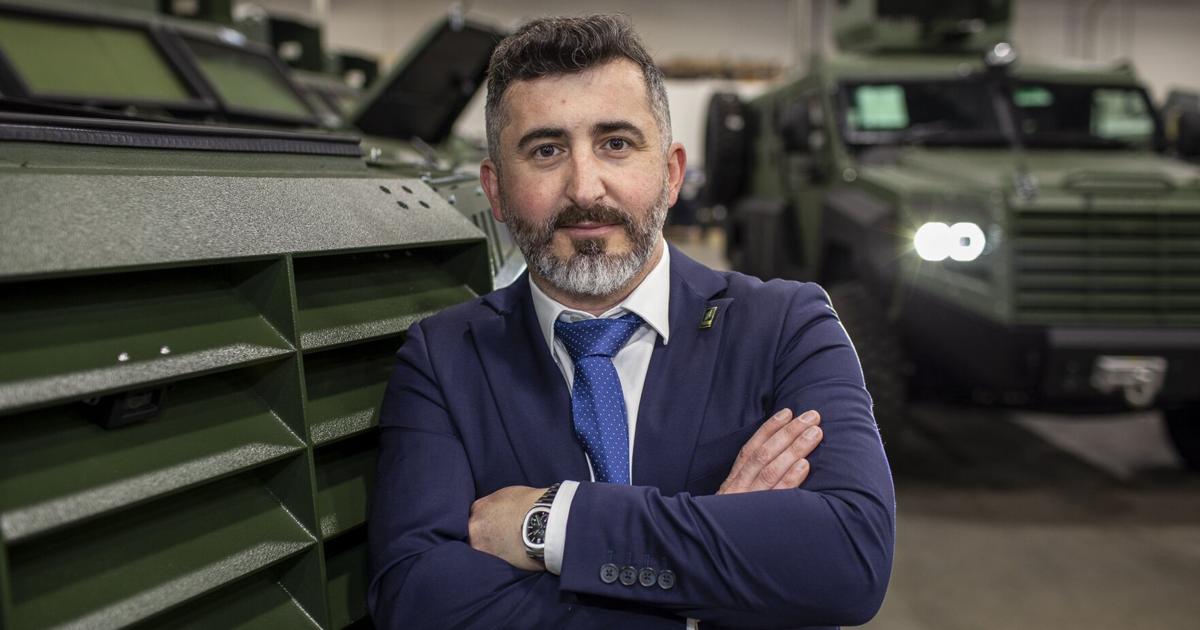
That, says Roshel founder and CEO Roman Shimonov, is his message to critics who have slammed his company’s purchase of the idled Stellantis plant in Brampton.
Shimonov says he’s buying the 2.95 million square-foot Brampton facility with hopes of producing vehicles for both military and civilian use.
“The plan is not to change the purpose of this plant,” Shimonov says, “but to keep it as an automotive plant with amazing capacities and capabilities and to add on top of that the defence production that is required by our allies and by our domestic needs.”
Stellantis announced Monday that it had reached a firm agreement to sell its Brampton assembly to the armoured vehicle firm, after signing a tentative memorandum of understanding in September.
The agreement — whose financial terms weren’t disclosed — was immediately slammed by union officials and people from across the political spectrum as a betrayal of the plant’s 2,100 workers, who have been off the job since the plant was shut down for retooling in December, 2023.
In a wide-ranging interview, Shimonov shot back at critics, said the federal government has reacted favourably to his plans for the plant, and strenuously denied the purchase is contingent on Roshel getting a contract to supply the Canadian military with light utility vehicles.
Roshel has already drawn interest from an unnamed European automotive manufacturer, Shimonov says, adding that he’s also signed an agreement to lease 25 per cent of the Brampton facility back to Stellantis.
“There’s one major European automaker already which submitted a letter of intent … to localize its production in Canada,” said Shimonov, who wouldn’t specify exactly what kind of production the LOI was for, but acknowledged it would be less than full-scale assembly, at least to start.
“Everything starts with something smaller and subject to the right environment, grows into something bigger,” Shimonov says.
Roshel’s armoured vehicles have typically been produced using the frame of existing civilian vehicles, including products like the Ford F-550 or the Toyota Land Cruiser.
As far as the Stellantis plant’s existing 2,100 employees, Shimonov said he’s open to hiring some of them.
“We will do our best, and we will give a priority to ex-Stellantis people and to any other people that are willing to work,” said Shimonov. “We can promise that we will do our best to generate thousands of jobs in this plant.”
Roshel, founded in 2016, already has a 400,000-square-foot manufacturing plant in Brampton, and plants in Shelby Township, Mich. and Springfield, Ohio.
It has supplied armoured vehicles to police forces in the U.S. and Canada, and came under criticism in both countries for selling some of its vehicles to U.S. Immigration and Customs Enforcement (ICE). It has also supplied thousands of vehicles to Ukraine.
While no one has publicly confirmed the identity of the other remaining bidder for the Canadian military contract, several industry sources have said it’s GM Defense Canada.
Shimonov said the deal to buy the Stellantis plant isn’t contingent on landing the military deal.
“Getting the LUV deal isn’t subject to us buying the plant, and buying the plant isn’t subject to us getting the LUV contract. One has nothing to do with the other,” said Shimonov. “We don’t need this plant to get the contract. We’re best-positioned to get the contract awarded because we’re the only Canadian-owned company still bidding. We’re the only company that has deployed thousands of vehicles into a combat environment, and we’re the only company that fully complied with everything that the government is expecting when it comes to Canadian content.”
While politicians from Prime Minister Mark Carney and federal industry minister Melanie Joly to Conservative leader Pierre Poilievre and Ontario Premier Doug Ford have criticized Roshel’s purchase of the Stellantis plant, Shimonov says the federal government has given the company a thumbs-up.
“By the way, we shared our plan with the government, and we got very positive feedback,” Shimonov says.
The head of the union representing the plant’s 2,100 workers, who has slammed the purchase as a “worst-case scenario,” called the apparent federal approval disappointing.
“That is disappointing but sadly not surprising,” said Lana Payne, national president of Unifor. “We had a lot of tough talk from the federal government but little action to prevent the loss of a full auto assembly plant and the jobs it supports. Now it’s in the feds’ interest to try to present the sale as a win.”
Payne said there’s nothing wrong with Roshel itself, but that its growth shouldn’t come at autoworkers’ expense.
“Shimonov has said he would consider Stellantis workers in the hiring process, but he has not guaranteed jobs,” said Payne. “Unifor has no issue with Roshel expanding production and bringing jobs to the Brampton community, but just not at the Stellantis Assembly Plant and not at the expense of the auto footprint.”
Workers shouldn’t need to be thankful for relative crumbs, Payne said.
“The reality is approximately 15,000 good-paying jobs at Brampton Assembly and in the auto supply chain are being sacrificed for hypothetical future jobs at Roshel based on unsigned procurement contracts and an unspecified MOU,” Payne added.
The head of an association representing parts makers also blasted the Roshel takeover, saying it seemed to be nothing more than a PR move to get a better shot at the Canadian military deal.
“That Roshel production could happen anywhere, including their current plants. And they don’t even have that contract yet,” said Flavio Volpe, CEO of the Automotive Parts Manufacturers Association. “What are we going to hear next? They have to get that contract to justify that plant?”
Shimonov dismissed his critics, saying that some jobs are better than none.
“What is the alternative? These people that are going on stage and are talking, what is the other alternative?” Shimonov said in an interview with the Star Tuesday. “The plant was idle for almost four years. So what is the alternative — to continue waiting? Nothing will change if we won’t take the steps.”
