

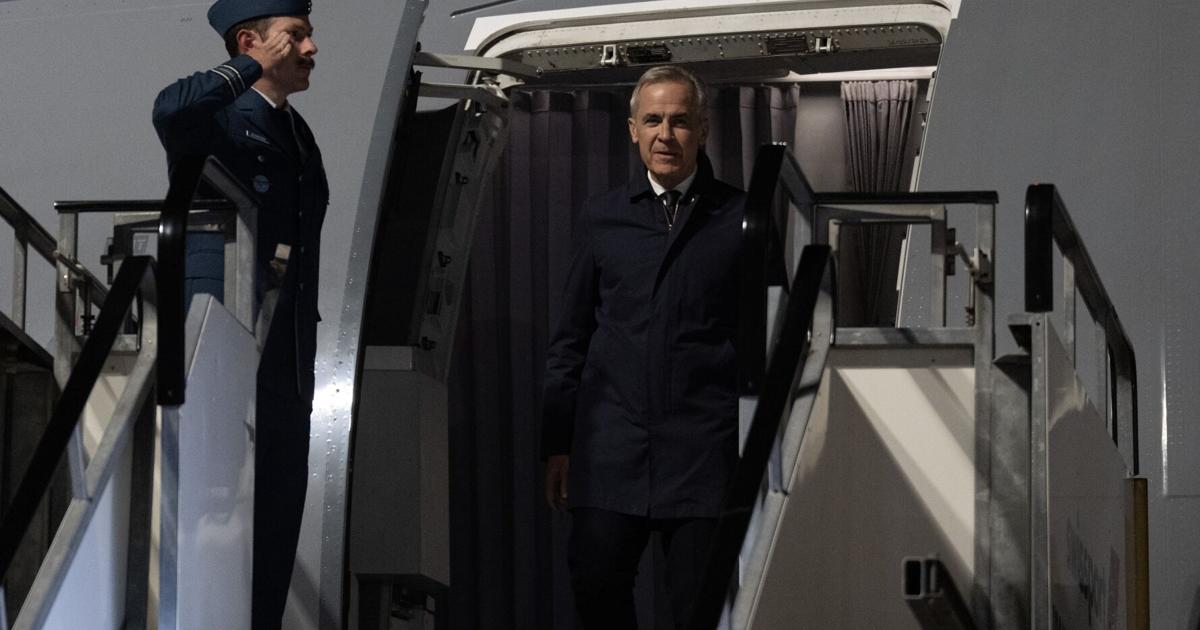
DUBLIN — Somewhere during the next nine days, as he travels across two oceans and two continents to meet with leaders from 132 countries, Mark Carney will sign a pair of potentially important free-trade agreements and, with any luck, mend Canada’s strained trade ties with the U.S., and call it a day.
Along the way, the prime minister may even sleep.
The man who, friends say, needs less shut-eye than most people is nothing if not relentlessly focused on what “we can control.” So, he continues his quest to expand markets for Canadian exports to buffer the hit from the U.S.-led global trade war and exhort middle powers to strengthen rules-based trade and security alliances.
However, on this diplomatic odyssey, not everything is in Carney’s control.
That starts with the timing. The whirlwind of summits is a function of a calendar that jams international meetings into the fall. Coincidentally, several are being hosted in Asia this year.
Then there are all the competing international and domestic political agendas at play and how they will intersect, or not, with Carney’s.
Europe
In Dublin Thursday for a meeting of the European Political Community (a 43-country grouping broader than the European Union), Ukraine and European security are front and centre, with America’s backing of Ukraine more in doubt than ever. Carney has had a lot of face time lately with EU executive leaders, but not with leaders of EU member states, some of whom, like Germany, are not keen on “associate EU membership” status for Canada.
Others are wary of how sweet a deal the EU will cut Canada. That includes the U.K., which has its own post-Brexit arrangement with the bloc, as well as Norway and Iceland, which have economic associations with it. EU aspirants such as Moldova are also watching closely.
Southeast Asia
In Manila Saturday for a meeting of Southeast Asian nations known as ASEAN, global trade tensions and supply chain crunches are the main agenda at a time when U.S. President Donald Trump, bruised and defiant in the face of midterm losses, is not backing off global tariff wars. A senior source told the Star that Carney will sign a free-trade agreement with the ASEAN trading bloc and, separately, another with the Philippines to advance his goal of doubling non-U.S. exports by 2030. The Star agreed not to identify the source, who was not authorized to publicly disclose details.
Reducing trade barriers with the ASEAN bloc would improve Canada’s access to a market of nearly 700 million people and a $6-trillion economy.
“It’s a big deal,” said Vina Nadjibulla, an Asia expert leading the Centre for Strategic Statecraft, a new foreign policy think tank, because the 11-nation group is “a large market and it’s fast growing.”
However, the ASEAN bloc includes countries such as Vietnam and this year’s host, the Philippines, which are viewed by the U.S. as transshipment points for Chinese-backed steel and aluminum exports seeking entry into the U.S. Will Trump and his team of tariff hawks, who are expected in Manila for part of the ASEAN meetings, according to Carney, see Canada as opening a back door to suspect exports?
Francophonie
In Phnom Penh, Cambodia, for the Francophonie summit, Carney will meet with francophone leaders, many of whom hail from countries where democracy and the rule of law are works in progress, including in Africa, a region to which the prime minister has paid little, if any, attention as he strives for new economic and security partnerships.
Canada is the next host of the Francophonie summit in 2028, so this will be a formal handoff. At issue is whether Carney can nurture new relationships with a different group of middle-power leaders from the Global South.
Also at issue is whether Carney can head off growing tensions with Quebec Premier Paul St-Pierre Plamondon.
Quebec and New Brunswick have observer status at the summit, and Plamondon is using it as his international coming-out party after skipping Carney’s invite to the Canada-EU summit and the first ministers’ meeting last month.
Plamondon provocatively declared he will negotiate Quebec’s trade terms directly with American legislators, prompting Carney to publicly remind everyone that trade treaties are negotiated between Canada and the U.S. federal government, not individual provinces.
China/APEC
Finally, Carney participates in APEC, the Asia-Pacific Economic Cooperation confab hosted by Chinese President Xi Jinping in Shenzhen. And those big global “hegemons” that ignore the rules, the ones Carney talked about hedging against in his widely quoted Davos speech that made him the darling of middle-power countries? They’re about to suck all the oxygen out of the APEC room.
China’s Xi has invited Russian President Vladimir Putin. Trump will be there, too. Trump and Carney are the only two NATO leaders present while Putin basks in China’s welcome and defies efforts to end the war in Ukraine, which Trump has increasingly blamed on Ukraine’s leaders. Trump’s own courting of China in pursuit of a better U.S.-China trade balance makes the international and interpersonal dynamics unpredictable.
Canada has offered to host APEC in 2029, but it’s not yet nailed down, so the Canadian prime minister will be working the rooms hard.
Yet most Canadians will eyeball how Carney navigates Canada’s trade fault lines with Trump.
Mexican President Claudia Sheinbaum will attend APEC, and a source said a face-to-face bilateral meeting between Mexico and the U.S., Sheinbaum’s first one-on-one sit-down with Trump, is scheduled. Mexico is in a fourth round of trade talks with the U.S., but progress has stalled.
Carney said Tuesday he didn’t have a sit-down booked with Trump but downplayed the need, saying he has lots of “opportunities” to engage with the president. A senior official said it’s possible Carney will meet with Sheinbaum, while a trilateral meeting on the future of the Canada-U.S.-Mexico Agreement (CUSMA), stuck in limbo, is not likely, although “anything” can happen.
Jonathan Berkshire Miller, a principal at Pendulum Geopolitical Advisory, said Carney’s intentions and ambition are “noble and right” but he is moving at such a fast pace it’s hard to evaluate where progress is really being made. He said the prime minister’s real focus remains on Europe — and Carney’s trip to Ireland detracts from his Asia goals. Carney, the former central banker, has become a bit of a “philosopher king” on foreign policy but may fail to appreciate some of the trade-offs of geopolitics, he said.
“Middle powers all have different interests,” he said, and the “Carney shtick” in the Davos speech, and his later Yerevan speech “where he said the future of the rules-based order is going to be decided in Europe” doesn’t cut it in the Indo-Pacific. “On foreign policy, they (Indo-Pacific leaders) have been very pragmatic for a long time,” and while the “pragmatic part of Carney” appeals to them, when it comes to the idea of Carney as “the voice on the U.S.”, countries like Japan, Korea and “probably the Philippines to an extent” are “wary of that sort of approach,” said Berkshire Miller. “They’re frustrated about the Trump administration too, but their bread is buttered on the U.S. security side.”
“I think he has to be careful about the way he calibrates those conversations,” Berkshire-Miller added. “The whole Davos thing sells less well in Asia than it does in Europe.”
Error! Sorry, there was an error processing your request.
There was a problem with the recaptcha. Please try again.
You may unsubscribe at any time. By signing up, you agree to our terms of use and privacy policy. This site is protected by reCAPTCHA and the Google privacy policy and terms of service apply.
Want more of the latest from us? Sign up for more at our newsletter page.
