
It’s not uncommon for workplace conversations to default to the weather as people file into an office each morning, but for Erin Boucher and her Camp Fortune colleagues it’s way more than just small talk.
At the ski hill, weather forecasts dictate everything from how many skiers are expected on a given day, how much grooming the runs need and, to a certain extent, how early the ski hill can be expected to open each winter.
“Weather is always a challenge, and, if we didn’t enjoy it that challenge, we wouldn’t be in this business,” said Boucher, the general manager at Camp Fortune.
Even with long-term forecasts of a strong El Niño expected to bring milder temperatures, less reliable snow cover and erratic freeze-thaw shifts this winter, Boucher says Camp Fortune is prepared after investing in technology over the past couple decades to ensure the weather wouldn’t control the success and duration of the season.
“El Niño is definitely something that people are talking about and how it’s going to impact us,” she said. “We don’t have answers for that, but we are definitely prepared and ready to take it on.”
Meanwhile at the Rideau Canal Skateway the issue of how well the ice surface will freeze this winter is still very much up in the air, says Bruce Devine, senior manager of facilities and programs at the National Capital Commission.
While technology can’t yet swoop in and save the day as it can on ski hills, a milder El Niño winter may not necessarily be the be-all-and-end-all for the Skateway.
It’s all about timing. A layer of snow over the thin ice surface tends to act as an insulator and hinders the freezing process, but, if it’s shortly followed by rain and a cold snap, the ice can thicken, according to Devine.
“At this point in time, we don’t know how this is going to happen,” Devine said, adding the usual seasonal preparations like installing huts, vehicle ramps and staircases were already underway. “We’ll react as it presents itself.”
Over the past few winters, skating seasons have varied significantly in length. While Ottawans have been gifted with longer skating seasons in the past two winters, not too far back in memory was the 2022-23 winter, when the Skateway didn’t open at all. During the last super El Niño event, in 2015-16, the Skateway was open for just 18 skating days.

Caused by warmer Pacific Ocean temperatures resulting in a temporary warming of the global temperature, this El Niño has already played a factor in the warm start to November in the nation’s capital, according to Geoff Coulson, a warning preparedness meteorologist at Environment Canada.
While warmer average temperatures are expected along with the potential for more freezing rain, Coulson underlined there would still be variability and it wouldn’t necessarily be warm every single day.
“It certainly doesn’t mean winter has been cancelled,” he said. “It certainly doesn’t mean that we’re not looking at the potential for large-scale, messy storm systems.
“Winter is still going to be evident, and we are still going to have stretches of very cold conditions.”
How can technology help weather the storm?
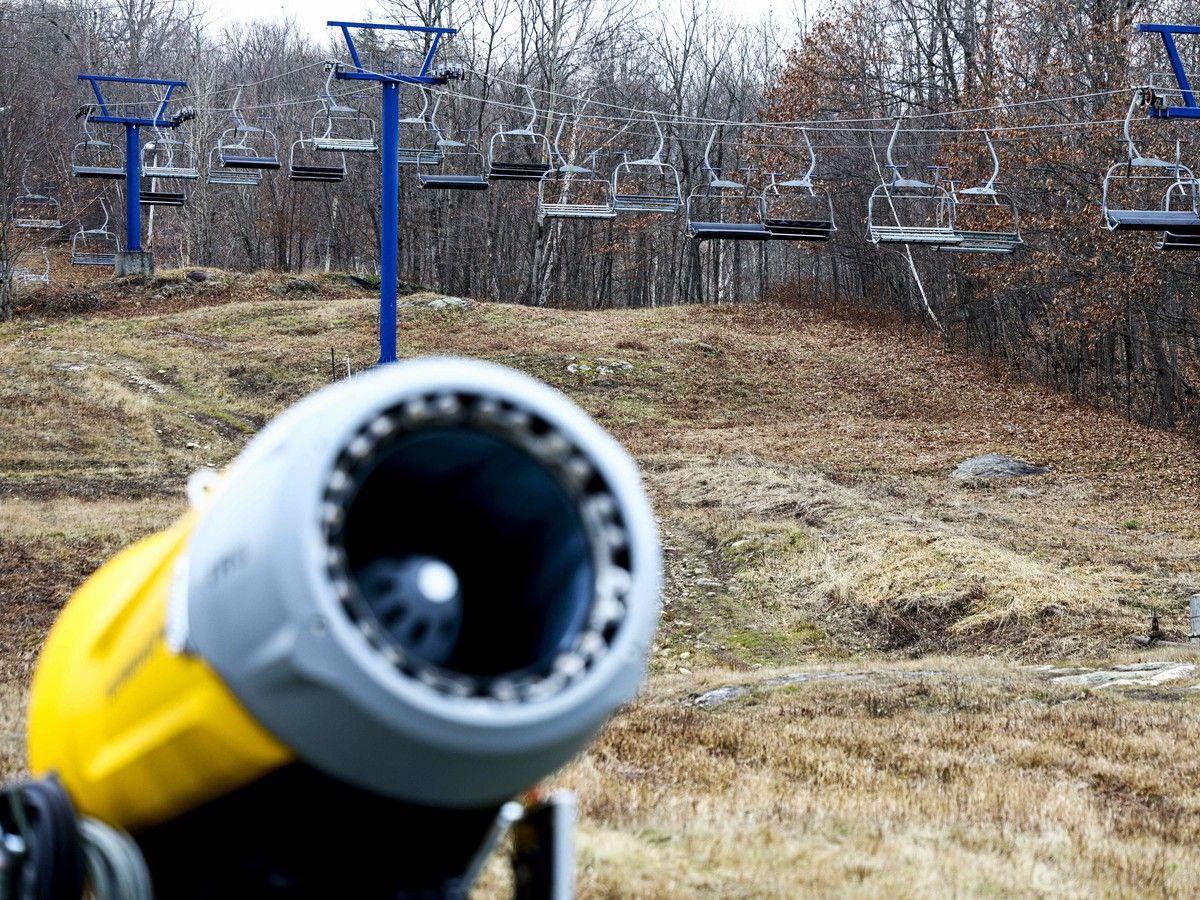
For ski hills, investing in artificial snowmaking machines, which spray a mixture of water and compressed air that freezes into snowflakes onto its ski runs, have been a game-changer. Many can now kickstart their seasons much more predictably, without having to wait for the first major snowfall.
Looking back at photo albums, Bouchard says it hasn’t been unusual to see white strips of man-made snow enclosed by green grass on either side of the runs as Camp Fortune opened for the season in the absence of the typical “winter wonderland” backdrop.
Now it’s just a waiting game until temperatures dip low enough for ski hills to start operating their snow-making machines, which, at Camp Fortune, typically require temperatures around -5 C to boot up for the season. Once the machines are up and running, they can continue making snow as long as temperatures stay below -2 C.
At Mount Pakenham, the ski runs are almost 100 per cent covered with artificial snow, with anything provided by Mother Nature considered an “added bonus,” said Andrew Burns, Pakenham’s director of operations.
Even if this winter brings more rain and a challenging freeze-thaw cycle, Burns said Pakenham’s snow-grooming machines were prepared to chew up and rebuild the snow surface.
“Even if we haven’t gotten natural snow in weeks, you come out here and conditions will be good,” he said.
The Rideau Canal Skateway is arguably much more at the mercy of winter temperatures and snowfall, though Devine said many innovations were in the works to ensure it could be more resilient to warming winters.
In the shorter-term, the NCC is already beginning to use lighter maintenance vehicles, meaning crews can start working on the ice earlier in the season.
Longer-term solutions and pilot projects are also in the works through an NCC partnership with Carleton University as a research team led by engineering professor Shawn Kenny looks at innovative ways to improve the resilience of the Skateway.
Devine added that the NCC had also commissioned a third party to look into whether it could use refrigeration technology on the 1.3-kilometre stretch of the Skateway from the National Arts Centre to the Corktown Bridge.
“It would be a conventional refrigerated slab, similar to the refrigeration system used in conventional arenas,” Devine said. “The proposed system would create ice by removing heat from the water above a concrete slab.”
But the project is still in the planning stages, and Devine said it was too early to tell when it could be rolled out. Other considerations, such as whether the refrigeration could be carbon neutral, are still being discussed.
Until then, with this year’s skating season still clouded in uncertainty, Devine encourages skaters to stay hopeful.
“I would suggest that let’s all think positively at this point and be hopeful that we get a season of some sort,” he said.
Related
Take control of your search results. Make the Ottawa Citizen a preferred source on Google and see verified local reporting first.