

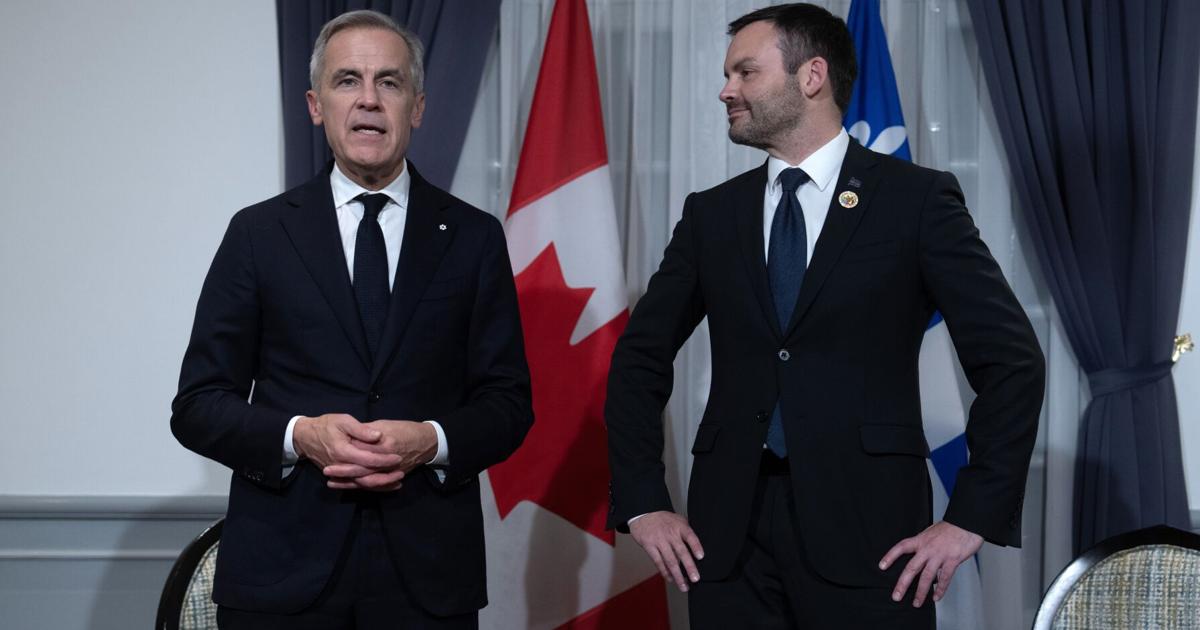
PHNOM PENH, Cambodia — If international summits are all about showing up for valuable face time with other leaders, this year’s Francophonie and Asia-Pacific summits show the upsides, and the potential downsides, for Mark Carney.
His meetings in China are still a day away, but the prime minister appeared to score a significant win when he met in Cambodia with the newly elected premier of Quebec.
At a gathering of French-language nations and subnational governments, separatist Quebec Premier Paul St-Pierre Plamondon emerged Sunday from his first face-to-face meeting with the prime minister declaring that, despite their public sparring in recent weeks, he was delighted with a conversation he described as “fun,” constructive and respectful.
The premier told reporters six times that he and Carney exchanged phone numbers, calling it “a good sign,” and toned down some of his sharpest rhetoric against Ottawa. This from a premier who has antagonized Carney since taking office in early October.
Plamondon was unapologetic about his demands for a greater say in Canada-U.S. trade negotiations and more power to set temporary immigration levels, saying not all of his disputes with Carney could be resolved in an initial meeting that ran past its allotted half-hour and lasted 47 minutes.
And Plamondon claimed victories, saying Carney agreed to provide more transparency and to consult with Quebec in the Canada-U.S. trade talks. Asked whether he agreed it was Carney’s job to negotiate the terms of any deal, Plamondon turned aside the question: “What we agreed upon is that we needed immediate and enhanced communication among our staff and between each other.” He touted as victories the fact that Carney supported his proposed 2027 francophone business leaders’ summit in Quebec, and agreed Quebec will decide how homelessness and housing funding will be spent. Plamondon said he “regretted nothing” about his advocacy for Quebec’s interests.
Yet from the perspective of the prime minister, those were easy concessions.
Carney, who did not take questions from reporters about the meeting, simply affirmed in a social media post that they’d had a “good meeting” and echoed Plamondon’s statement on X summarizing their points of agreement.
So, what seemed like a charm offensive from the get-go appears to have worked.
In the same way Carney has deflated tensions with other ornery or Ottawa-skeptical premiers, whether over energy in Alberta, environmental policy in British Columbia or auto-sector jobs in Ontario, he appears to have deflated Quebec-Ottawa tensions, at least for now.
He had agreed to meet the Quebec premier on international soil, despite the fact the Quebec premier twice refused to attend Carney’s national and international summits in Canada where Plamondon would have been relegated to the role of a subnational leader.
Although Plamondon arrived here waving his own flag, telling reporters he was pleased to be treated like a “head of state” — Quebec and New Brunswick have observer status at the summit — Carney happily plugged Plamondon’s business summit idea in his own speech to the summit.
And it was clear which of the two was more at ease when Carney and he shook hands and smiled for the cameras before their meeting. They joked about who was in shape and who was the better goalie when each played hockey at Oxford University, but their body language signalled this is the start of an uneasy friendship.
Carney was looser, more relaxed and complimentary toward the Quebec leader. Plamondon stood in an awkward, legs-akimbo posture throughout the photo opportunity. Earlier, cameras also captured images of a more serious exchange between the duo.
No surprise there. The relationship got off to a rocky start after Plamondon skipped the First Ministers meeting of Carney and premiers with First Nations leaders, saying he’d do his own outreach to Indigenous leaders.
He also skipped the Canada-EU summit in Montreal, calling Carney’s invitation, which did not include a prominent speaking role, tantamount to making him a “waiter” at the table. He declared Quebec would negotiate trade terms directly with U.S. lawmakers. Most importantly, Plamondon has vowed to hold another referendum on Quebec sovereignty once Donald Trump is out of the White House.
On Sunday, Plamondon dodged questions about whether he raised his sovereigntist project at the francophone summit.
Chalk up another win for Carney.
Ironically, the Quebec separatist leader was mistakenly introduced at a session at the Francophonie summit as the Prime Minister of Canada before Carney’s arrival. The presenter who made the embarrassing mistake then joked, “Maybe next time.”
However, the signals from both sides about what lies ahead are clear.
Quebec’s premier intends to invoke historic grievances and gain as much ground as possible in his bid to build support for a future referendum, the “dream” he spoke about on election night.
On the other hand, Carney has made clear he speaks for Canada on the international stage.
“Look, the Prime Minister has been very clear, we will build a Canada that works for everyone. We will work in collaboration with all of our provincial and territorial counterparts,” said International Trade Minister Maninder Sidhu, speaking to reporters in Manila ahead of the Carney-Plamondon meeting in Cambodia.
Sidhu said Plamondon’s referendum promise is not deterring investors or creating uncertainty.
“I wouldn’t say so. I think what Canada presents is certainty to the world. All the conversations we’ve had here with Prime Minister Carney talking to investors, they want to do more with Canada.”
He noted Ottawa’s international trade delegations have included a range of Quebec “businesses and workers,” and Quebec’s own trade officers are housed in Canadian embassies “around the world and we’ll continue working on that.”
Next stop Monday on Carney’s whirlwind Asia tour is the Asia-Pacific summit in China, where there will be more dragons from a political perspective.
The summit is hosted by President Xi Jinping, who will welcome Russian President Vladimir Putin and U.S. President Donald Trump alongside the other leaders of the 21-member Asia-Pacific Economic Cooperation forum. Canada is a founding member, but this is Xi’s show.
Carney will meet separately with Xi to advance the bilateral relationship reset that began in January after a deep freeze triggered by the Meng Wanzhou affair, trade reprisals and the nearly three-year detention of the Two Michaels.
Putin’s presence here is a giant elephant in the room. So is Trump’s.
“Out of respect for the host,” Carney said he will stand onstage with Putin for the APEC leaders’ so-called family photo, but he emphasized Canada’s repudiation of Putin’s invasion of Ukraine.
On the other hand, Carney said Saturday he would welcome a trilateral meeting on the sidelines with Trump and Mexican President Claudia Sheinbaum, but isn’t holding his breath, given the “current trajectory” of trade talks between them with the U.S.
Even before Carney stepped foot on Chinese soil, Canada’s Conservatives dismissed his approach to trade and international relations, which he describes as “values-based realism” — tailoring relations to areas where Canada can find common ground even amid disagreements.
Conservative international trade critic Stephanie Kusie said Carney’s second trip to China this year is the latest example of “a concerning trend among Liberal politicians: cosying up to state actors whose records on democracy, human rights, individual liberty, press freedom and more are questionable at best.”
“From China to Qatar, Turkey and the UAE, Prime Minister Carney has made the deliberate choice to build not only deeper trading relationships but also ‘strategic partnerships’ with nations that, in many cases, do not share our fundamental values and freedoms,” said Kusie.

