

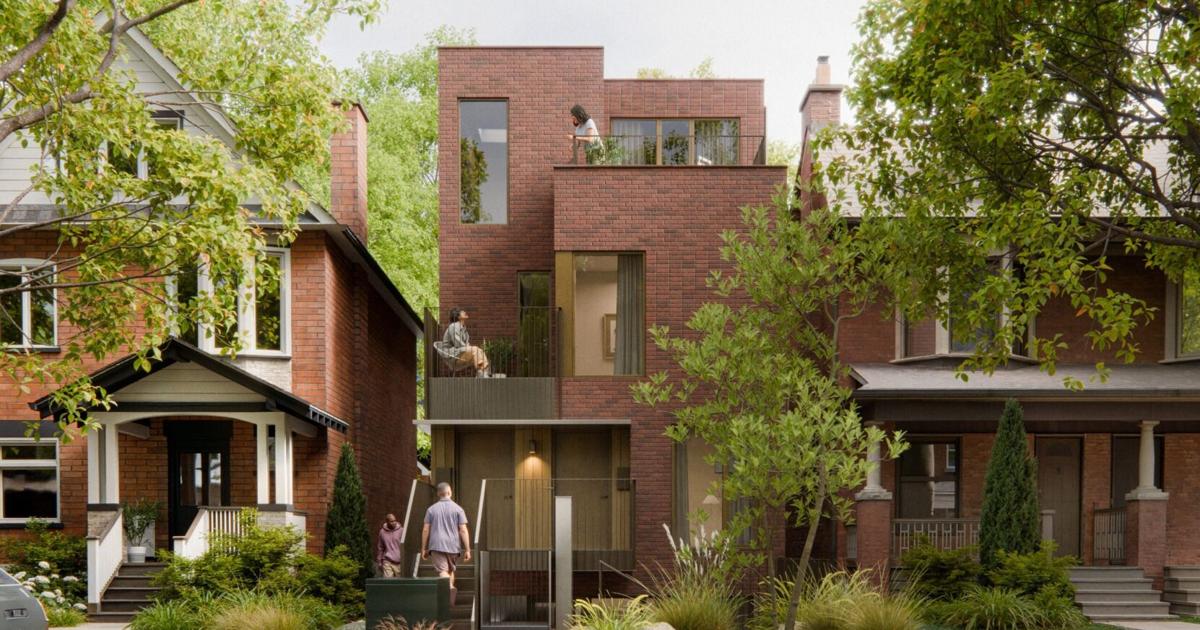
A review of City of Toronto records has uncovered more than 100 applications to build sixplexes since the city began allowing the developments in select neighbourhoods last summer — dozens more than the city initially reported.
Last week, the Star reported city data that pointed to growing interest in adding smaller-scale housing to traditionally single-family neighbourhoods with just over 60 applications, helping fill the “missing middle” that housing advocates have long called for.
After publication, readers contacted the Star with addresses they believed were missing from the map. The Star subsequently identified about 40 additional applications for sixplexes since the city began allowing the developments in June 2025.
The findings offer a clearer picture of interest in a new form of small-scale housing, while experts say the discrepancy underscores the importance of accurate, comprehensive data as Toronto considers whether to expand the policy to more neighbourhoods.
The city said its initial count was based on a manual search of available building permit data using filters that did not capture every application.
“Terms such as ‘multiplex’ and ‘sixplex’ are not official Building Code classifications, some applications may not have included these terms in their submissions, which can impact what is reflected in the database,” said senior communications adviser Hilary Caton-King.
“The City recognizes this is not ideal when reporting specific application numbers. However, we’re continuing to refine its approach to identify and track multiplex applications in Open Data, including sixplexes, more accurately. This will improve consistency in how they are monitored and reported,” Caton-King added.
The Star used AI to search the city’s database of active and closed permits, identifying about 20 additional applications, and then manually verified the results. A separate manual search of thousands of permit records uncovered about 20 more.
The wards with the most sixplex applications were Toronto-Danforth, with 23; Davenport, with 20; and Toronto-St. Paul, with 16. Seven wards where sixplexes are not permitted as of right also saw applications, including Eglinton-Lawrence, which had seven proposed developments.
More than 40 per cent of the properties with sixplex applications have also sought permission to build a garden or laneway suite.
Sixplex policy ‘working’
“These numbers show us that the policy is working,” said Jamaal Myers, the former Ward 23 (Scarborough North) councillor who championed sixplexes in Toronto.
“There is a demand for these types of rentals and homes in Toronto, especially for people who are looking for an affordable option where they can raise their family while staying in the same neighbourhood they grew up in.”
Sixplexes had a contentious path to approval in Toronto. The city permitted multiplexes of up to four units across the city in 2023, but city staff’s recommendation to allow buildings with five or six units faced pushback from suburban councillors and residents. In June 2025, council voted to restrict the larger developments to the former Toronto and East York district and Ward 23.
Myers, who represented Scarborough North at the time, had pushed for the ward to be included as a suburban testing ground. The Star’s review identified an application in the ward that was submitted before the new permissions took effect and therefore is not included on the map.
Myers said it’s important for the city to track applications accurately, particularly as it considers whether to extend the permissions to more wards.
“It tells the story about the housing market and helps us figure out where people want to live,” he said. “It also shows us whether the policies created are having an effect on real people.”
Data and uptake
Thaddeus Sherlock, a volunteer with More Neighbours Toronto who advocated for larger multiplexes to be allowed in more wards, said the applications point to steady demand for sixplexes, which he believes is stronger than for other forms of multi-unit housing, such as midrise and highrise apartments.
He pointed to areas along Eglinton Avenue, including neighbourhoods on either side of the boundary between wards where sixplexes are permitted and those where they are not, as places where the map suggests there may be additional demand.
“I think it is very important to have accurate data for multiplex application uptake in the early years,” Sherlock said.
“In a time where building new housing is more important than ever, I think the public deserves to know what and where the real barriers to development are, as well as where in the process housing units actually are.”
Ken Greenberg, an urban planner and former Toronto chief planner, previously told the Star the number of applications should be viewed in the context of how recently the city introduced the permissions and that the success of the policy should not be judged over just a year or two as homeowners and smaller developers take time to adapt.
“Sixplexes offer an important choice. Their contribution over time will be gradual and widely distributed,” Greenberg said.
With files from Kate Allen
Error! Sorry, there was an error processing your request.
There was a problem with the recaptcha. Please try again.
You may unsubscribe at any time. By signing up, you agree to our terms of use and privacy policy. This site is protected by reCAPTCHA and the Google privacy policy and terms of service apply.
Want more of the latest from us? Sign up for more at our newsletter page.

